

ESC or click to close
|
Press releases and reports
Perception of European and USA policy towards Ukraine
The press release was prepared by Anton Grushetskyi,executive director of KIIS
From May 7 to June 3, 2026, the Kyiv International Institute of Sociology (KIIS) conducted its own all-Ukrainian public opinion survey "Omnibus", to which, on its own initiative, added questions related to Ukraine's international relations with partners. Bythemethodoftelephoneinterviews (computer-assistedtelephoneinterviews, CATI) based on a random sample of mobile phone numbers (with random generation of phone numbers and subsequent statistical weighting) in all regions of Ukraine (the territory controlled by the Government of Ukraine), 1,000 respondents were surveyed. The survey was conducted with adult (aged 18 and older) citizens of Ukraine who, at the time of the survey, lived in the territory of Ukraine controlled by the Government of Ukraine. The sample did not include residents of territories temporarily not controlled by the Ukrainian authorities (at the same time, some of the respondents are IDPs who moved from the occupied territories), and the survey was not conducted with citizens who left abroad after February 24, 2022. Formally, under normal circumstances, the statistical error of such a sample (with a probability of 0.95 and taking into account the design effect of 1.3) did not exceed 4.1% for indicators close to 50%, 3.5% for indicators close to 25%, 2.5% for indicators close to 10%, 1.8% for indicators close to 5%. Under conditions of war, in addition to the specified formal error, a certain systematic deviation is added. Factors that may affect the quality of results in "wartime" conditions were previously cited by KIIS. In general, we believe that the obtained results are still highly representative and allow a fairly reliable analysis of the public moods of the population.
Since September 2022, KIIS has been regularly studying one of the most important narratives from the point of view of information security - about the perception of the West's policy towards Ukraine. Russia (not only it, but still primarily it) is trying to impose on Ukrainians the idea that the West is tired of Ukraine, its support is weakening and it is pressuring Ukraine to approve unacceptable concessions (and this despite multi-billion dollar support in money and weapons and despite serious economic sanctions). Belief in such a narrative may push some Ukrainians to the idea that without Western allies, Ukraine's resistance is a futile endeavor and, accordingly, that Ukraine will comply with Russian demands to end the war (in other words, more directly - capitulate). Along with this, in February 2025, after D. Trump became President of the USA, we divided the questions into two: we began to ask a separate question about Europe, a separate one about the USA. Moreover, to avoid the possible influence of the order of the questions, we asked one half of the randomly selected respondents a question about Europe, and the other half about the USA. This time, we asked each respondent both questions, but in a different order (half - first about Europe, then - about the USA, the other half - first about the USA and then - about Europe). This allows, first, to have a larger sample for each of the questions and more opportunities for additional analysis. Second, we can assess what influence the order of the questions may have.
Perception of European and USA policy towards Ukraine
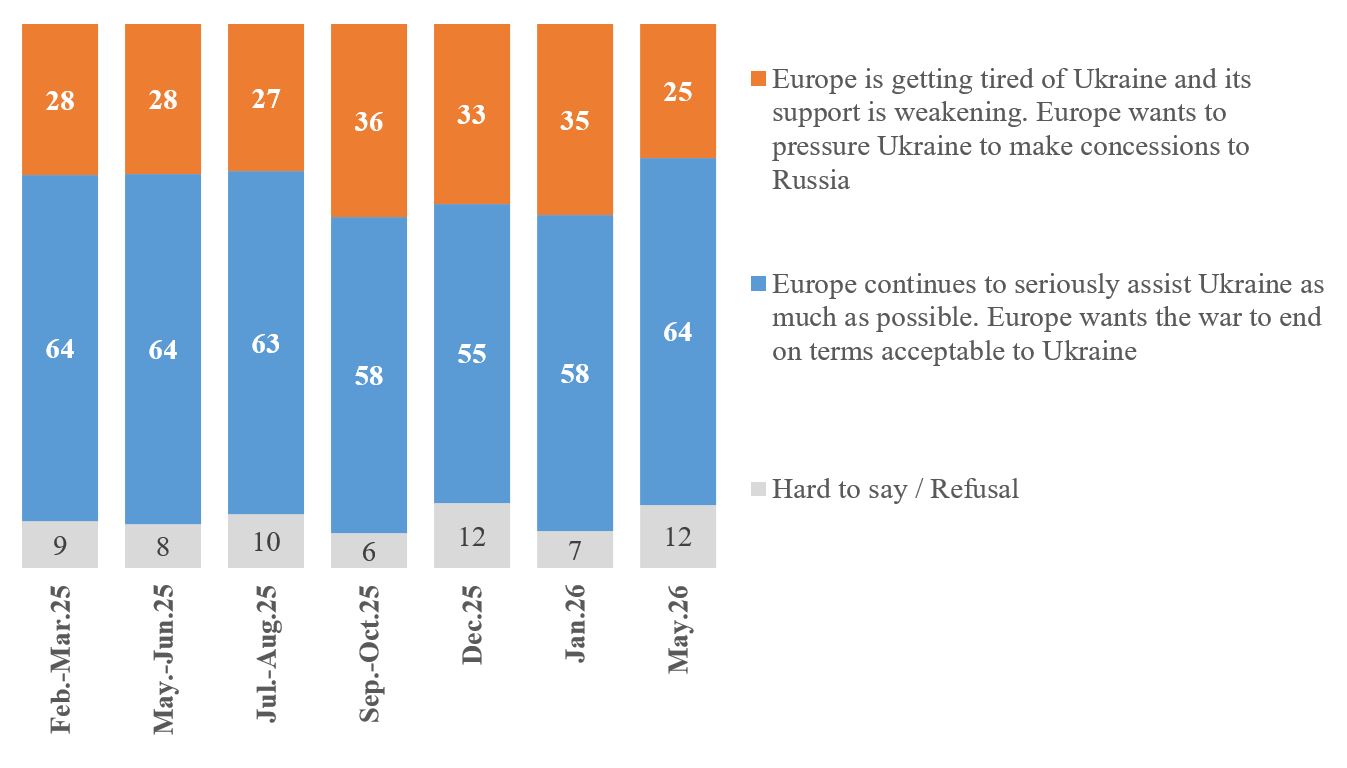
So, graph 1 shows the results for Europe, graph 2 shows the results for the USA. As can be seen in graph 1 below, most Ukrainians – 64% – continue to believe that Europe is seriously helping Ukraine and wants the war to end on fair terms. Believe that Europe is tired and is pushing for an unfair peace – 25%. At the same time, compared to January 2026, there are slightly more people who perceive Europe's policy towards Ukraine positively. Thus, from 58% to 64%, there are more people who consider Europe a reliable ally, and from 35% to 25% fewer people who believe that Europe is getting tired and its support is weakening. This may be partly due to, for example, the provision of a multi-billion loan to Ukraine by the EU (and in a broader context – a consequence of the results of the elections in Hungary and expectations of more decisive actions from the EU, especially against the background of the USA). At the same time, as we will show below, the perception of Europe is somewhat better when we ask a question after a similar question about the USA. That is, partly the positive dynamics are a consequence of the fact that we asked about the USA before that. But even without this, the perception of Europe improved (only to a somewhat lesser extent than the results in the graph might suggest).
Graph 1. And with which statement about Europe's support for Ukraine do you agree to a greater extent?
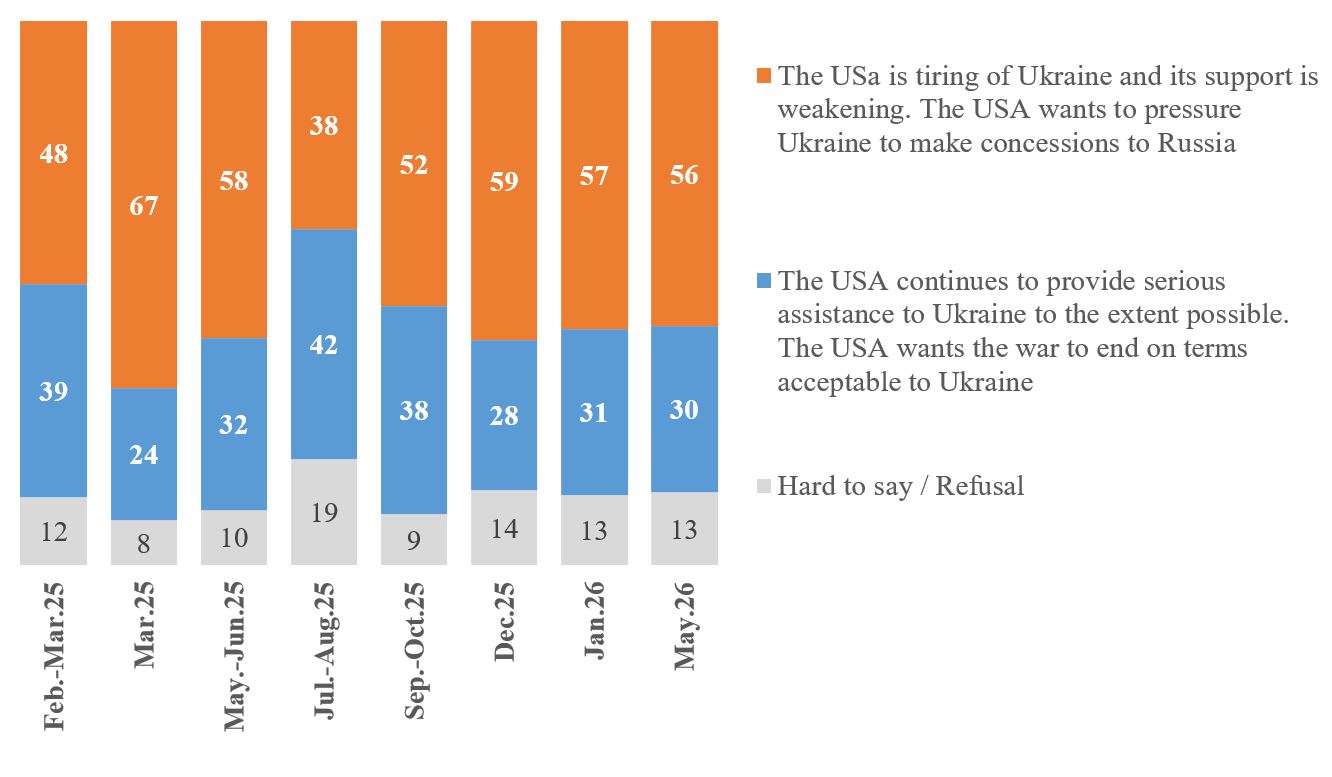
In the case of the USA, 56% believe they are tired and pressuring Ukraine for concessions to Russia. In contrast, 30% say the USA, on the contrary, continues to be a reliable ally. Over the past six months (since December 2025), public moods on this issue has not changed. At the same time, we remind that according to other KIIS results, there is a differentiated attitude towards the USA among Ukrainians - if the majority is truly critical of the leadership, then 83% have a good attitude towards ordinary Americans[1].
Graph 2. And with which statement about the USA support for Ukraine do you agree to a greater extent?
 Impact of questions order
The table below shows the results of the answers to both questions, depending on the order in which they were asked. Of the 1,000 respondents, 475 answered the question about Europe first, then about the USA. The remaining 525 answered the question about the USA first, then about Europe. In the case of the USA, the difference is within the margin of error, i.e. formally, regardless of the order of perception, the USA is the same. Although there is a weak tendency that if to ask after Europe, the perception of the USA is slightly worse. In the case of Europe, the differences are statistically significant, i.e., beyond the margin of error. So, if to ask about Europe first, then 60% consider it a reliable ally of Ukraine. If to ask the question second after the USA, the indicator increases to 67%. That is, in contrast to the USA, Ukrainians perceive Europe somewhat better. At the same time, regarding Europe, we note that even when the question was asked first, the balance of positive-negative answers was +31%. In January 2026, the balance was +23%. That is, between January and May 2026, there was indeed some improvement in the perception of Europe's policy towards Ukraine.
Table 1. Impact of question order on perceptions of European/USA policy towards Ukraine
A. Grushetskyi, comments on the survey results:
Our previous comments remain relevant even now, so it is worth citing them again, taking into account the current context. So, firstly, to maintain defense capability, it is important for Ukrainians to see support from our allies, which objectively remains very significant. Europe provides Ukraine with a multi-billion dollar loan (and numerous other supports - let's just mention the contract for combat aircraft from Sweden) and, despite the complications caused by the war in Iran, maintains strong sanctions against Russia and even strengthens them. And the EU, for its part, is working on the integration of Ukraine. In the case of the USA, even if we do not like the decisions of the leadership, we can see continued support from American society at various levels (from individual high-ranking officials to ordinary citizens). M. Rutte, as the head of NATO, is making significant efforts to properly support Ukraine. Destroying faith in the long-term stability of the allies' support remains one of the top propaganda directions of the Russian enemy for the erosion of the confidence of Ukrainians. We fully understand and often share the emotions of indignation of many Ukrainians due to some questionable decisions of our Western partners (or their indecision and lack of decisions). However, it is worth remaining calm and soberly assessing the volume of support for Ukraine. Our enemy wants from us instant emotions -> deep indignation -> a sense of betrayal -> a decline in confidence. We must not succumb to this and, together with our allies, resist. Secondly, there is another important point – a peace agreement in the context of trust in allies. Given the low trust in the USA, Ukrainians reasonably demand specific security guarantees that would really prevent a second Russian invasion. If security guarantees are not unambiguous and binding (in particular, with specific convincing strong steps that the USA and other partners will definitely take in the event of a new invasion), Ukrainians will not trust them and this will affect the general readiness to approve the corresponding peace plan. We have already seen that over the past six months, fewer and fewer Ukrainians believe that both Europe and especially the USA will fulfill their obligations in the event of a second Russian invasion[2]. At the same time, higher trust in Europe means that Ukrainians expect decisive steps and place great hope in European allies.
Appendix 1. Formulation of questions from the questionnaire
HALF OF RESPONDENTS FIRST THOUGHT ABOUT EUROPE AND THEN ABOUT THE USA, HALF FIRST THOUGHT ABOUT THE USA AND THEN ABOUT EUROPE
And with which statement about Europe's support for Ukraine do you agree to a greater extent? RANDOMIZATION OF THE ORDER OF STATEMENTS
And with which statement about the USA support for Ukraine do you agree to a greater extent? РАНДОМІЗАЦІЯ ПОРЯДКУ ТВЕРДЖЕНЬ
[1] Attitude towards the USA as a whole, Americans and USA leadership: results of a survey conducted February 12-24, 2026 // https://www.kiis.com.ua/?lang=ukr&cat=reports&id=1592&page=1 [2] Opinions and views of Ukrainians on war and peace: results of a survey conducted during April 20-27, 2026 // https://www.kiis.com.ua/?lang=ukr&cat=reports&id=1608&page=2 [3] The composition of the macroregions is as follows: West – Volyn, Rivne, Lviv, Ivano-Frankivsk, Ternopil, Zakarpattia, Khmelnytskyi, Chernivtsi oblasts; Center – Vinnytsia, Zhytomyr, Kyiv, Kirovohrad, Poltava, Sumy, Cherkasy, Chernihiv oblasts, Kyiv city; South – Dnipropetrovsk, Zaporizhzhia oblasts, Mykolaiv, Odesa, Kherson oblasts; East – Donetsk and Kharkiv oblasts (formally, the macroregion also includes Luhansk oblast, but due to almost complete occupation, none of the respondents currently live there, although there are respondents who lived in this oblast until 2022).
12.6.2026
|
Our social media:
 KIIS page
 KIIS channel