

ESC or click to close
|
Press releases and reports
Is Volodymyr Zelenskyi able to work effectively as Supreme Commander: views of Ukrainians before and after the large-scale Russian invasion
The press release was prepared by the Executive Director of KIIS Anton Hrushetskyi
From May 26 to June 5, 2023, the Kyiv International Institute of Sociology (KIIS) conducted its own all-Ukrainian public opinion survey "Omnibus". Bythemethodofcomputer-assistedtelephoneinterviews(CATI) based on a random sample of mobile phone numbers (with random generation of phone numbers and subsequent statistical weighting), 984 respondents living in all regions of Ukraine (except the Autonomous Republic of Crimea) were interviewed. The survey was conducted with adult (aged 18 and older) citizens of Ukraine who, at the time of the survey, lived on the territory of Ukraine (within the boundaries controlled by the authorities of Ukraine until February 24, 2022). The sample did not include residents of territories that were not temporarily controlled by the authorities of Ukraine until February 24, 2022 (AR of Crimea, the city of Sevastopol, certain districts of the Donetsk and Luhansk oblasts), and the survey was not conducted with citizens who left the country after February 24, 2022. Formally, under normal circumstances, the statistical error of such a sample (with a probability of 0.95 and taking into account the design effect of 1.1) did not exceed 3.4% for indicators close to 50%, 3.0% for indicators close to 25%, 2.1% - for indicators close to 10%, 1.5% - for indicators close to 5%. Under conditions of war, in addition to the specified formal error, a certain systematic deviation is added. In particular, if in May 2022, among all the respondents we interviewed, 2.5-4% lived in the territories occupied after February 24 (and this corresponded to the percentage of those who live there, because the generation of telephone numbers was random), now due to the occupiers turning off the telephone connection, not a single respondent who currently lives in occupied settlements was included in the sample (along with this, out of a total of 984 respondents, 32 respondents lived in a settlement that is currently occupied until February 24, 2022). It is important to note that although the views of the respondents who lived in the occupation were somewhat different, the general trends were quite similar. That is, the impossibility of interviewing such respondents does not significantly affect the quality of the results. There are other factors that can affect the quality of results in "wartime" conditions (see Annex 2). In general, we believe that the obtained results are still highly representative and allow a fairly reliable analysis of public moods of the population.
Is Volodymyr Zelenskyi able to work effectively as Supreme Commander
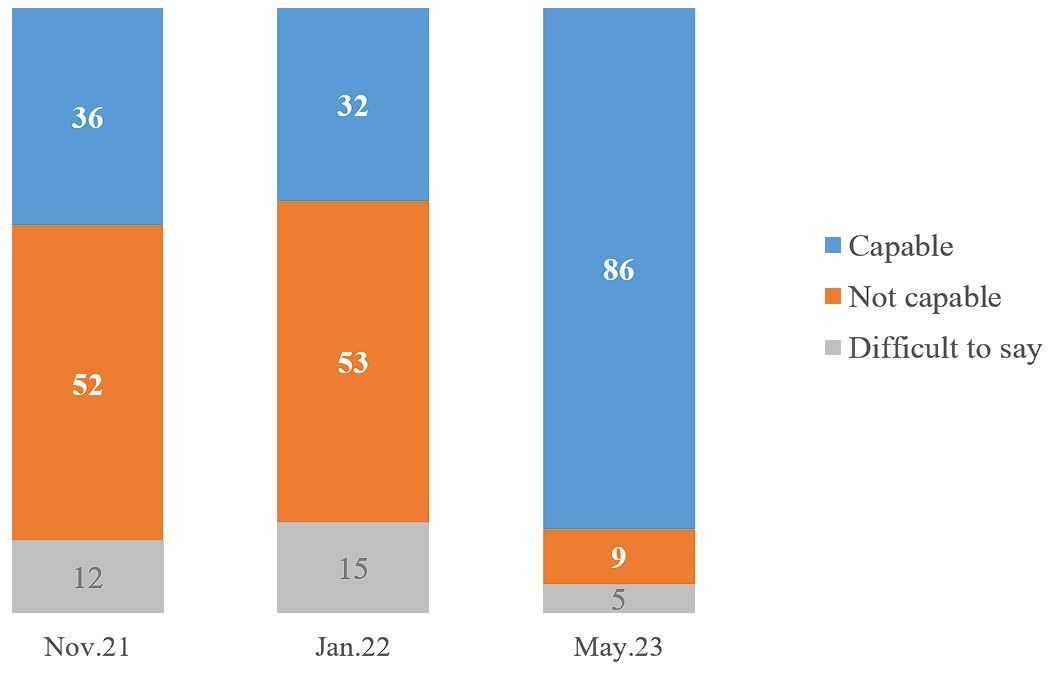
Before the large-scale Russian invasion in November 2021 and January 2022, KIIS asked respondents whether, in their opinion, V. Zelenskyi is capable of effectively functioning as Supreme Commander and organizing the country's defense. Now, in May 2023, KIIS repeated the question to track how Ukrainians' views on this issue have changed. Graph 1 shows the respondents' answers. As you can see, before the large-scale invasion, only a third of Ukrainians believed that V. Zelenskyi was able to function effectively as Supreme Commander. Moreover, between November 2021 and January 2022, confidence in this even decreased somewhat. However, after the large-scale invasion, Ukrainians radically changed their views and currently 86% believe that V. Zelenskyi works effectively as Supreme Commander.
Graph 1. In your opinion, is Volodymyr Zelenskyi capable or not capable of working effectively as Supreme Commander and organizing the defense of the country?
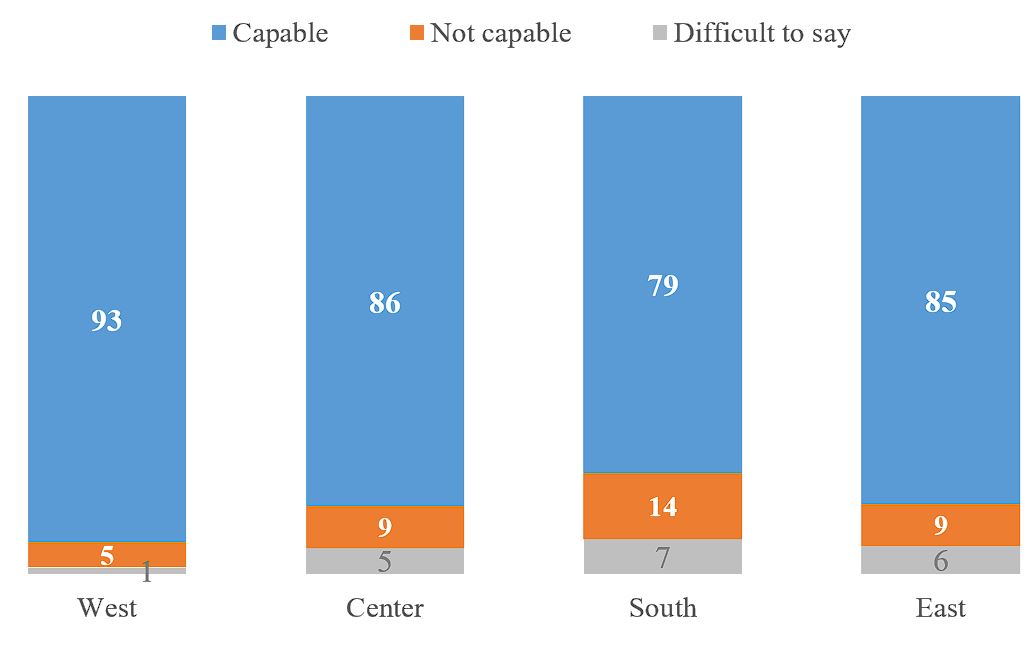
In the graph below, the data are shown in a regional dimension. In all regions of Ukraine[1] the absolute majority of the population believes that V. Zelenskyi works effectively as Supreme Commander.
Graph2. V. Zelenskyi's ability to work effectively as Supreme Commander in the regional dimension
A. Hrushetskyi, comments on the survey results:
The perception of V. Zelenskyi's ability to work effectively as Supreme Commander demonstrates several important trends in public attitudes at once. First, the concept of "rally around the flag" is confirmed - the rallying of the population around the leader in very difficult situations, especially during war. This concept was proposed in 1970 by the American sociologist John Mueller and was observed in various countries. Until the middle of February 2022, there was a steady trend of decreasing trust and approval of V. Zelenskyi's activities, but after the invasion, the indicators increased sharply. V. Zelenskyi is currently perceived by Ukrainians "in his place" and is one of the symbols of resistance to the occupiers. Secondly, V. Zelenskyi and V. Zaluzhnyi currently have the highest levels of trust and approval among the population. At the same time, despite Russian propaganda and the short-sighted attitude of some Ukrainian subjects, the vast majority of Ukrainians believe that the political and military leadership act in harmony as one team. Ukrainians believe that now we are finally moving away from "where there are two Ukrainians, there are three hetmans". Third, although public opinion is important, the public can be wrong about many expert issues. Very often, politicians even put questions to referendums, which are the subject of discussions among experts ("should Ukraine be presidential-parliamentary or parliamentary-presidential", "which parliament is better for the country - unicameral or bicameral", etc.). In this case, Ukrainians initially mostly did not believe in V. Zelenskyi as the commander-in-chief, but after the large-scale invasion, they radically changed their views and now, after almost a year and a half of war, retain confidence in him.
Annex 1. Formulation of questions from the questionnaire
In your opinion, is Volodymyr Zelenskyi capable or not capable of working effectively as Supreme Commander and organizing the defense of the country? (% among all respondents)
Annex 2. Methodological comments on the representativeness of telephone surveys conducted during the war Even before the full-scale Russian invasion on February 24, 2022, there were a number of factors that negatively affected the representativeness of the polls (for example, the absence of a census for more than 20 years). A full-scale war, of course, greatly affects representativeness and complicates the work of sociologists, but does not make it impossible. Access to reliable data on the state of public moods remains relevant both for Ukrainians themselves and for our foreign partners (who, as the events of recent months have shown, often underestimated and did not understand Ukraine and Ukrainians). At the same time, in order to maintain objectivity, it is necessary to understand what limitations the war imposes on the conduct of sociological surveys. First of all, we pay attention to large-scale population movements. As of May, 2023, the UN estimates the number of Ukrainian refugees at almost 8.3 million. Obviously, due to various reasons, it is difficult to consider these data unequivocally accurate, but in general, the quite significant scale of departure from the country is understandable. There is no exact data on how many of them are adult citizens, but, most likely, it is about half. Among about 30 million adult citizens (estimated at the time of the full-scale invasion), it can be roughly estimated that about 15-20% have left the country, and it is impossible to reliably survey these citizens using telephone interviews. Even more citizens have become internally displaced persons, but they have a much smaller impact on the quality of telephone surveys, since almost all of these citizens have mobile phones and are reachable to participate in the survey (in fact, 16% of the respondents of this survey are IDPs). Another important problem is the accessibility for the survey of the population of the territories that were occupied after February 24, 2022, due to the conduct of intensive military operations or due to interruptions in telephone communication. Now there is practically no connection. In May 2022, 2.5-4% of respondents lived in these territories, now the sample does not include a single respondent who currently lives in an occupied settlement (together with this, out of a total of 984 respondents, 32 respondents lived in a settlement that is currently occupied until February 24, 2022; now these respondents live in one of the settlements on the territory controlled by the Government of Ukraine). According to our estimates, the territories that were occupied by Russia as of the beginning of September 2022 (occupied after February 24, 2022) accounted for about 9% of the total adult population. Taking into account the mass exodus of the population from these territories (most likely, we are talking about at least half of the population), as well as the fact that significant territories of Kharkiv and Kherson regions were liberated from this period, we estimate that no more than 3-5% of the total adult population of Ukraine were unavailable due to communication problems. In our opinion, a more significant impact on representativeness can be either a generally lower willingness of citizens with "pro-Russian" attitudes to participate in surveys, or the insincerity of those who did take part in the survey (taking into account the obvious facts and prevailing opinions in the media regarding the Russian invasion , some citizens will not want to say what they really think "in public"). If to talk about the general willingness of respondents to participate in the survey, then in recent surveys we see either the same indicators or somewhat lower (although it should be borne in mind that the lower willingness to participate of "pro-Russian" citizens can be compensated by the higher willingness to participate of "pro-Ukrainian"-minded citizens). We conducted a methodical experiment in May, which shows that the citizens who are currently participating in the surveys in terms of demographic characteristics and meaningful attitudes are close to those who participated in the surveys until February 24, 2022. Preliminarily, we see some shift in the direction of "pro-Ukrainian"-minded citizens, which is reflected in up to 4-6% deviations for individual questions (in the direction of more frequent selection of answers that correspond to the "pro-Ukrainian" interpretation of events). In our opinion, in the current conditions, this is a rather optimistic indicator. However, this experiment does not give an answer as to how sincere the respondents are now in their answers. To assess the sincerity of responses to sensitive questions, in July we conducted another experiment using the "imagined acquaintance" method. The results showed that the respondents generally answered the survey questions honestly. That is, we have reason to say that during the interview, the respondents really answer our questions sincerely. [1] The region is determined by where the respondent lived until February 24, i.e. IDPs who, for example, lived in the Donetsk oblast until February 24, but now live in another oblast, are considered residents of the East for the analysis. [2] The composition of the macroregions is as follows: Western macroregion – Volyn, Rivne, Lviv, Ivano-Frankivsk, Ternopil, Zakarpattia, Khmelnytskyi, Chernivtsi oblasts; Central macroregion – Vinnytsia, Zhytomyr, Sumy, Chernihiv, Poltava, Kirovohrad, Cherkasy, Kyiv oblasts, Kyiv city, Southern macroregion – Dnipropetrovsk, Zaporizhzhia, Mykolaiv, Kherson, Odesa oblasts, Eastern macroregion – Donetsk, Luhansk and Kharkiv oblasts.
22.6.2023
|
Our social media:
 KIIS page
 KIIS channel