

ESC or click to close
|
Press releases and reports
Dynamics of trust in President V. Zelenskyi in 2019-2025 and attitude towards holding elections
The press release was prepared by Anton Hrushetskyi, executive director of KIIS
During March 12-22, 2025, the Kyiv International Institute of Sociology (KIIS) conducted its own all-Ukrainian public opinion survey "Omnibus", to which, on its own initiative, added questions about trust in the President and the need for elections. By the method of telephone interviews (computer-assisted telephone interviews, CATI) based on a random sample of mobile phone numbers (with random generation of phone numbers and subsequent statistical weighting) in all regions of Ukraine (the territory controlled by the Government of Ukraine), 1,326 respondents were surveyed. The survey was conducted with adult (aged 18 and older) citizens of Ukraine who, at the time of the survey, lived in the territory of Ukraine controlled by the Government of Ukraine. The sample did not include residents of territories temporarily not controlled by the Ukrainian authorities (at the same time, some of the respondents are IDPs who moved from the occupied territories), and the survey was not conducted with citizens who left abroad after February 24, 2022. Formally, under normal circumstances, the statistical error of such a sample (with a probability of 0.95 and taking into account the design effect of 1.3) did not exceed 3.5% for indicators close to 50%, 3.1% for indicators close to 25%, 2.1% for indicators close to 10%, 1.6% for indicators close to 5%. Under conditions of war, in addition to the specified formal error, a certain systematic deviation is added. Factors that may affect the quality of results in "wartime" conditions were previously cited by KIIS. In general, we believe that the obtained results are still highly representative and allow a fairly reliable analysis of the public moods of the population.
KIIS continues to monitor the dynamics of trust in President V. Zelenskyi. Our last published survey covers the period from February 14 to March 4, 2025. The current survey was conducted from March 12 to 22, 2025, so we can see what changes have occurred over the past few weeks. In addition, we asked questions about the advisability of holding national elections now or after a possible truce.
Dynamics of trust in President V. Zelenskyi in 2019-2025
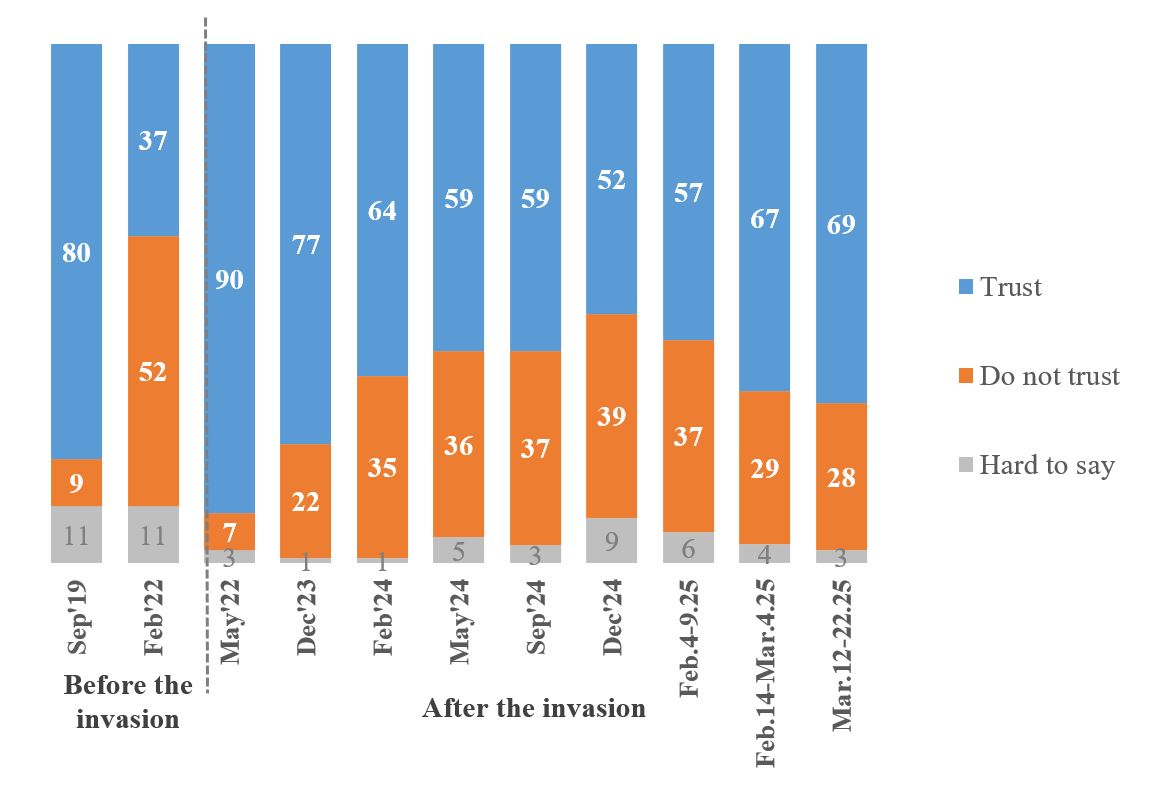
So, as of the second half of March 2025, 69% of Ukrainians trust President V.Zelenskyi, do not trust - 28%. The balance of trust-distrust is +41%. Compared to our last survey, all changes are formally within the statistical error range. Thus, in the period from February 14 to March 4, 2025, 67% trusted the President, and 29% did not. The balance of trust-distrust was +38%.
Graph 1. Dynamics of trust in President V. Zelenskyi during 2019-2025 "To what extent do you trust or distrust Volodymyr Zelenskyi?"
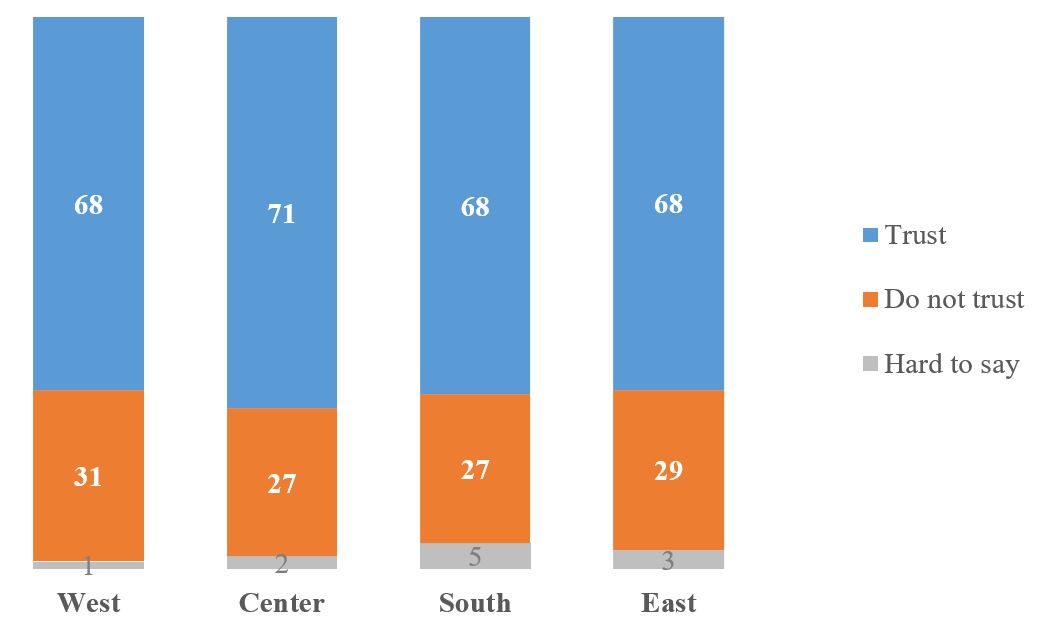
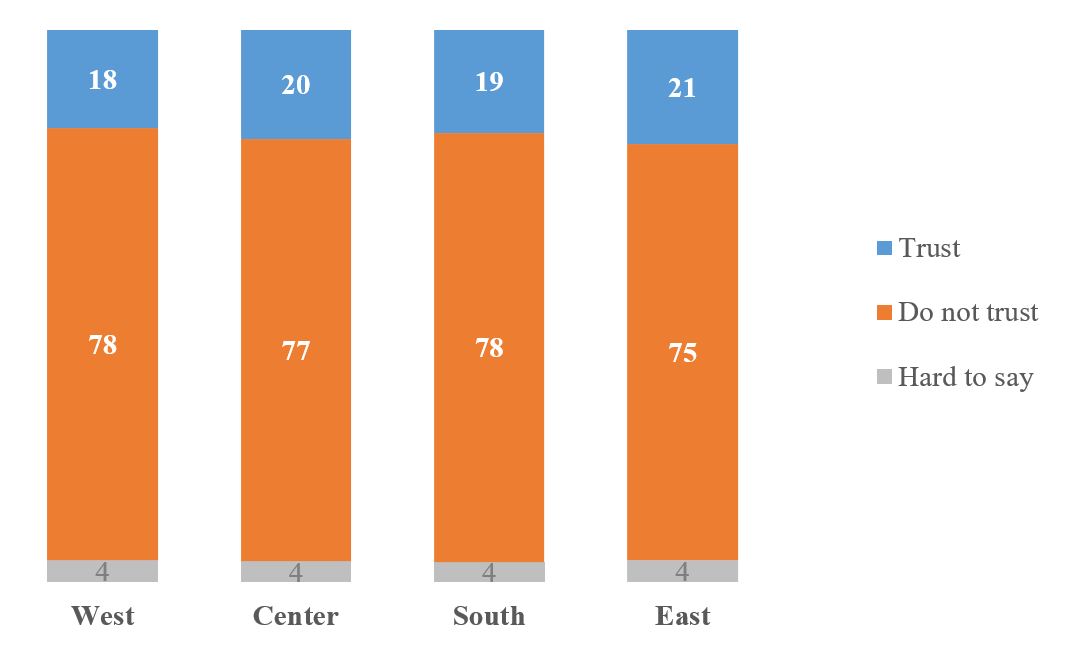
In all regions of Ukraine[1] the situation is similar and the balance of trust-distrust is positive. Thus, in all regions, the share of those who trust is 68-71% (and the share of those who do not trust is 27-31%).
Graph 2. Trust in President V. Zelenskyi in the regional dimension
Attitude towards holding national elections
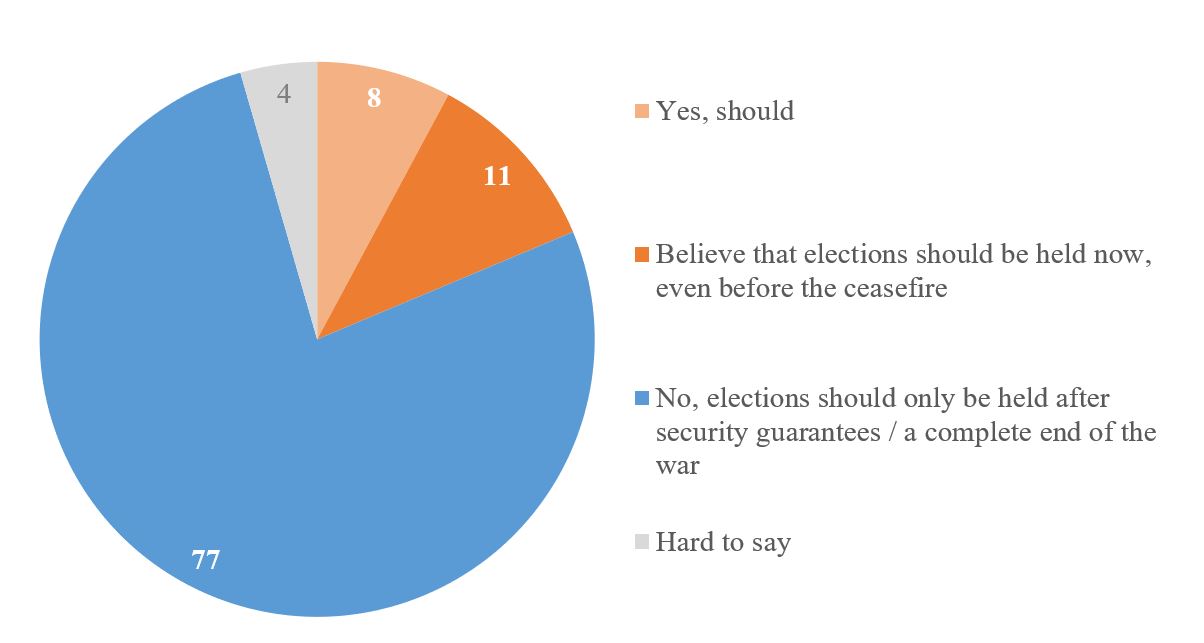
Now there is regular information about the demand for Ukraine to hold national elections. Surveys by KIIS and other companies have consistently shown that the vast majority of Ukrainians are against holding elections before the end of the war. At the same time, in March 2025, talks intensified about a possible temporary truce and the possibility of holding elections under such conditions. We decided to ask Ukrainians how they feel about holding elections under a ceasefire. For half of the respondents, we simulated a ceasefire without security guarantees, and for the other half, with security guarantees. That is, in the first case, we are talking about whether it is worth holding elections when there is simply a ceasefire and Ukraine does not receive additional security mechanisms. In the second case, a hypothetical ceasefire is accompanied by the provision of security guarantees to Ukraine. It is worth starting with the option without security guarantees. As can be seen in the graph below, if we have a temporary ceasefire without security guarantees, then 77% speak out against elections and choose the option that elections should only be held only "after receiving security guarantees or a final peace agreement and a complete end to the war". At the same time, 8% answered that in such conditions it is worth holding elections, and 11% answered that elections should be held right now, without even waiting for a ceasefire. That is, in total, 19% support holding elections now or in the event of a ceasefire, even without security guarantees.
Graph 3. Imagine that a ceasefire does take place, but Ukraine receives no security guarantees, such as additional weapons or peacekeepers. Should Ukraine then hold national elections afterwards?
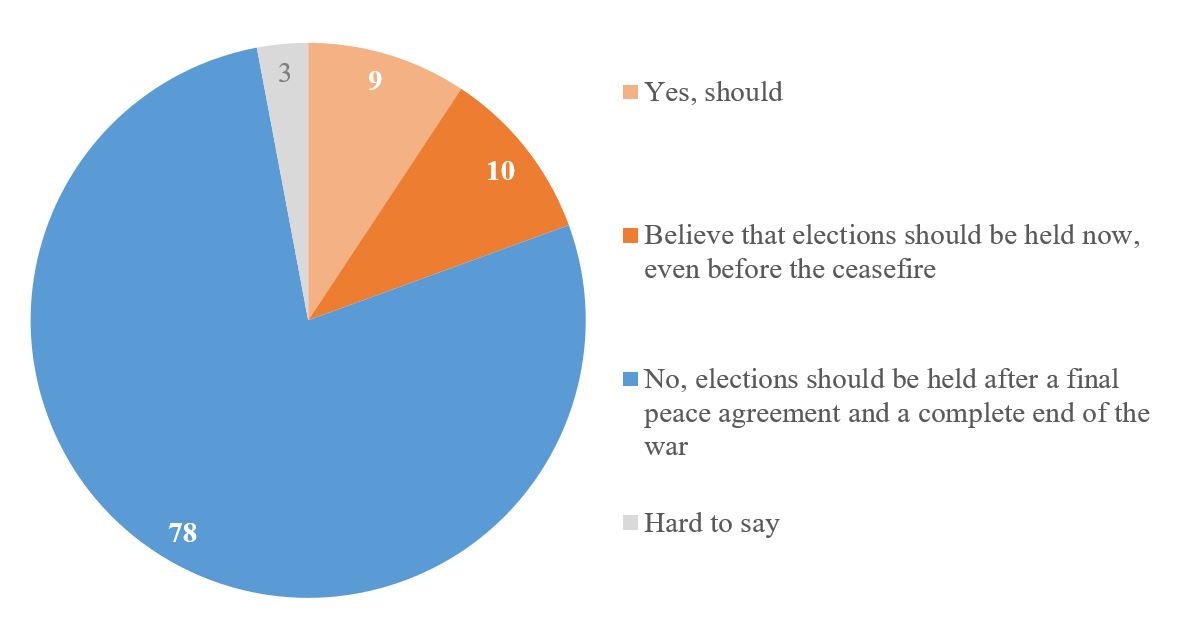
Then the natural question is whether they will support elections after a possible ceasefire with certain security guarantees. The graph below shows that even in the event of a ceasefire with security guarantees, the absolute majority – 78% – is against holding elections and says that elections should be held after a final peace agreement and a complete end of the war. Overall, 19% support holding elections (after a ceasefire with security guarantees or even right now).
Graph 4. Imagine that a ceasefire really takes place and Ukraine receives reliable security guarantees: more weapons, peacekeepers from a European country, etc. Should Ukraine then hold national elections after that?
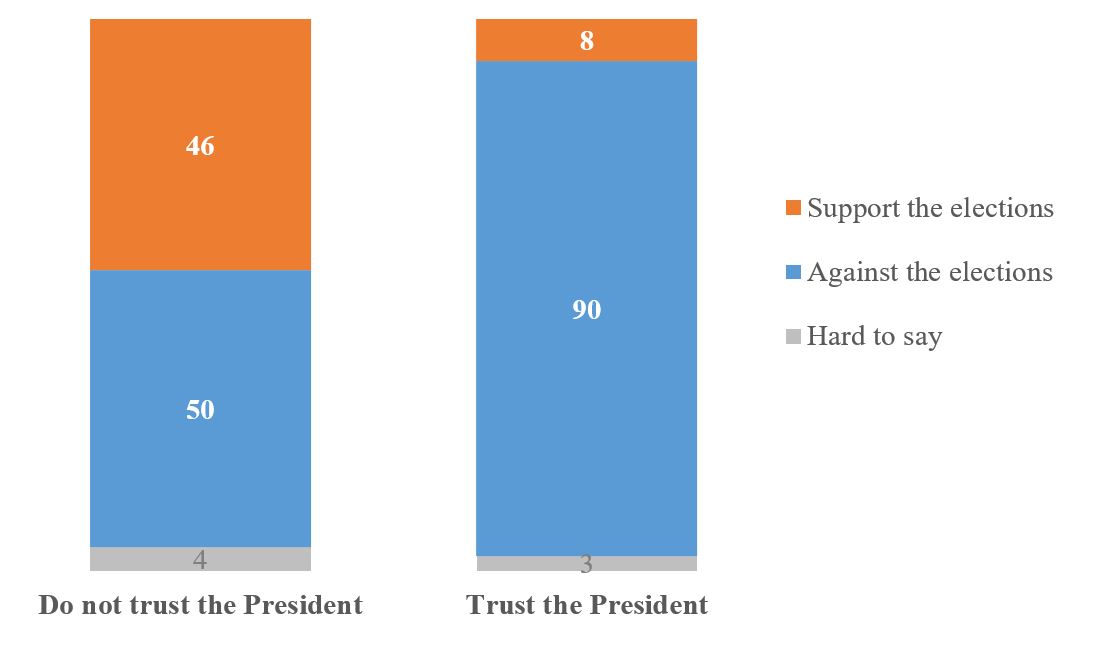
 Support for the elections is closely linked to trust in the President. Thus, those who do not trust the President are more likely to support the elections. Even among them, 50% do not support them (46% support the elections). Among those who trust the President, 90% are against the elections (8% support them).
Graph 5. Support for elections depends on trust in the President
In all regions of Ukraine, the absolute majority (75-78%) oppose holding elections.
Graph 6. Support for the holding of elections in the regional dimension
A. Hrushetskyi, comments on the survey results:
Ukrainians maintain a fairly high level of trust in President Volodymyr Zelenskyi, and he himself is perceived as a legitimate head of state. It should be understood that high trust (and its growth over the recent period) is primarily due to the perception of V. Zelenskyi as the President and the spokesperson for the interests of Ukraine and Ukrainians (and to a lesser extent, it can be about sympathy on a personal level as a person or politician). Ukrainians are aware of the existential threat from Russia and the Russians, and it is precisely resistance to the ruthless enemy that is priority No. 1. Accusations that Ukraine itself is to blame for Russia's attack or other incorrect (to put it mildly) interpretations of Ukrainian-Russian relations are painfully perceived by the Ukrainian public and motivate Ukrainians to greater unity (and we see another wave of "rally around the flag"). At the same time, there is no doubt that Ukrainians have accumulated questions for the authorities and justified criticism of certain actions and decisions. There is also no doubt that Ukrainians would like a reboot and would like to see new competent faces in responsible positions (especially when so many of our compatriots in the conditions of a full-scale invasion have excellently proven themselves in their activities - we are talking about military personnel, volunteers, diplomats, and about some effective officials and managers). However, Ukrainians remain categorical that it is the sovereign right of Ukrainians to decide when exactly elections should be held. Currently, there is no request for elections, and on the contrary, the overwhelming majority consistently emphasizes that elections are possible only after the end of the war.
Annex 1. Formulation of questions from the questionnaire
To what extent do you trust or not trust Volodymyr Zelenskyi?
HALF OF THE RESPONDENTS CHOOSE OPTION A, HALF – Б А. Imagine that a ceasefire really takes place and Ukraine receives reliable security guarantees: more weapons, peacekeepers from a European country, etc. Should Ukraine then hold national elections after that?
Б. Imagine that a ceasefire does take place, but Ukraine does NOT receive security guarantees, such as additional weapons or peacekeepers. Should Ukraine then hold national elections afterwards?
[1] The composition of the macroregions is as follows: Western macroregion - Volyn, Rivne, Lviv, Ivano-Frankivsk, Ternopil, Zakarpattia, Khmelnytskyi, Chernivtsi oblasts; Central macroregion - Vinnytsia, Zhytomyr, Sumy, Chernihiv, Poltava, Kirovohrad, Cherkasy, Kyiv oblasts, Kyiv city, Southern macroregion - Dnipropetrovsk, Zaporizhzhia, Mykolaiv, Kherson, Odesa oblasts, Eastern macroregion - Donetsk, Luhansk and Kharkiv oblasts.
27.3.2025
|
Our social media:
 KIIS page
 KIIS channel