

ESC or click to close
|
Press releases and reports
Dynamics of trust in President V. Zelenskyy in 2019-2025 and attitude towards holding elections
The press release was prepared by Anton Grushetskyi, executive director of KIIS
From September 2 to 14, 2025, the Kyiv International Institute of Sociology (KIIS) conducted its own all-Ukrainian public opinion survey "Omnibus", to which, on its own initiative, added questions related to trust in the President and attitude towards holding elections. By the method of telephone interviews (computer-assistedtelephoneinterviews, CATI) based on a random sample of mobile phone numbers (with random generation of phone numbers and subsequent statistical weighting) in all regions of Ukraine (the territory controlled by the Government of Ukraine), 1,023 respondents were surveyed. The survey was conducted with adult (aged 18 and older) citizens of Ukraine who, at the time of the survey, lived in the territory of Ukraine controlled by the Government of Ukraine. The sample did not include residents of territories temporarily not controlled by the Ukrainian authorities (at the same time, some of the respondents are IDPs who moved from the occupied territories), and the survey was not conducted with citizens who left abroad after February 24, 2022 Formally, under normal circumstances, the statistical error of a sample of 1,023 respondents (with a probability of 0.95 and taking into account the design effect of 1.3) does not exceed 4.1%. Under the conditions of war, in addition to the specified formal error, a certain systematic deviation is added. Factors that may affect the quality of results in "wartime" conditions were previously cited by KIIS. In general, we believe that the obtained results are still highly representative and allow a fairly reliable analysis of the public moods of the population.
Dynamics of trust in President V. Zelenskyy in 2019-2025
KIIS continues to monitor trust in President V. Zelenskyy and this press release presents the current results as of the first half of September 2025. We remind you that we ask our respondents the question “To what extent do you trust or distrust Volodymyr Zelenskyy?” and ask them to choose one of the following answers: “completely trust”, “rather trust”, “rather do not trust”, “completely do not trust” (we do not offer the answer “hard to say”, but if the respondent insists, then we mark it). In the Annex you can see the full distribution of answers and, in particular, in a regional breakdown. So, Compared to the beginning of August 2025, the level of trust in the President has practically not changed. Currently, 59% of Ukrainians trust him, 34% do not trust him (at the beginning of August, the corresponding indicators were 58% and 35%). The balance of trust-distrust is +25% (at the beginning of August – +23%). The current level of trust is lower than it was earlier this year (a high of 74% trust in early May, just after the signing of the Minerals Agreement and on the eve of the Istanbul talks). However, it is still higher than the 52% in December 2024 (the relative lowest we have seen since the start of the full-scale invasion).
Graph 1. To what extent do you trust or not trust Volodymyr Zelenskyy? 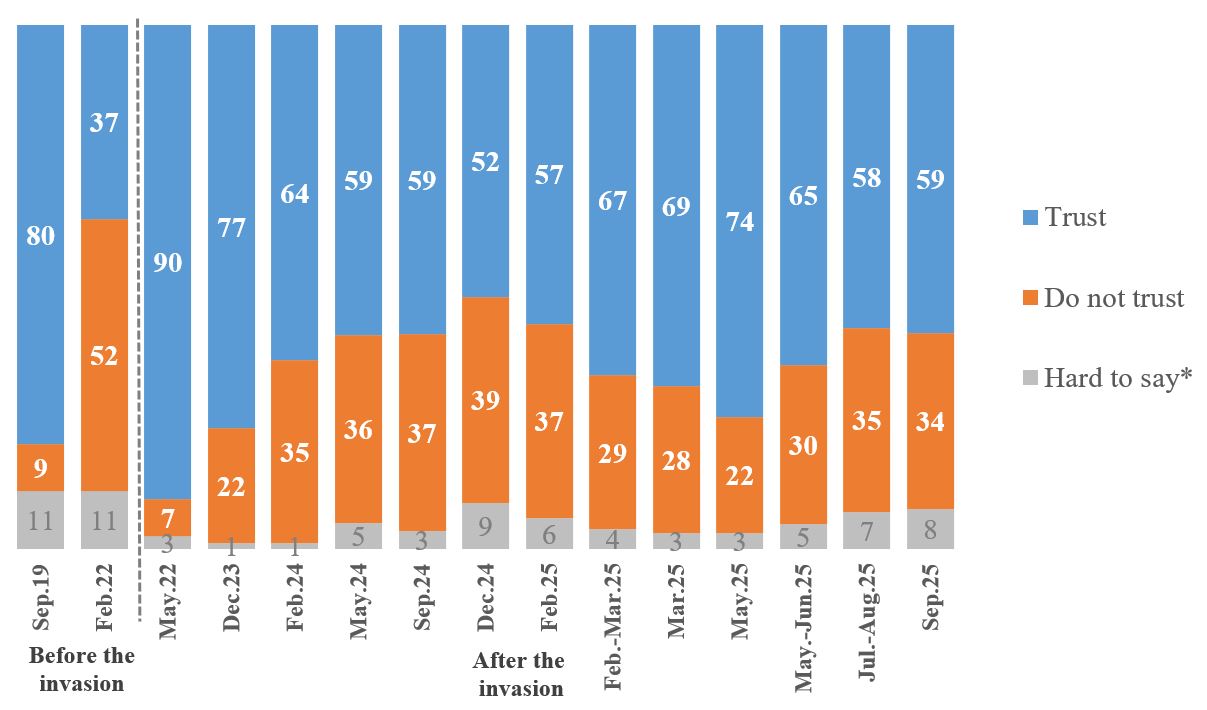 * The option “hard to say” was not read to respondents. It was only marked if the respondent requested it.
Attitude towards holding national elections
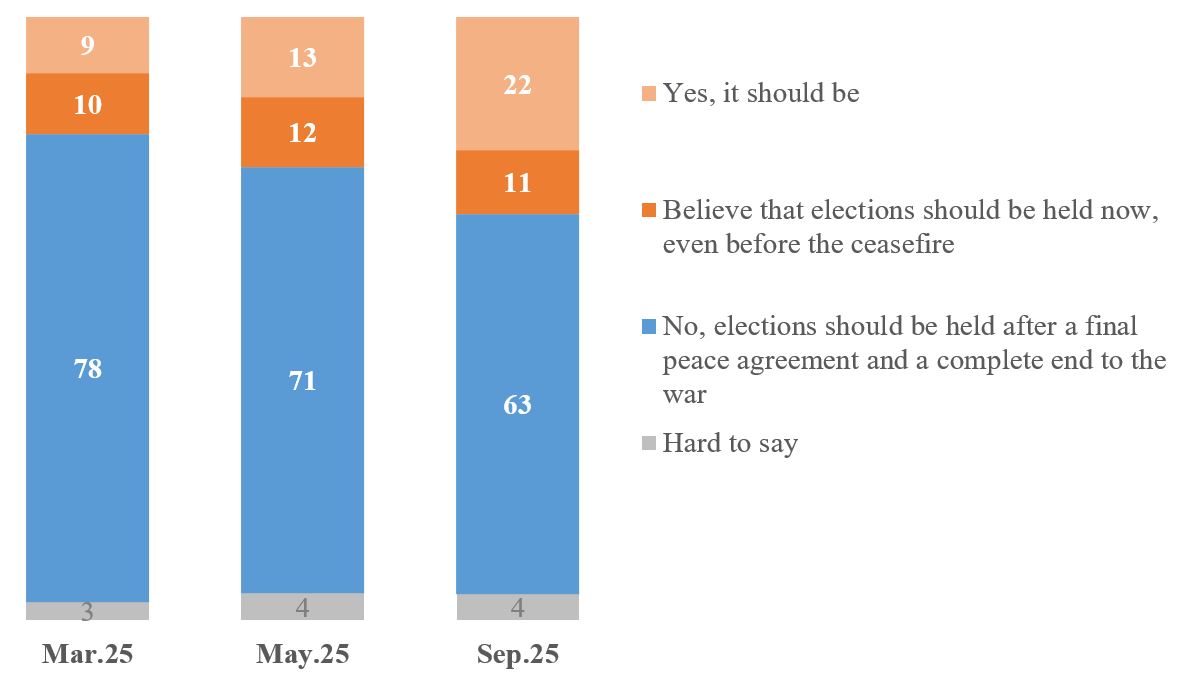
KIIS also regularly monitors the question of when Ukrainians think national elections should be held. In March 2025, we first tested two options for holding elections after a possible ceasefire, subject to the presence/absence of reliable security guarantees[1]. In May and September 2025, we repeatedly raised the question of whether it would be worth holding national elections in the event of a ceasefire and security guarantees (since objectively the option of elections without security guarantees seems unrealistic). As can be seen in the graph below, the share of those who support elections right now, even before the ceasefire, remains consistently low at 12% (in May 2025 – 12%, in March 2025 – 10%). At the same time, since March 2025, we have observed an increase in the share of those who support holding elections after a ceasefire with security guarantees – from 9% in March 2025 to 22% in September 2025. Perhaps this increase is related to a more substantive discussion of security guarantees for Ukraine recently. However, the majority of Ukrainians – 63% – continue to believe that elections should be held after a final peace agreement and a complete end to the war. In May 2025, 71% believed so, in March 2025 – 78%.
Graph 2. Imagine that a ceasefire really takes place and Ukraine receives reliable security guarantees: more weapons, peacekeepers from a European country, etc. Should Ukraine then hold national elections after that?
Support for holding elections is closely linked to trust in the President. Thus, the more respondents trust the President, the less they support holding elections (both now and after the ceasefire). At the same time, it is worth noting that Even among those who completely do not trust the President, only 29% support holding elections right now, before the war ends.
Graph 3. Support for holding elections depending on trust in the President

In this survey, we also asked questions about war and peace, which were published earlier this week[2]. In the table below, we suggest that you familiarize yourself with the views on the issues of war and peace held by those who support/oppose the holding of elections. So, it can be seen that in general, the views of those who support holding elections after a ceasefire are quite similar to the views of those who believe that elections should be held after the war is completely over. In particular, the absolute majority in both cases is categorically against the Russian peace plan (i.e., against surrender). At the same time, those who insist on elections right now stand out noticeably more. Among them, half are even ready to surrender to end the war, although the other half categorically rejects the Russian peace plan. That is, in this segment (votes in favor of elections right now) there is an ideological division and one part is the votes of those who agree to any end to the war, even surrender. Perhaps that is why these people insist on elections, because they see this as a way to any peace, but as soon as possible. The other part is, most likely, those who view elections as an opportunity to improve public administration in Ukraine and strengthen defense against the aggressor.
Table 1. Public opinion on issues of war and peace in terms of attitude towards holding elections
A. Grushetskyi, comments on the survey results:
President V. Zelenskyн retains a fairly high level of trust among the Ukrainian public (especially by the standards of democratic societies, where few political leaders can boast the same indicators). At the same time, only a small proportion of Ukrainians insist on holding elections now (and among them, half of them seek this because of their defeatist moods). Thus, V. Zelenskyy retains high legitimacy as the head of state. At the same time, it is impossible to ignore the fact that, firstly, a significant share of the population (a third) consistently does not trust the President. Secondly, among the 59% among those who trust the President, 23% trust him completely, and 36% rather trust him. It can be assumed that some of those who trust the President are guided by the argument of the need to unite in the face of an existential threat from Russia. Then, in peaceful conditions (whenever they occur), the attitude towards V. Zelenskyy may change significantly, since the agenda will be different and, accordingly, there will be different criteria for evaluating his activities. It is important that the President and his government and parliamentary teams understand the objective reasons for criticism and respond to them constructively. However, all of us – Ukrainian society – need to realize that discussions about the successes and failures of V. Zelenskyy (and any other Ukrainian figures) are possible only in Independent Ukraine. In the current circumstances, it is important to adhere to the most constructive approach and be guided by the principle that the No. 1 priority should be achieving a successful end to the war for Ukraine.
Annex 1. Formulation of questions from the questionnaire
To what extent do you trust or not trust Volodymyr Zelenskyy?
Imagine that a ceasefire really takes place and Ukraine receives reliable security guarantees: more weapons, peacekeepers from a European country, etc. Should Ukraine then hold national elections after that?
[1] Dynamics of trust in President V. Zelenskyy in 2019-2025 and attitude towards holding elections // https://www.kiis.com.ua/?lang=ukr&cat=reports&id=1510&page=1 [2] Results of the all-Ukrainian KIIS survey on war and peace issues // https://kiis.com.ua/?lang=ukr&cat=reports&id=1551&page=1 [3] The composition of the macroregions is as follows: Western macroregion - Volyn, Rivne, Lviv, Ivano-Frankivsk, Ternopil, Zakarpattia, Khmelnytskyi, Chernivtsi oblasts; Central macroregion - Vinnytsia, Zhytomyr, Sumy, Chernihiv, Poltava, Kirovohrad, Cherkasy, Kyiv oblasts, Kyiv city, Southern macroregion - Dnipropetrovsk, Zaporizhzhia, Mykolaiv, Kherson, Odesa oblasts, Eastern macroregion - Donetsk, Luhansk and Kharkiv oblasts.
19.9.2025
|
|||||||||||||||||||||||||||||||||||||||||||||||||||||||||||||||||||||||||||||||||||||||||||||||||||||||||||||||||||||||||||||||||||||||||||||||||||||||||
Our social media:
 KIIS page
 KIIS channel