

ESC or click to close
|
Press releases and reports
Dynamics of readiness for territorial concessions and impact of interpreting “territorial concessions”
The press release was prepared by Anton Grushetskyi, executive director of KIIS
From September19 to October 5,2025,the Kyiv International Institute of Sociology (KIIS) conducted its own all-Ukrainian public opinion survey “Omnibus”, to which, on its own initiative, added a monitoring question about readiness for territorial concessions, and also conducted an experiment on how different interpretations of “territorial concessions” affect the results. By the method of telephone interviews (computer-assisted telephone interviews, CATI) based on a random sample of mobile phone numbers (with random generation of phone numbers and subsequent statistical weighting) in all regions of Ukraine (the territory controlled by the Government of Ukraine), 2,015 respondents were surveyed (about 500 randomly selected respondents answered each of the 4 versions of questions about territorial concessions). The survey was conducted with adult (aged 18 and older) citizens of Ukraine who, at the time of the survey, lived in the territory of Ukraine controlled by the Government of Ukraine. The sample did not include residents of territories temporarily not controlled by the Ukrainian authorities (at the same time, some of the respondents are IDPs who moved from the occupied territories), and the survey was not conducted with citizens who left abroad after February 24, 2022. Formally, under normal circumstances, the margin of error of such a sample (with a probability of 0.95 and taking into account the design effect of 1.3) did not exceed 2.9%. the margin of error for the sample around 500 respondents does not exceed 5.8% . Under the conditions of war, in addition to the specified formal error, a certain systematic deviation is added. Factors that may affect the quality of results in "wartime" conditions were previously cited by KIIS. In general, we believe that the obtained results are still highly representative and allow a fairly reliable analysis of the public moods of the population.
Readiness for territorial concessions
Since May 2022, KIIS has been regularly asking questions in its own surveys about the population’s readiness to make territorial concessions in order to achieve peace as soon as possible and preserve independence. The original wording (which we prepared in May 2022) reads as follows: “Which of these statements regarding possible compromises to achieve peace with Russia do you agree with to a greater extent?”, and the respondent was asked to choose one of two such statements (the statements were read to different respondents in different orders to reduce the order effect):
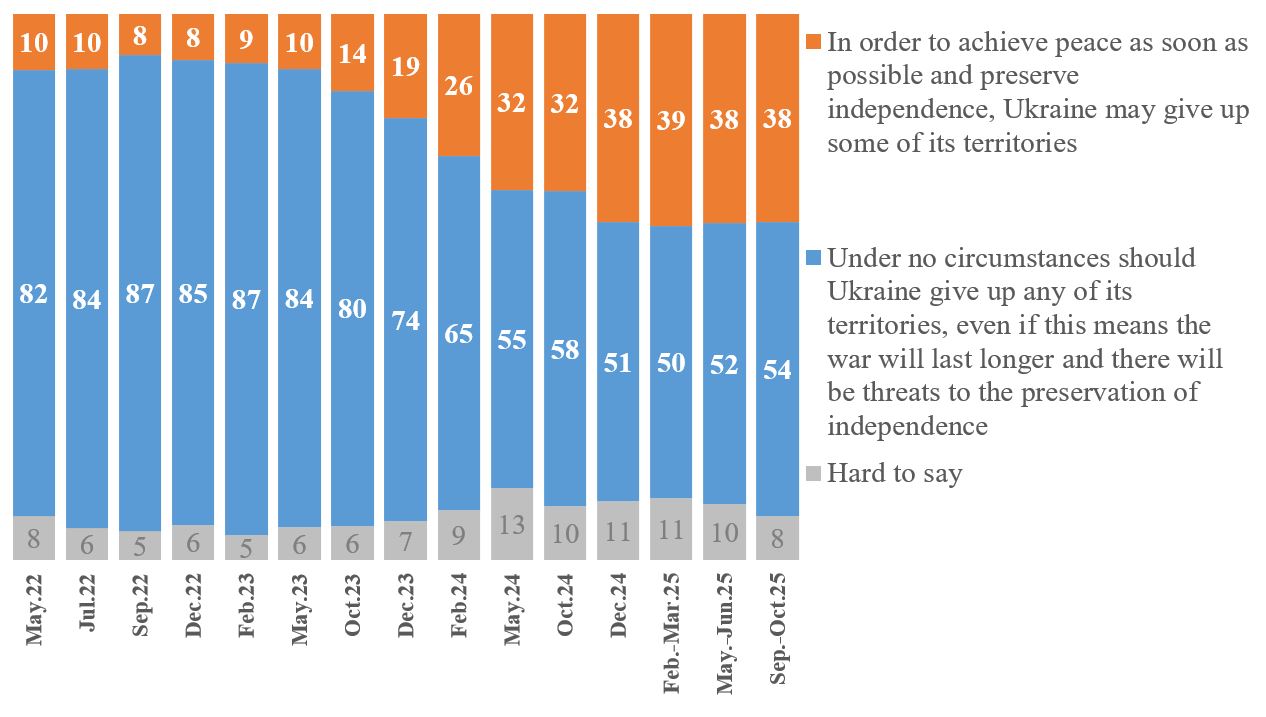
We specially emphasize that the first statement does not specify which territories may be the subject of concessions, and also what “territorial concessions” are in question. Another factor is that our formulation provides a more socially acceptable form of accepting losses, since in exchange “the war ends” and “Ukraine retains its independence”. Our experiment in February 2025 showed that Ukrainians strongly react to “preserving sovereignty” and consider it one of the fundamental points for any peace deal. In particular, some respondents could, for example, understand “preserving independence” as receiving security guarantees. That is, their interpretation may be broader than the question directly implies. It is especially important to emphasize that there are several interpretations of “territorial concessions”, so this time, in addition to the original monitoring question, we formulated three alternative formulations, where we more clearly specified what we mean by “territorial concessions”. The respondent was asked a randomly selected 1 of 4 questions. This issue will be considered in more detail in the next paragraph (before graph 2), and first we propose to consider what changed the answers of Ukrainians to our typical monitoring question (where we do not specify the definition of “territorial concessions”). Graph 1 shows the respondents’ answers. Compared toMay-early June 2025, the situation has not changed. Thus, 54% of Ukrainians are firmly against any territorial concessions (in early summer 2025 – 52%). Ready to accept certain territorial losses – 38% (previously the same number).
Graph 1. Which of these statements regarding possible compromises to achieve peace with Russia do you agree with to a greater extent?
Impact of interpreting “territorial concessions”
Now it is worth considering how specifying “territorial losses” affects the results. In the other three versions of our question, the wording was as follows.
v Version “Official recognition of occupation” – Ukraine officially recognizes certain territories as part of Russia and no longer claims them:
v Version “Transfer of unoccupied territories to Russia” – Ukraine transfers control of territories that it currently controls, such as the cities of Kherson, Zaporizhzhia, etc.:
v Version “De facto recognition of occupation without de jure” – Ukraine de facto recognizes Russia’s control over certain territories, but does not recognize it officially:
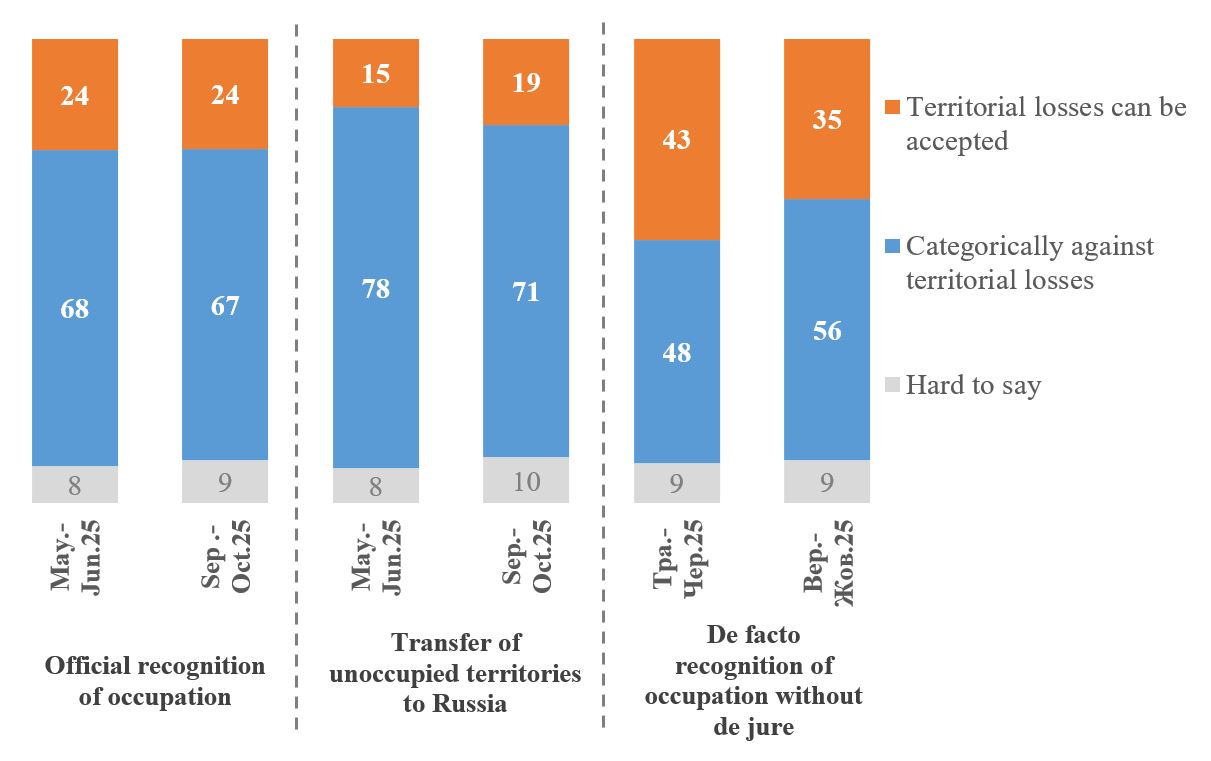
Therefore, if we are asking about the official recognition of certain territories as part of Russia, then the vast majority (67%) will be against. Ready to accept – 24%. Compared to May-June, the situation has practically not changed. Also, the absolute majority – 71% – reject the transfer of territories controlled by Ukraine under Russian control. Ready to accept – only 19%. In May-June, 78% categorically rejected it, and 15% were ready for such an option. In the case of the option of freezing the front line without officially recognizing any occupied territories as part of Russia, 56% categorically reject this option, and 35% are ready for it. At the same time, the readiness to accept this option has decreased since May-June - so, the share of those who can agree has decreased from 43% to 35%. The share of those who are categorically against has increased from 48% to 56%. In this context, it is necessary to recall the results of our survey, which we conducted in early September 2025[1]. So, although the majority, as we see from the results of this survey, is against even freezing the front line, if the peace plan is supplemented by reliable security guarantees and European integration, then 74% will be ready to accept the freeze.
Graph 2. Which of these statements regarding possible compromises to achieve peace with Russia do you agree with to a greater extent?
Regional dimension
The table below shows the data broken down by region of residence of respondents[2]. Since each question was answered by around 500 respondents, there were not so many respondents per region and the results below should be taken as tendencies. In all regions, the option of officially recognizing certain territories as part of Russia or even transferring territories currently controlled by Ukraine under Russian control is not supported. That is, these demands are unacceptable to Ukrainians in general and in all regions. At the same time, support for the option of de facto recognition of Russian control over certain territories is growing from 26% in the West to 46% in the East. Although even in the East, opinions are almost evenly divided on this issue, meaning that there is no region where this option enjoys overwhelming support. However, again, according to the results of our survey conducted in early September (which we mentioned above), if the freeze is supplemented by reliable security guarantees and a European perspective, then the majority of Ukrainians in all regions are ready to approve such an option (albeit without enthusiasm).
Table 1. Readiness for territorial concessions in the regional dimension
A. Grushetskyi, comments on the survey results:
The current survey actually repeats the trends that we consistently observe in various surveys with different wording of questions about war and peace and, in particular, possible territorial losses. So, despite all the difficulties, Ukrainians are determined to continue their resistance and reject unacceptable territorial demands. Especially if they try to impose territorial losses on Ukraine without any compensation in the form of reliable security guarantees and a European perspective. In any case, we see that the option of officially recognizing certain territories as part of Russia or the option of transferring territories currently controlled by Ukraine to Russia are “unviable” from the point of view of Ukrainian public opinion and are doomed to categorical rejection. The only option – and only within a more comprehensive package – that has the potential to be discussed is the freezing of the current front line without any legal recognition.
Annex 1. Formulation of questions from questionnaire
DIVIDE THE SAMPLE INTO 4 GROUPS. EACH GROUP IS ASKED ONE QUESTION VERSION
A.Which of these statements regarding possible compromises to achieve peace with Russia do you agree with to a greater extent? RANDOMIZE ORDER
B.Which of these statements regarding possible compromises to achieve peace with Russia do you agree with to a greater extent? RANDOMIZE ORDER
C.Which of these statements regarding possible compromises to achieve peace with Russia do you agree with to a greater extent? RANDOMIZE ORDER
D.Which of these statements regarding possible compromises to achieve peace with Russia do you agree with to a greater extent? RANDOMIZE ORDER
[1] Results of the all-Ukrainian KIIS survey on war and peace issues // https://kiis.com.ua/?lang=ukr&cat=reports&id=1551&page=1 [2] The composition of the macroregions is as follows: Western macroregion - Volyn, Rivne, Lviv, Ivano-Frankivsk, Ternopil, Zakarpattia, Khmelnytskyi, Chernivtsi oblasts; Central macroregion - Vinnytsia, Zhytomyr, Sumy, Chernihiv, Poltava, Kirovohrad, Cherkasy, Kyiv oblasts, Kyiv city, Southern macroregion - Dnipropetrovsk, Zaporizhzhia, Mykolaiv, Kherson, Odesa oblasts, Eastern macroregion - Donetsk, Luhansk and Kharkiv oblasts.
9.10.2025
|
Our social media:
 KIIS page
 KIIS channel