

ESC or click to close
|
Press releases and reports
Dynamics of trust in President Volodymyr Zelenskyy and how his activities and those of Petro Poroshenko are perceived after the war
The press release was prepared by Anton Hrushetskyi, executive director of KIIS
From September 19 to October 5, 2025, the Kyiv International Institute of Sociology (KIIS) conducted its own all-Ukrainian public opinion survey "Omnibus", to which, on its own initiative, added a monitoring question about trust in President V. Zelenskyy, as well as a question about how Ukrainians see the future activities of V. Zelenskyy and P. Poroshenko after the end of the war. By the method of telephone interviews (computer-assistedtelephoneinterviews, CATI) based on a random sample of mobile phone numbers (with random generation of phone numbers and subsequent statistical weighting) in all regions of Ukraine (the territory controlled by the Government of Ukraine), 1,008 respondents were surveyed. The survey was conducted with adult (aged 18 and older) citizens of Ukraine who, at the time of the survey, lived in the territory of Ukraine controlled by the Government of Ukraine. The sample did not include residents of territories temporarily not controlled by the Ukrainian authorities (at the same time, some of the respondents are IDPs who moved from the occupied territories), and the survey was not conducted with citizens who left abroad after February 24, 2022. Formally, under normal circumstances, the statistical error of such a sample (with a probability of 0.95 and taking into account the design effect of 1.3) did not exceed 4.1% for indicators close to 50%, 3.5% for indicators close to 25%, 2.5% for indicators close to 10%, 1.8% for indicators close to 5%. Under conditions of war, in addition to the specified formal error, a certain systematic deviation is added. Factors that may affect the quality of results in "wartime" conditions were previously cited by KIIS. In general, we believe that the obtained results are still highly representative and allow a fairly reliable analysis of the public moods of the population.
Dynamics of trust in President V. Zelenskyy in 2019-2025
KIIS continues to monitor trust in President V. Zelenskyy and this press release presents the current results as of the second half of September-early October 2025. We remind you that we ask our respondents the question “To what extent do you trust or distrust Volodymyr Zelenskyy?” and ask them to choose one of the following answers: “completely trust”, “rather trust”, “rather do not trust”, “completely do not trust” (we do not offer the answer “hard to say”, but if the respondent insists, then we mark it). In the Annex you can see the full distribution of answers and, in particular, in a regional breakdown. So, compared to the first half of September 2025, the level of trust in the President has practically not changed. Currently, 60% of Ukrainians trust him, 35% do not trust him (in the first half of September, the corresponding indicators were 59% and 34%). The balance of trust-distrust is +25% (the same indicator was in the first half of September). Overall, we see that after a decline in trust between the beginning of May and the beginning of August (initially from 74% to 65% in early June and then to 58% in early August), stabilization has occurred and over the past two months the level of trust in the President has fluctuated within insignificant limits (within the margin of error). At the same time, although the level of trust is now lower than it was in May (when we recorded the highest indicator for the recent period), it is higher than in December 2024 (when we recorded the relatively lowest indicator for the period since February 2022, i.e. since the full-scale invasion).
Graph 1. How much do you trust or not trust Volodymyr Zelenskyy?
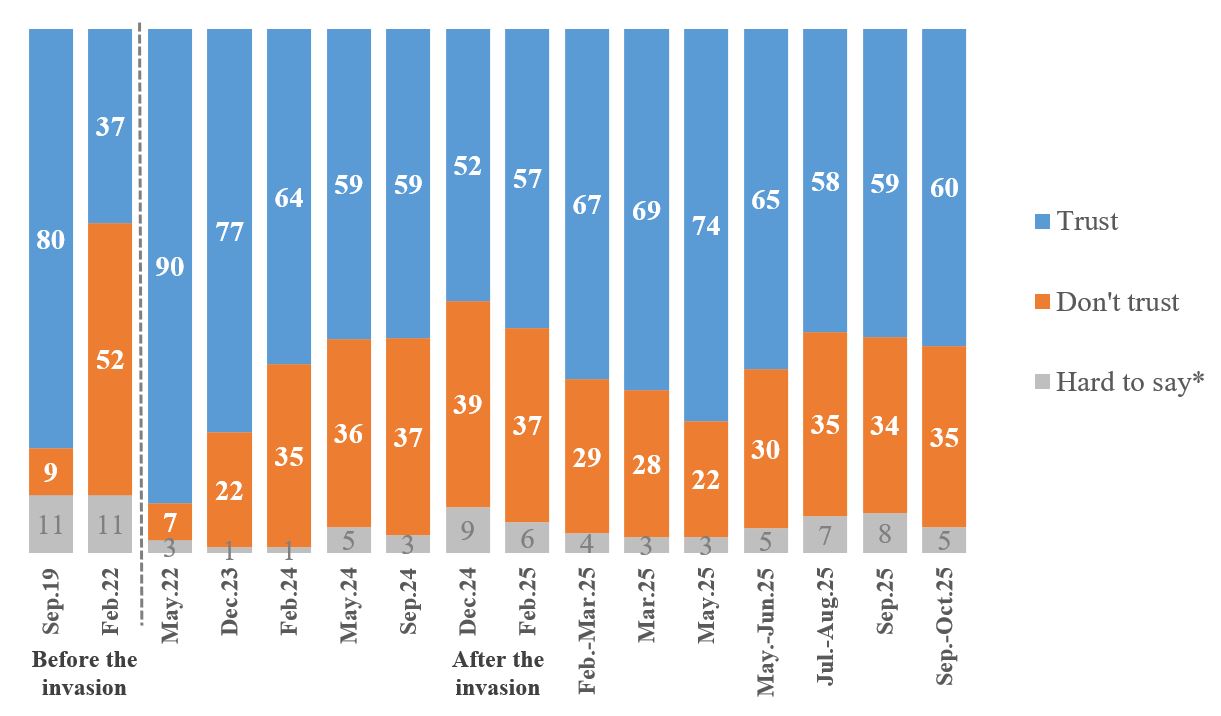 * The option “hard to say” was not read to respondents. It was marked only if the respondent requested it..
How do see the activities of Volodymyr Zelenskyy and Petro Poroshenko after the war
In addition to the question about trust, we also asked how Ukrainians see the future activities of V. Zelenskyy after the war. For a more complete understanding of public moods (and, in particular, for balance), we also asked a similar question about the future activities of P. Poroshenko (who is considered by the largest number of Ukrainians to be the leader of the opposition[1]). It is important to emphasize that we asked about activities after the war. Currently, only 11% of Ukrainians believe that elections should be held now (i.e. before the end of hostilities)[2], therefore, the results discussed below are not an indicator of the legitimacy of President V. Zelenskyy at the present moment (given the level of trust and critical attitude towards holding elections before the end of hostilities, V. Zelenskyy currently retains the necessary legitimacy among the public). The same applies to P. Poroshenko, who is a people's deputy, leader of the largest opposition faction and a person who is actively invested in national defense. That is, expectations from future activities after the war are not identical to the assessment of the situation now. We offered respondents a choice of one of the following future options: (a) to be in a top position (for V. Zelenskyy – to continue being President, for P. Poroshenko – to be President or Prime Minister), (b) to simply remain in politics, but not in a top position (as a people’s deputy or party leader), (c) to leave politics, or (d) to be subject to criminal investigations and be held accountable. So, in the case of V. Zelenskyy, 41% believe that he should remain in politics, although of them would like V. Zelenskyy to continue as President – 25%. Instead, 36% of respondents expressed the opinion that it would be better for him to leave politics after the war. 14% want criminal prosecution of V. Zelenskyy. At the same time, even fewer respondents would like P. Poroshenko to remain in politics (and, in particular, to hold top positions). Thus, in total, 23% of Ukrainians believe that he should remain in politics, and of them 9% of Ukrainians would like P. Poroshenko to take the position of President or Prime Minister after the war. Instead, 46% would like him to leave politics. Want criminal prosecution of the former President – 23%. At the same time, it is important to note in this context that the share of those who see a given person as the President after the war is not equivalent to an electoral rating. During elections, people choose between specific participants, so the composition of the candidates may determine the decision for whom to vote (for example, a certain person may not enjoy great trust, but be perceived as the best option among the available ones).
Graph 2. What would you like to see the future activities of Volodymyr Zelenskyy / Petro Poroshenko after the end of the war? (grouped answers)

Table 1. What would you like to see the future activities of Volodymyr Zelenskyy / Petro Poroshenko after the end of the war? (detailing)
If to combine the answers to the two questions, then in total, 45% of respondents do not see either V. Zelenskyy or P. Poroshenko in politics after the war. Another 46% have a “polarizing” approach, when they see one person in politics, but would not like the other to remain in politics. Moreover, there are more who would like V. Zelenskyy to remain. Thus, 32% believe that V. Zelenskyy should remain in politics, but not P. Poroshenko. On the contrary, 14% would like it. And only 9% answered that they would like both V. Zelenskyy and P. Poroshenko to remain in politics.
Graph 3. Do see V. Zelenskyy and P. Poroshenko in politics after the war
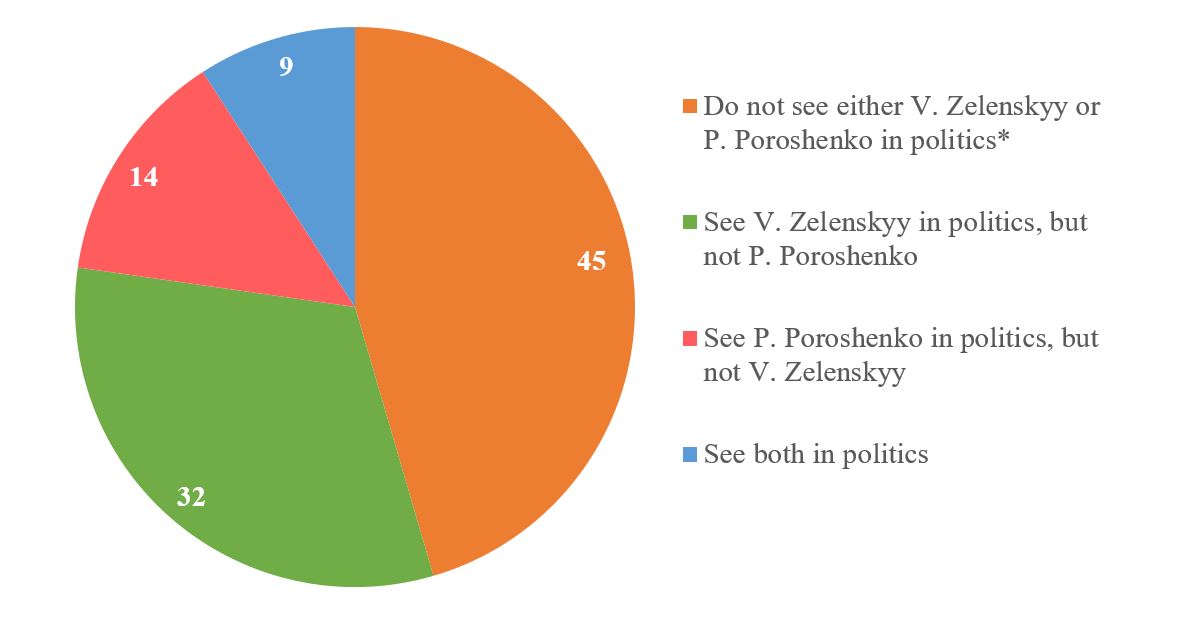 * That is, for both individuals, respondents answered "leave politics," "were subject to criminal prosecution," or "hard to say.".
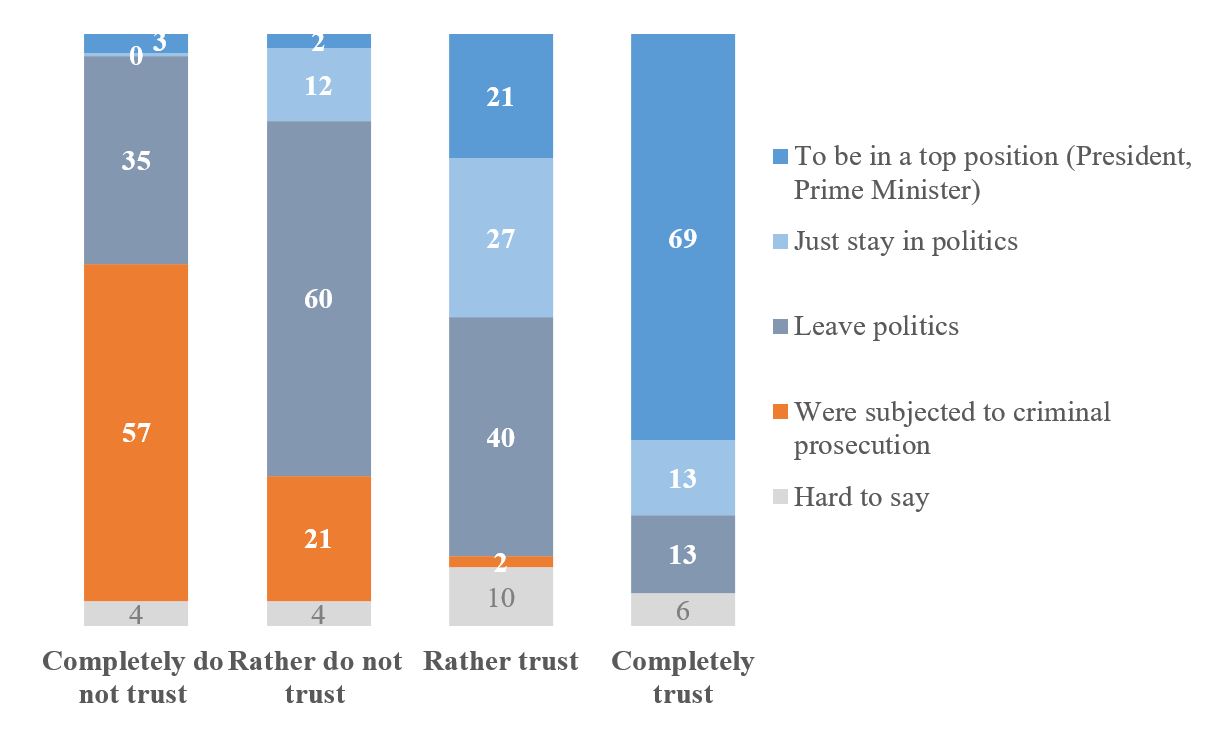
Another important point that is not reflected in the graph above is that 32% of all respondents would like to see criminal prosecution of either V. Zelenskyy or P. Poroshenko, or both of them. Moreover, out of the 32%, 5% said that both figures should be prosecuted, and the remaining 27% would like to see prosecution of one of them. And although 32% is a fairly high indicator (i.e., the request for criminal punishment is tangible), it also means that 68% would not want criminal prosecution in either the case of V. Zelenskyy or P. Poroshenko. And finally, we would like to show what those who (don't) trust him think about the future activities of President V. Zelenskyy. So, only among those who completely trust him, the vast majority would like to see him as President after the war – 69%. Among those who rather trust him, the indicator is 21%. And among those who do not trust him at all or rather do not trust him – only 3% and 2%, respectively. At the same time, there is a difference in views on the future of V. Zelenskyy among those who completely and rather do not trust. Among those who completely do not trust, the majority (57%) want criminal prosecution of the current President. Among those who rather do not trust, only 21% talk about criminal prosecution, and the majority (60%) believe that V. Zelenskyy should simply leave politics.
Graph 4. What would you like to see Volodymyr Zelenskyy's future activities among those who trust and do not trust him
A. Hrushetskyi, comments on the survey results:
The results obtained show that President V. Zelenskyy retains a fairly high level of trust in Ukrainian society. Together with our other data, according to which the majority of Ukrainians are against holding elections in the near future, it can be argued that V. Zelenskyy retains high legitimacy as head of state for the period until the end of the war. At the same time, for the period after the end of the war, there is more of an expectation to see someone new in the position of President (of course, it should be taken into account that everything will depend on the specific conditions of the end of the war and if these conditions turn out to be much more successful than can be expected now, then this may affect the desire to see V. Zelenskyy as President in the future). However, the request to see someone new in the position of President (or other top positions in the state) does not mean a desire for the current parliamentary opposition to come to power. During the full-scale war, many servicemen, volunteers, public figures, and central and local officials have proven themselves as true leaders and effective crisis managers. A new generation of Ukrainian leaders is being forged in the fire of war, and ordinary citizens are aware of this and are ready to give them a chance to prove themselves in politics after the war. Therefore, we see that in the case of V. Zelenskyy (as a representative of the current government) and in the case of P. Poroshenko (as a representative of the opposition), many Ukrainians would like them to make way for new leaders. Another important point that we would like to draw attention to is the rather soft idea of Ukrainians about the exit of prominent figures from politics. That is, for the most part, it is about giving them the opportunity to simply leave politics and focus on charitable, international or family activities. Quite a few Ukrainians demand “blood,” that is, public harsh punishment. This approach (simply leaving politics without the threat of prosecution) is very civilized and should actually be encouraged if we strive to build a European democratic Ukraine. The current government needs to understand that there is no demand among the public for the punishment of P. Poroshenko. At the same time, the ex-President’s team should also realize that there is no demand for the criminal prosecution of V. Zelenskyy.
Annex 1. Formulation of questions from the questionnaire
To what extent do you trust or not trust Volodymyr Zelenskyy?
What would you like to see Volodymyr Zelenskyy's future activities after the war is over? Do you want him to …?
And what would you like to see Petro Poroshenko do in the future after the war is over? Do you want him to …?
[1] Who do Ukrainians consider the leader of the opposition in Ukraine // https://kiis.com.ua/?lang=ukr&cat=reports&id=1384&page=1 [2] Dynamics of trust in President V. Zelenskyy in 2019-2025 and attitude towards holding elections // https://www.kiis.com.ua/?lang=ukr&cat=reports&id=1552&page=1 [3] Склад макрорегіонів такий: Західний макрорегіон – Волинська, Рівненська. Львівська, Івано-Франківська, Тернопільська, Закарпатська, Хмельницька, Чернівецька області; Центральний макрорегіон – Вінницька, Житомирська, Сумська, Чернігівська, Полтавська, Кіровоградська, Черкаська, Київська області, м. Київ, Південний макрорегіон – Дніпропетровська, Запорізька, Миколаївська, Херсонська, Одеська області, Східний макрорегіон – Донецька, Луганська і Харківська області.
13.10.2025
|
Our social media:
 KIIS page
 KIIS channel