

ESC or click to close
|
Press releases and reports
Perception of the fight against corruption in Ukraine and the attitude of Ukrainians towards criticism of the authorities' actions during the period of full-scale invasion
The press release was prepared by Anton Hrushetskyi, executive director of KIIS
From September 19 to October 5, 2025, the Kyiv International Institute of Sociology (KIIS) conducted its own all-Ukrainian public opinion survey "Omnibus", to which, on its own initiative, added a monitoring question about the perception of the fight against corruption, as well as the question of whether it is worth criticizing the government during a full-scale war. By the method of telephone interviews (computer-assistedtelephoneinterviews, CATI) based on a random sample of mobile phone numbers (with random generation of phone numbers and subsequent statistical weighting) in all regions of Ukraine (the territory controlled by the Government of Ukraine), 1,008 respondents were surveyed. The survey was conducted with adult (aged 18 and older) citizens of Ukraine who, at the time of the survey, lived in the territory of Ukraine controlled by the Government of Ukraine. The sample did not include residents of territories temporarily not controlled by the Ukrainian authorities (at the same time, some of the respondents are IDPs who moved from the occupied territories), and the survey was not conducted with citizens who left abroad after February 24, 2022. Formally, under normal circumstances, the statistical error of such a sample (with a probability of 0.95 and taking into account the design effect of 1.3) did not exceed 4.1% for indicators close to 50%, 3.5% for indicators close to 25%, 2.5% for indicators close to 10%, 1.8% for indicators close to 5%. Under conditions of war, in addition to the specified formal error, a certain systematic deviation is added. Factors that may affect the quality of results in "wartime" conditions were previously cited by KIIS. In general, we believe that the obtained results are still highly representative and allow a fairly reliable analysis of the public moods of the population.
KIIS regularly asks questions about Ukrainians' perception of the problem of corruption in the country. For example, we recently published the results of a survey according to which 71% of Ukrainians believe that the level of corruption has increased since the start of the full-scale war[1]. At the same time, it is necessary to understand that intensive media coverage of the activities of law enforcement agencies and journalistic investigations can both indicate serious attempts to combat corruption, and, conversely, be perceived by part of the population as yet another evidence of the total, almost hopeless impregnation of Ukrainian society with corruption. Therefore, since September 2023, we have been asking the question of how Ukrainians perceive the fight against corruption. The results are presented further in the press release. In addition, an important question is how appropriate it is now to criticize the authorities for possible wrongdoings or miscalculations. We asked this question in May 2024 and re-asked it now to understand how public moods has changed. These results are also covered in the press release.
Perception of the fight against corruption in Ukraine
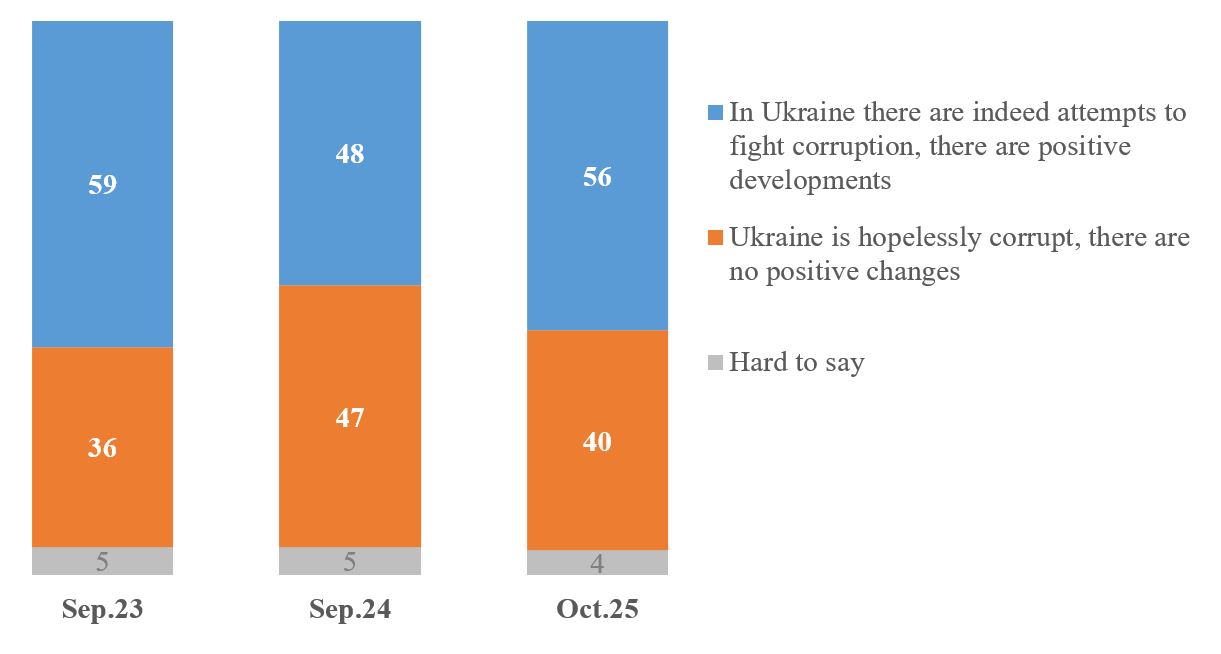
As can be seen in Graph 1 below, between 2023 and 2024, the number of those who were more optimistic about the fight against corruption in Ukraine decreased from 59% to 48% (and the number of those who considered the country hopelessly corrupt increased from 36% to 47%). While in 2023 the majority still believed that there were real attempts to overcome corruption, in 2024 we saw parity in the opinions of optimists and pessimists. Currently, as of early October 2025, 56% of Ukrainians believe that there are real attempts to fight corruption in Ukraine. At the same time, the share of those who consider Ukraine hopelessly corrupt is 40%. That is, between 2024 and 2025, the perception improved, although the indicators remain slightly worse than in 2023.
Graph 1. The media regularly reported on corruption investigations, detentions, arrests, etc. For you personally, this is more of an indication that …
Ukrainians' attitude towards criticism of the authorities' actions during the period of full-scale invasion
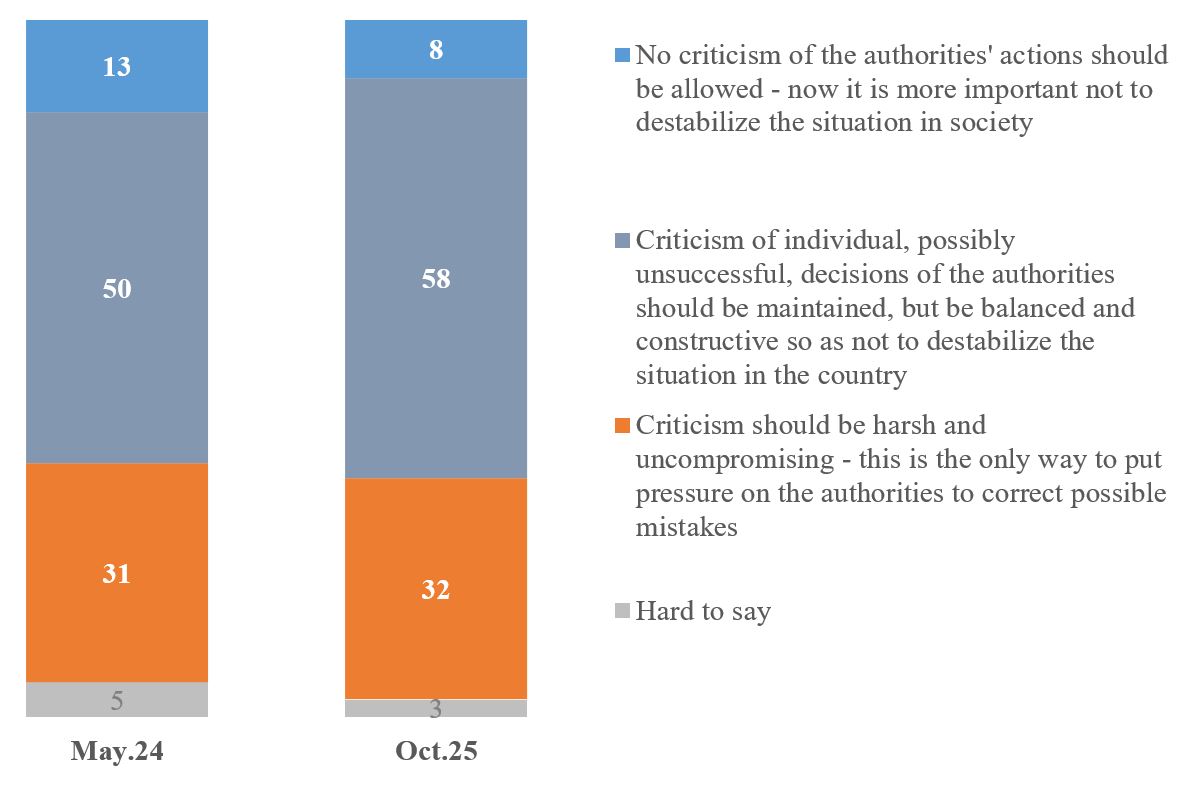
In the case of the question of the appropriateness of criticizing the actions of the authorities, we were interested in whether Ukrainians seek more harsh, uncompromising criticism, or whether they are more inclined to constructive criticism of individual actions of the authorities (or are categorically against any criticism at all). Thus, only 8% of Ukrainians believe that the government should not be criticized at all (and the share of those who think so has decreased from 13% since 2024). In contrast, 90% agree that criticism of the government should be present (an increase from 81% compared to 2024). At the same time, the majority of respondents (58% of these 90%) believe that criticism should be "balanced and constructive so as not to destabilize the situation in the country.". A minority – 32% – insists on harsh and uncompromising criticism. Compared to 2024, the share of those who insist on harsh criticism has not changed, while the share of those who insist on constructive criticism has increased.
Graph 2. Some people believe that during a war, one should not criticize the actions of the authorities so as not to destabilize the situation. Others believe that it is important to maintain the opportunity to criticize so that possible mistakes can be corrected and taken into account for the future. And with which of these opinions do you agree to a greater extent?
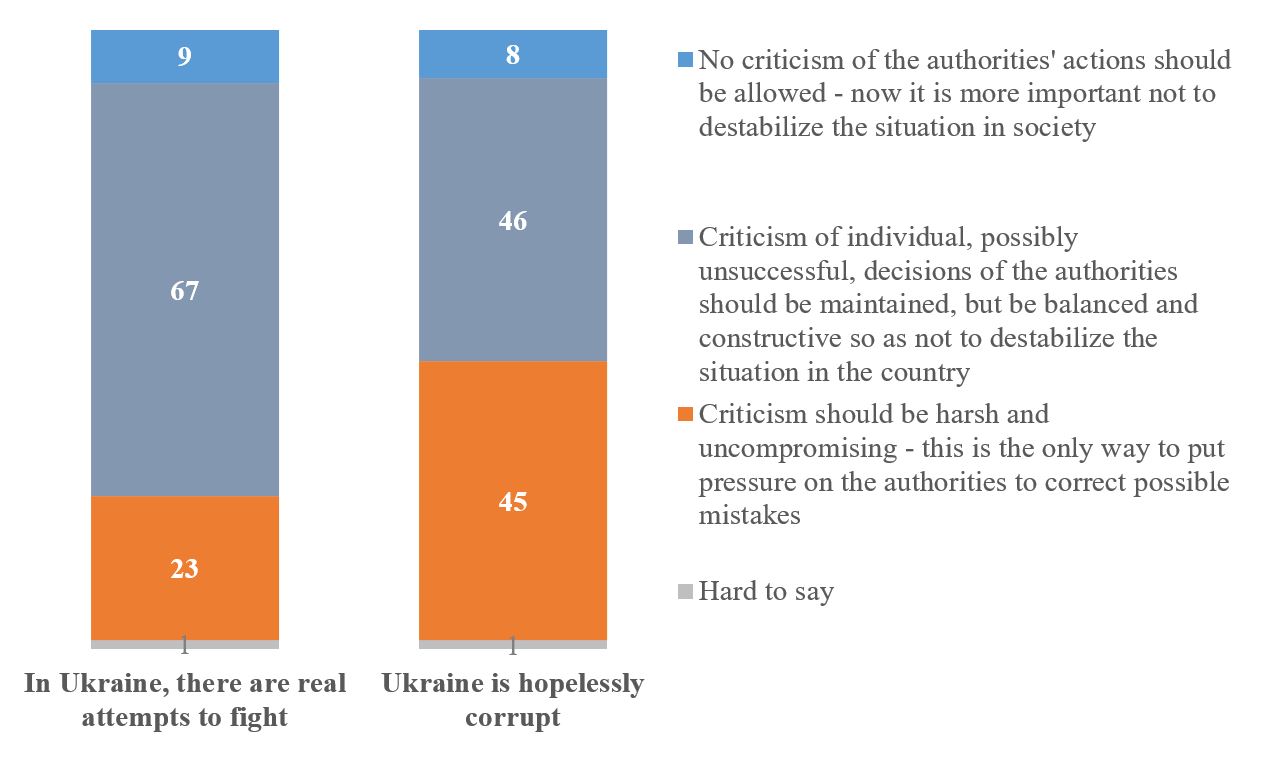
The graph below shows how those who are optimistic/pessimistic about the fight against corruption in Ukraine feel about criticism of the government. Among those who consider Ukraine hopelessly corrupt, there are more who insist on uncompromising criticism, but even among them, only about half (45%) are of this opinion. At the same time, 54% of those who consider Ukraine hopelessly corrupt are in favor of constructive criticism or against criticism at all.
Graph 3. Feasibility of criticizing the authorities in terms of how Ukrainians perceive the fight against corruption
Attitude towards territorial losses depending on perceptions of the fight against corruption and attitude towards criticism of the authorities
In this survey, we also asked question about Ukrainians' readiness for territorial losses to end the war[2]. The table below shows how those who have different perceptions of the fight against corruption and those who have different attitudes towards the appropriateness of criticizing the authorities relate to territorial losses. As can be seen, those who consider Ukraine hopelessly corrupt are more ready to accept territorial losses. In particular, 34% of them are ready for official recognition of certain territories as part of Russia (versus 22% among those who see attempts to combat corruption), and 25% are even ready to transfer territories currently under Ukrainian control to Russia (versus 15%). Although it should be emphasized that the majority of those who are critical of the fight against corruption are still against the most difficult demands in the context of territories (i.e., against official recognition or transfer of unoccupied territories under Russian control). In the context of attitudes towards criticism of the authorities, the trends are quite similar, although to a lesser extent. For example, those who advocate harsh and uncompromising criticism are somewhat more prepared for territorial losses. However, the majority of them are still against the most difficult territorial demands.
Table 1. Readiness for territorial concessions depending on the perception of the fight against corruption and attitude towards criticism of the authorities
A. Hrushetskyi, comments on the survey results:
Corruption and the responsibility of the authorities for overcoming it remain a very important and vexing issue for Ukrainian society. There are various opinions on this issue, but we suggest you read Yaroslav Hrytsak's publication "On Corruption, War and History"[3]. So, there is an offer in the publication "... stop talking about Ukraine as a very corrupt country, we should talk about Ukraine as a country that is fighting corruption". As our results show, the narrative of a “hopelessly corrupt Ukraine” is associated with a higher share of those who are ready for any, even the most difficult, conditions to end the war. In our other publication in the near future, we will also show that those who believe in such a narrative are significantly less optimistic about the future of Ukraine. The spearhead of the information war is the enemy's dissemination of ideas about mass evasion of service and total corruption (because this reduces the population's motivation to join the army and reduces support for Ukraine among donor countries). And this adds to the perception of Ukraine as totally corrupt. That is, the spread and entrenchment of such a narrative among the Ukrainian public seriously undermines national security. It is very convenient (and, of course, there are reasons for this) to shift the blame to the authorities and place all responsibility on them: since there are no outstanding successes in the fight against corruption in a short period of time - from the point of view of the average citizen - then the prevalence of such a narrative is exclusively the result of the ineffective actions of the authorities. However, this would be a populist and irresponsible approach, since long-term institution-building and a long-term strategy for reducing corruption are the business of the whole society - from officials in government offices to ordinary citizens. A special responsibility lies with the media community and “profile” public activists, who with their revelations and investigations emotionally stir up the already psychologically tired Ukrainian public. As our results show, the majority of Ukrainians support constructive criticism of the authorities. This is quite compatible with promoting a more optimistic narrative about corruption (“Ukraine is a country that fights corruption”), so for the common good it would be great if the next sensational revelations and investigations followed this approach.
Annex 1. Formulation of questions from the questionnaire
Some people believe that during a war, one should not criticize the actions of the authorities so as not to destabilize the situation. Others believe that it is important to maintain the opportunity to criticize so that possible mistakes can be corrected and taken into account for the future. And with which of these opinions do you agree to a greater extent?
The media regularly reported on corruption investigations, detentions, arrests, etc. For you personally, this is more of an indication that … RANDOMIZATION OF THE ORDER
[1] Perceptions of changes in the level of corruption in Ukraine during the full-scale invasion // https://kiis.com.ua/?lang=ukr&cat=reports&id=1556&page=1 [2] Dynamics of readiness for territorial concessions and the role of the interpretation of "territorial concessions" [3] Yaroslav Hrytsak. On corruption, war and history // https://nv.ua/ukr/opinion/istorik-gricak-rozpoviv-pravdu-pro-korupciyu-v-ukrajini-50541035.html [4] The composition of the macroregions is as follows: Western macroregion - Volyn, Rivne, Lviv, Ivano-Frankivsk, Ternopil, Zakarpattia, Khmelnytskyi, Chernivtsi oblasts; Central macroregion - Vinnytsia, Zhytomyr, Sumy, Chernihiv, Poltava, Kirovohrad, Cherkasy, Kyiv oblasts, Kyiv city, Southern macroregion - Dnipropetrovsk, Zaporizhzhia, Mykolaiv, Kherson, Odesa oblast, Eastern macroregion - Donetsk, Luhansk and Kharkiv oblasts.
17.10.2025
|
|||||||||||||||||||||||||||||||||||||||||||||||||||||||||||||||||||||||||||||||||||||||||||||||||||||||||||||||||||||||||||||||||||||||||||||||||||||||||||
Our social media:
 KIIS page
 KIIS channel