

ESC or click to close
|
Press releases and reports
Public opinion in the context of Russia's attempts to plunge Ukraine into darkness and cold: results of a survey conducted on January 23-29, 2026
The press release was prepared by Anton Hrushetskyi,executive director of KIIS
During January 23-29, 2026, the Kyiv International Institute of Sociology (KIIS) conducted its own all-Ukrainian public opinion survey, which, among other things, included questions related to war and peace. By the method of telephone interviews (computer-assistedtelephoneinterviews, CATI) based on a random sample of mobile phone numbers (with random generation of phone numbers and subsequent statistical weighting) in all regions of Ukraine (the territory controlled by the Government of Ukraine), 1,003 respondents were surveyed. The survey was conducted with adult (aged 18 and older) citizens of Ukraine who, at the time of the survey, lived in the territory of Ukraine controlled by the Government of Ukraine. The sample did not include residents of territories temporarily not controlled by the Ukrainian authorities (at the same time, some of the respondents are IDPs who moved from the occupied territories), and the survey was not conducted with citizens who left abroad after February 24, 2022. Formally, under normal circumstances, the statistical error of such a sample (with a probability of 0.95 and taking into account the design effect of 1.3) did not exceed 4.1%. At the same time, for the question about the attitude towards the transfer of Donbass to Russian control in exchange for security guarantees, an experiment was conducted, where half of the respondents (i.e. about 500) were asked a regular direct question (how acceptable it is for the respondent), and the other half were asked using the “imagined acquaintance” method. Therefore, for this question, the error does not exceed 5.8%. Under conditions of war, in addition to the specified formal error, a certain systematic deviation is added. Factors that may affect the quality of results in "wartime" conditions were previously cited by KIIS. In general, we believe that the obtained results are still highly representative and allow a fairly reliable analysis of the public moods of the population.
Main results:
Attitude towards the transfer of the entire Donbas under Russian control in exchange for security guarantees from the USA and Europe
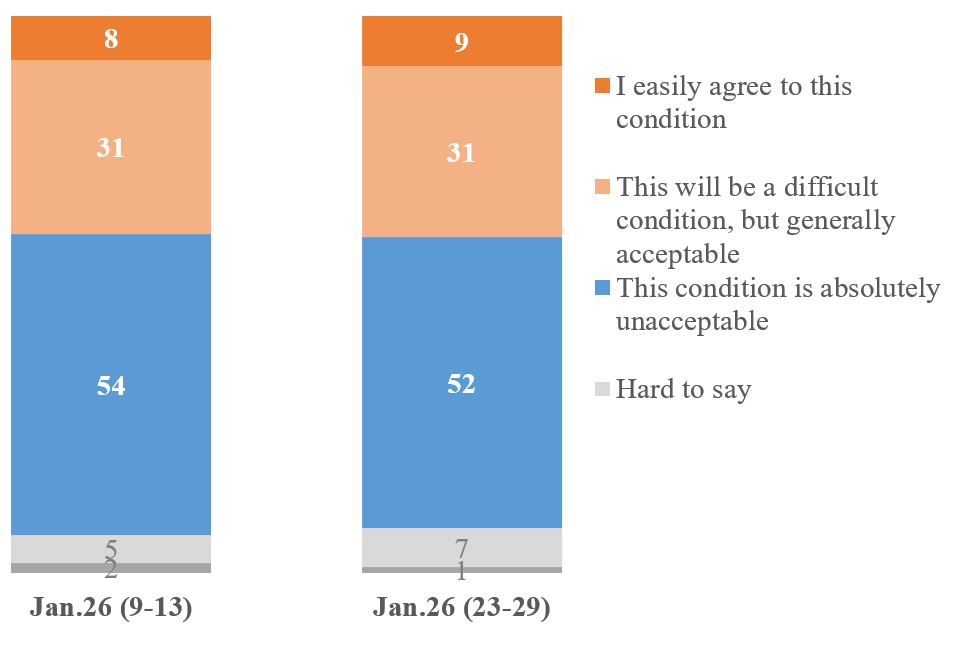
Since late 2025, much of the discussion around potential peace agreements has focused on the territories controlled by Ukraine in the Donetsk oblast. In particular, a proposal to transfer the entire Donbas to Russia in exchange for security guarantees from Europe and the USA has been discussed. Therefore, in mid-January 2026, we first asked about such a proposal (Russia – gaining control over the entire Donbas, Ukraine – gaining security guarantees from Europe and the USA)[1]. Now, at the end of January 2026, we have re-asked this question to understand how the difficult situation in the country due to the consequences of Russian attacks on the energy sector could affect the attitude towards such a proposal. We asked half of the respondents a direct question about their attitude to the proposal to transfer control of Donbas to Russia in exchange for security guarantees. At the same time, we also conducted an experiment and asked the other half of the respondents a question using the “imagined acquaintance” method. We wanted to assess the sincerity of the respondents’ answers, taking into account the sensitivity of the question. The results for the direct question are presented below (graph 1), and then (graph 2) the results of the experiment. So, 52% of respondents personally consider it categorically unacceptable to transfer the entire Donbas under Russian control in exchange for security guarantees. At the same time, 40% are ready for such a concession (although most of them admit that this is a difficult condition). Another 7% could not decide on their opinion. In mid-January 2026, the indicators were almost identical (the difference is within the margin of error), meaning that during the last 2 weeks of January, despite large-scale shelling and problems with electricity and heat supply, support for such a demand for peace did not increase. It should be noted separately that among Kyiv residents, 59% consider such a condition to be categorically unacceptable. 31% are ready to accept it. That is, despite the difficult situation in the capital, the majority reject it. If to talk about other regions, in the West 57% categorically reject and 38% are ready to accept, in the Center / North (excluding Kyiv) – 49% and 42%, in the South – 49% and 44%, in the East – 50% and 39%.
Graph 1. “Now I will read a possible condition for achieving peace, and you tell me how acceptable it is to you. Use the scale “I easily agree with this condition”, “This will be a difficult condition, but generally acceptable”, “This condition is absolutely unacceptable”. Ukraine withdraws its troops from the territories of Donbas that it currently controls, i.e. from Kramatorsk, Sloviansk, etc., and these territories pass under Russian control. In return, the USA and Europe give Ukraine security guarantees
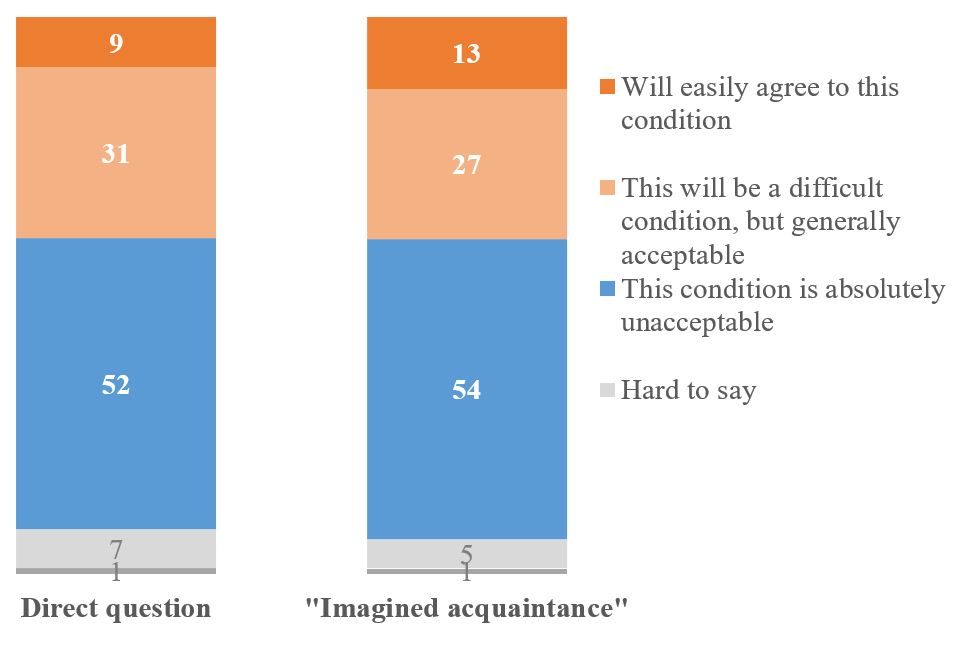
The graph below compares the results when the question is asked directly and when it is asked using the “imagined acquaintance” method. For the “imagined acquaintance” method, respondents were asked the question “Now there will be a slightly unusual question. Please think of someone you know really well. It could be yourself. Or a family member, a work colleague, a friend, etc. We won’t know this in any case. Have you thought? I will read a possible condition for achieving peace, and you tell how acceptable it is to the person you have in mind. Use the scale “This person will easily agree to this condition”, “For this person it will be a difficult condition, but I think it is generally acceptable, ready to agree”, “This condition will be absolutely unacceptable to this person, this person will categorically reject it”.” Our previous experiments showed that this question provides respondents with anonymity (respondents often thought of themselves or people very similar in views) and ensures sincerity of answers even on questions to which a sincere answer may indicate illegal activity (in particular, we have successfully studied the shadow economy). As can be seen, the results obtained by the “imagined acquaintance” method are practically the same (in fact, the differences are within the margin of error). Thus, 54% claim that the “imagined person” categorically rejects such a requirement (compared to 52% if the respondent is directly asked for his or her opinion). This gives us reason to cautiously assume that although social approval of issues of war and peace may retain its influence, in general we get correct trends. That is, respondents are quite sincerely answering the question, and if we really see that many Ukrainians categorically reject such a proposal, this really corresponds to public moods.
Graph 2. Attitudes to the condition of transferring Donbas under Russian control in exchange for security guarantees: direct question and question using the “imagined acquaintance” method
When will the war end and how long Ukrainians are still ready to endure the war
Our other focus is the expectation of when the war might end (which also reflects the attitude towards the current negotiations and expectations of their effectiveness), and the self-assessment of the population's resilience (which is particularly important in difficult weather conditions against the backdrop of significant destruction by Russia of the Ukrainian energy sector). Only 20% of Ukrainians expect the war to end in the coming weeks or at least in the first half of 2026. Instead, 18% expect completion in the second half of 2026, 43% in 2027 or later, and 19% answered “hard to say.”. At the same time, in September-October 2025, 33% expected that the war could end no later than the first half of 2026, in December 2025, this number was already 26%. Now it is 20%, that is, fewer and fewer people expect it to end by mid-2026.
Graph 3. In your opinion, when might the war end?
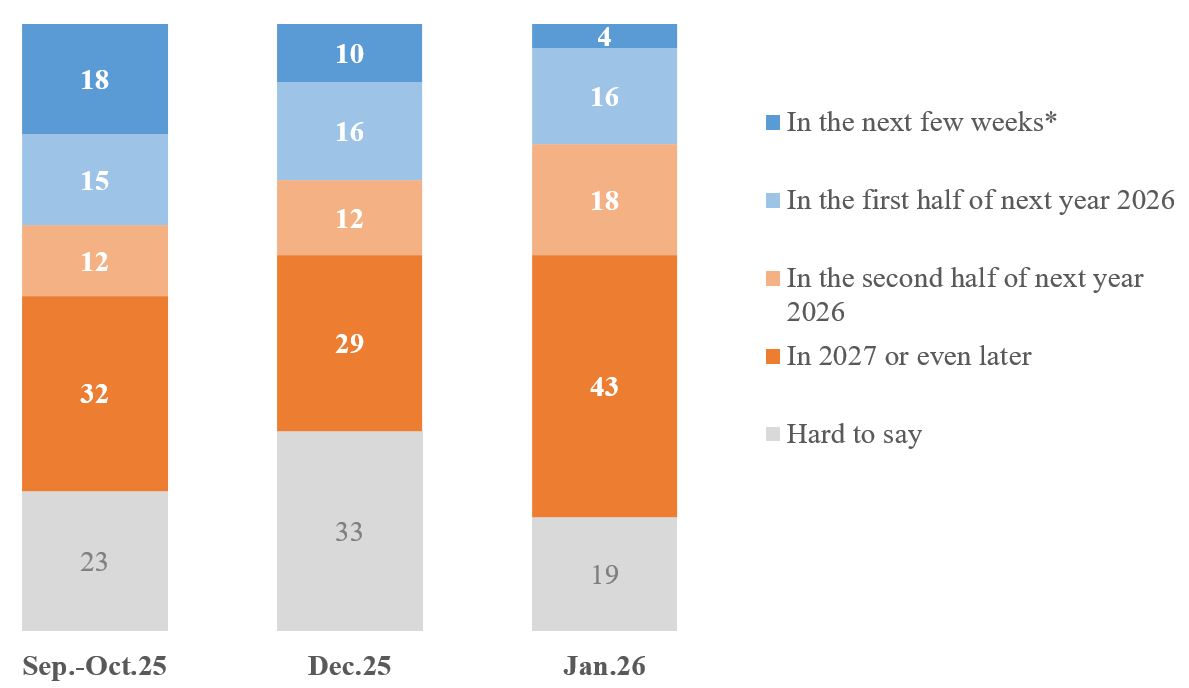
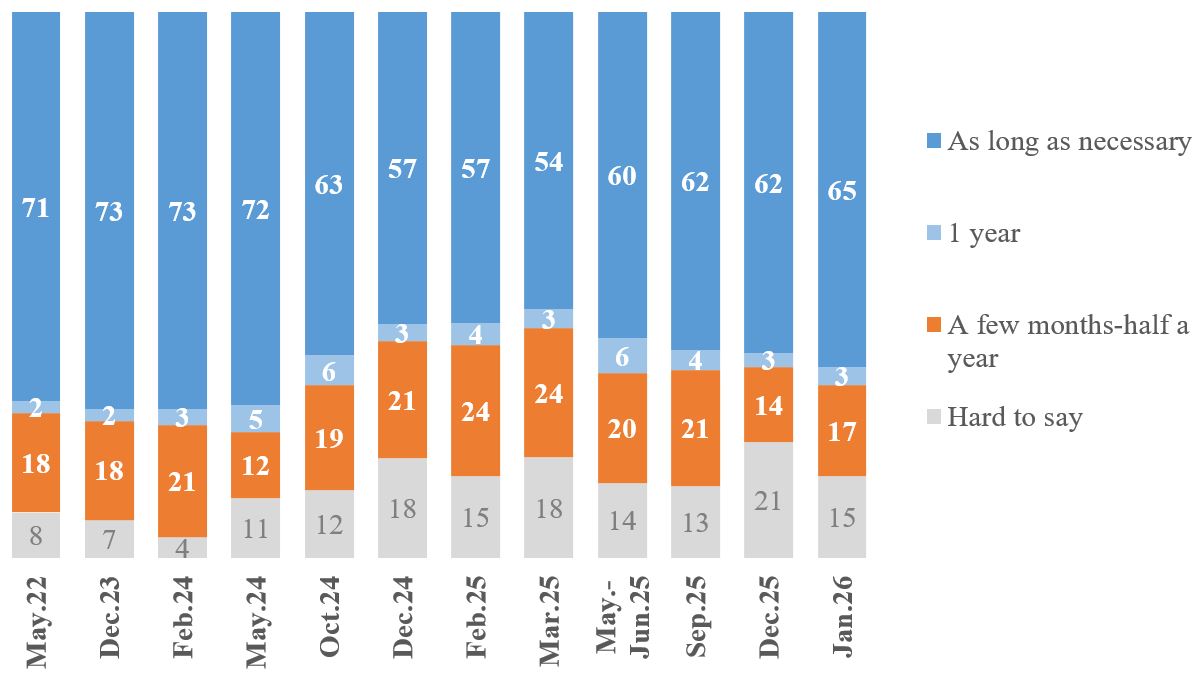
* In September-October and December 2025, the wording was “By the end of 2025 or early 2026” At the same time the majority of Ukrainians (65%) continue to say that they are ready to endure the war as long as necessary. 17% of respondents say about a shorter period (six months or several months). In December 2025, 62% were ready to endure as long as necessary, and in September 2025, 62%. That is, we are currently not observing any significant changes in public moods. Despite Russia's large-scale attempts to create a humanitarian catastrophe, the same majority of Ukrainians are still determined to continue the resistance until an acceptable outcome is achieved. At the same time, in all regions, the majority – 58-72% – are ready to endure war as long as necessary. In particular, in Kyiv, this number is 72%. If to talk about other regions, then in the West – 66%, in the Center / North (excluding Kyiv) – 64%, in the South – 64%, in the East – 58%.
Graph 4. How much longer are you ready to endure war?
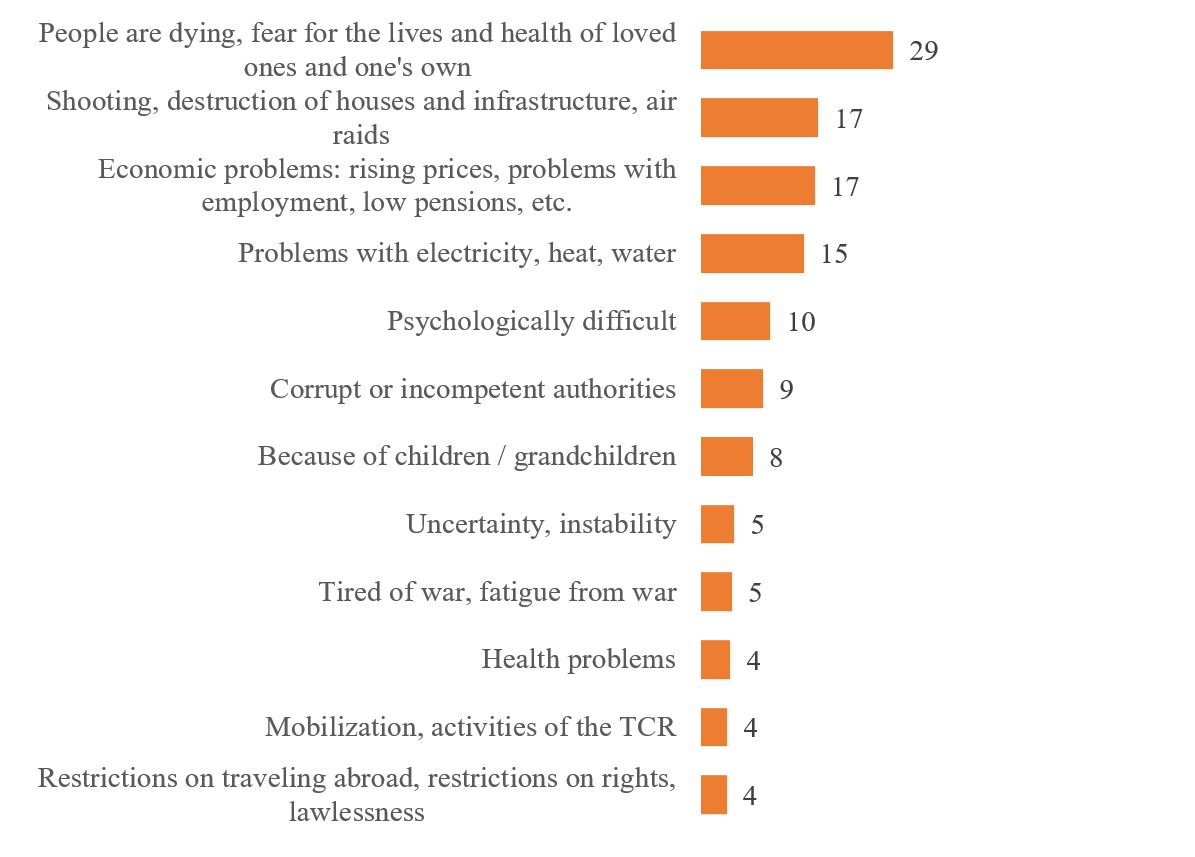
We asked respondents who did not answer that they were ready to endure as long as necessary an additional open question about why they answered that way. Most often, respondents talked about people dying / fear for the life and health of loved ones (29%), about shelling and destruction (17%), about economic hardship (17%), about problems with electricity / heat supply (15%), about psychological difficulties (10%). At the same time, we note that in terms of the entire adult population, only 5% responded that they were not ready to endure the war as long as necessary, and attributed this to problems with electricity and/or heat supply.
Graph 5. And due to what circumstances or reasons are you not ready to endure the war as long as necessary? What is the most difficult thing for you to endure right now? Open question, top answers, % among those who did not answer that are ready to endure as long as necessary
Russian shelling of Ukrainian energy sector and experience of relocation due to problems with electricity and heat supply
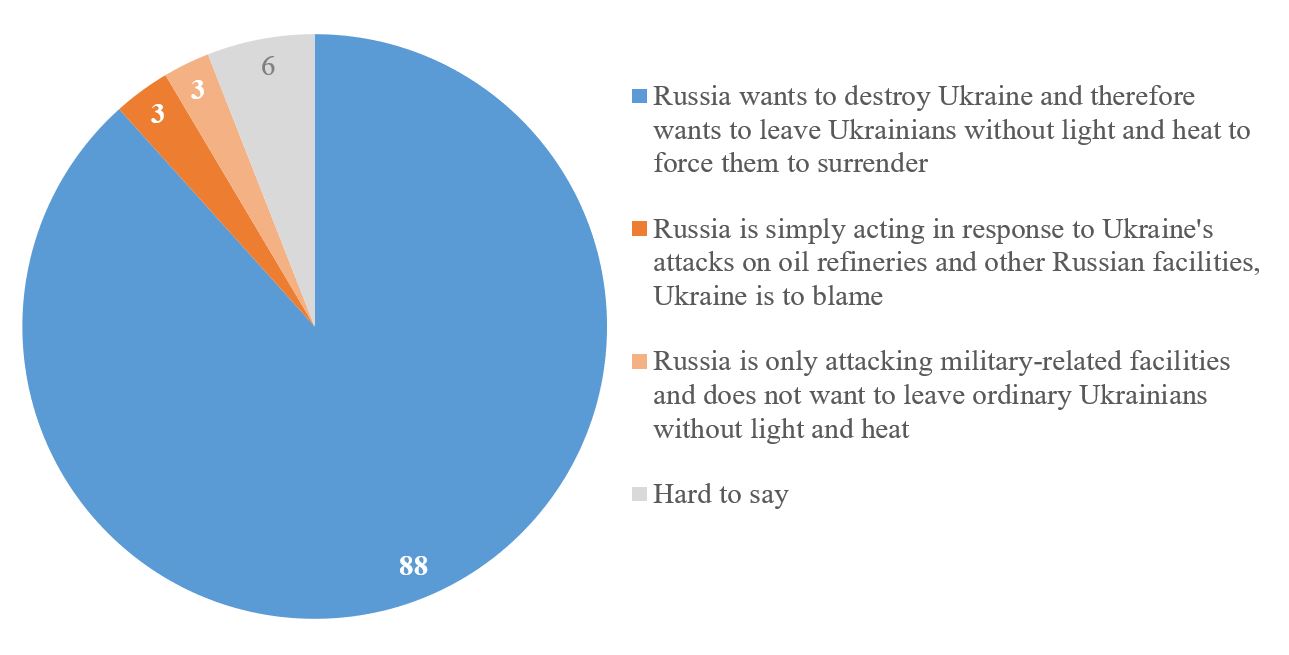
In December 2025, a KIIS survey showed that 54% of Ukrainians primarily blame the lack of electricity on Russian shelling[2]. However, 31% primarily blamed the Ukrainian authorities. Now we decided to ask why, in the opinion of the respondents, Russia is shelling the Ukrainian energy sector at all. Respondents were offered three options, in particular, two of them conditionally describe pro-Russian interpretations - supposedly these are strikes in response to strikes by Ukraine, that is, Ukraine itself is to blame, or Russia is supposedly attacking only military facilities. The absolute majority of Ukrainians – 88% – believe that with these strikes Russia is trying to leave Ukrainians without light and heat and force them to surrender. At the same time, they believe that Russia is only striking back and that Ukraine itself is to blame – 3%. The same number (3%) believe that Russia is only attacking military facilities.
Graph 6. Which point of view regarding Russia's attacks on Ukrainian energy do you agree with to a greater extent?
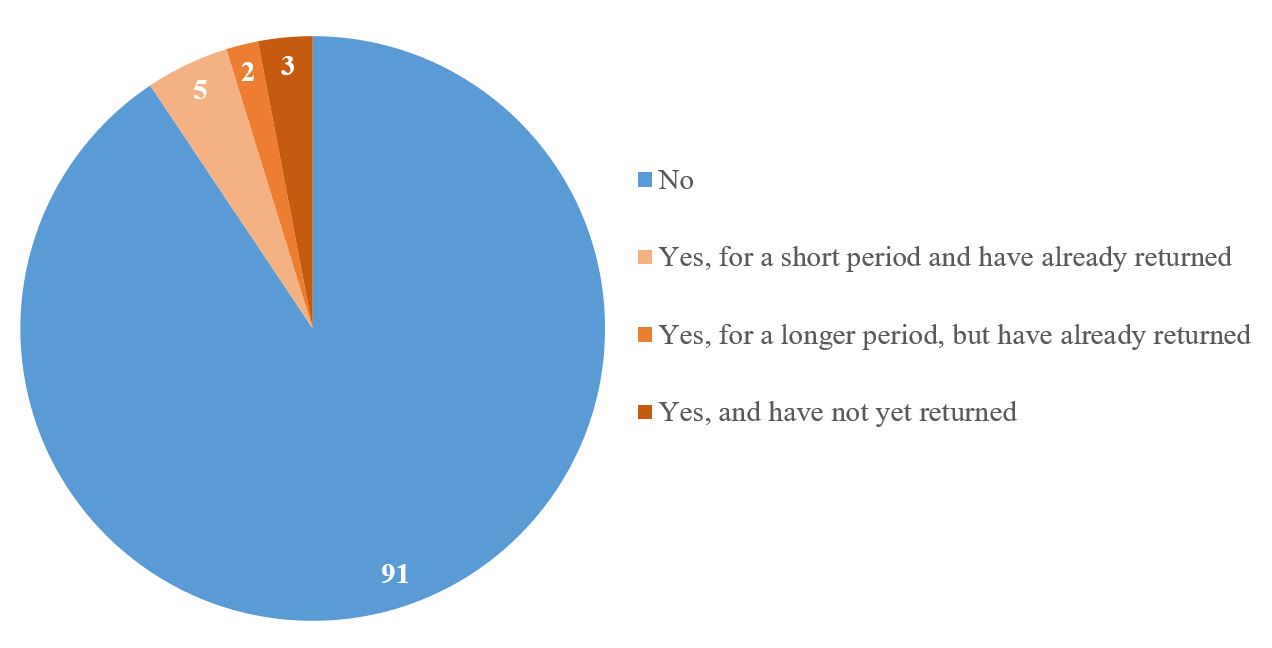
 We also asked whether respondents had moved to another settlement or dwelling due to problems with heating or electricity. Thus, 9% of Ukrainians in the period from autumn 2025 had experience of moving to another settlement or dwelling (if they are counted as 100%, then 66% moved to another settlement in Ukraine, 31% - to another dwelling in the same settlement, and 3% - abroad). At the same time, 6% of these 9% have already returned home. Among the remaining 3%, 1% have moved and now live in another settlement, and 2% in another dwelling in the same settlement. Separately, we note that among the civilian residents of Kyiv (who lived there until autumn of 2025), 3% moved and did not return to their homes. Of these, 2% live in another home in Kyiv, and the remaining 1% moved to another settlement. At the same time, it should be noted that these calculations apply only to adult citizens (i.e., they do not take into account possible moves of children), as well as only to those who are currently in Ukraine (i.e., we do not take into account those who could have left Ukraine due to these problems and moved abroad).
Graph 7. Since last autumn of 2025 until now, have you personally had to move to another home or settlement due to problems with heating or electricity?
Feasibility of Ukraine launching strikes against Russia
In February 2023, we asked the question of whether Ukraine should strike Russian territory or not, so as not to provoke an escalation. In January 2026, we asked this question again, but added a new option (we singled out strikes on military facilities and oil and gas infrastructure)[3]. Both in February 2023 and January 2026, 90% believe that Ukraine should strike at Russian territory. At the same time, the number of those who speak of strikes only on military targets has decreased from 38% to 10%. Instead now 80% believe that in addition to military targets, Ukraine should strike at other targets as well (growth of 52% compared to February 2023). So, 7% talk about military and oil and gas infrastructure, 48% add Russia's energy sector to this, and 25% generally believe that Ukraine should strike at the Russian population (an increase from 13% in February 2023).
Graph 8. Some Ukrainians believe that launching strikes on Russian territory leads to an escalation of the war, others believe that it is necessary to do so. What is your point of view?
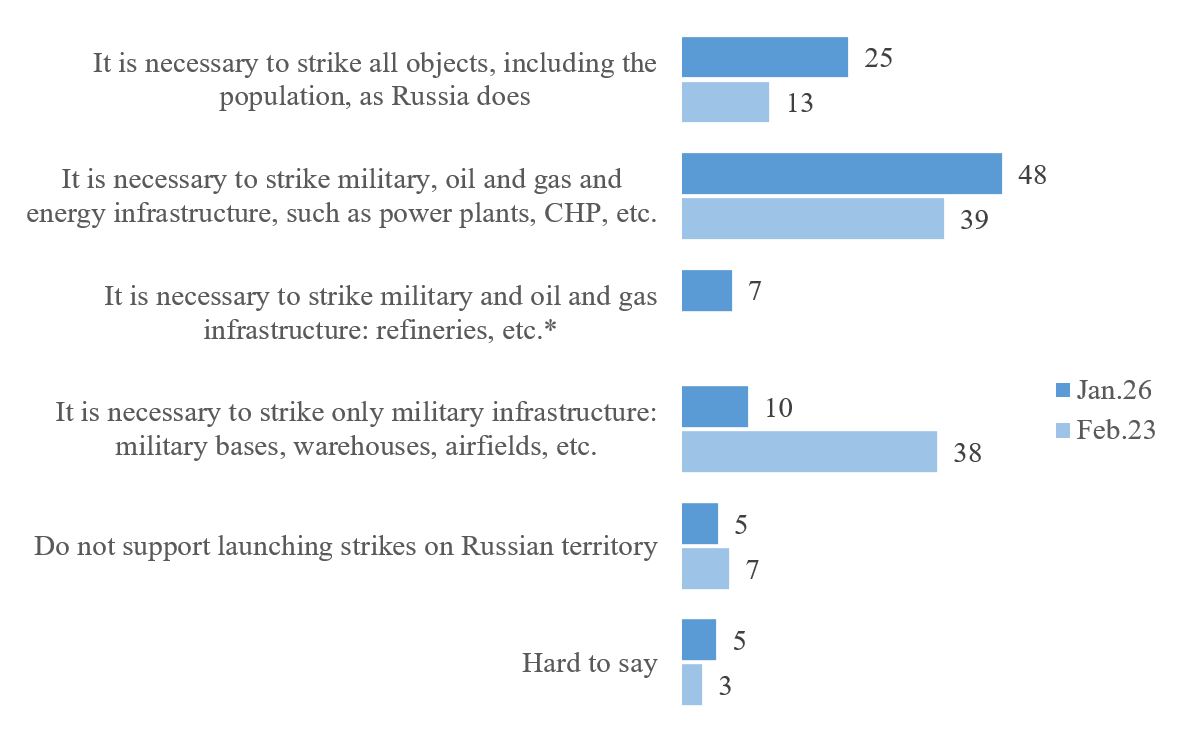 * New option, was not in the February 2025 survey.
Optimism about Ukraine's future
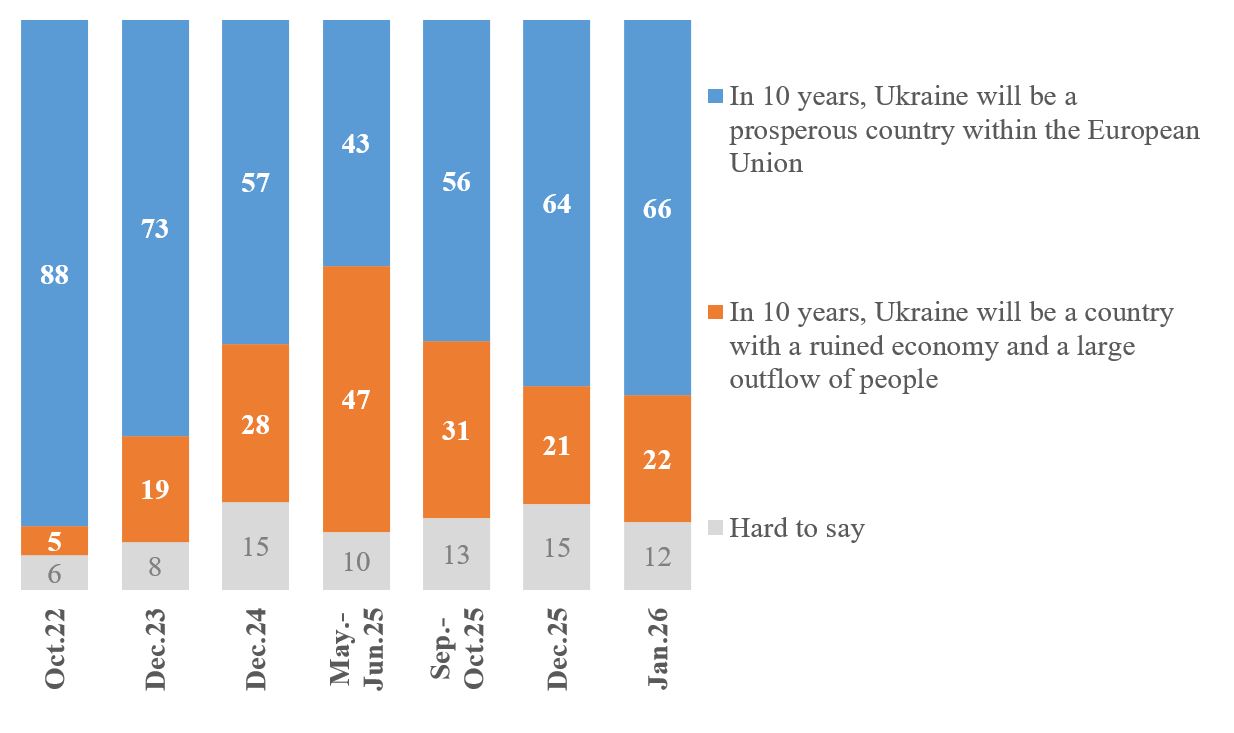
Despite the difficult winter and terrorist actions by Russia, at the end of January 2026, 66% of respondents were optimistic and believed that in 10 years Ukraine would be a prosperous EU member state. Were pessimistic about the future – 22%. At the same time, compared to December 2025, there were almost no changes, that is, despite the difficult circumstances, we do not observe an increase in pessimism among the population.
Graph 9. How do you see the future of Ukraine in 10 years?
A. Hrushetskyi, comments on the survey results:
As of late January 2026, the Russian campaign of large-scale strikes on Ukrainian energy and efforts to plunge the population into darkness and cold have not had a significant impact on public moods. We do not observe an increase in support for “peace on any terms” (in particular, we do not observe it in the capital, which was a particular target of strikes in January). On the contrary, we see that the will to continue the resistance remains among the majority of the population, and the majority also supports launching strikes on Russia. Until February 24, 2022, it seemed impossible to many Ukrainians that Ukraine could effectively resist the “second army of the world.” However, February and March 2022 convincingly proved to the whole world and to Ukrainians themselves that even the formidable Russian army can be stopped and inflicted painful defeats on the battlefield. In the autumn of 2022, many could not imagine how it would be possible to live in conditions of no electricity. However, ordinary Ukrainians and businesses survived and demonstrated high adaptability. By the beginning of 2025, many could not imagine that Ukraine would be able to fight without full support from the USA – but Ukrainians were able to do it again. The severe winter of 2025-2026 is another challenge for Ukraine and Ukrainians – will Ukrainians be able to withstand prolonged severe frosts with power and heat supply shutdowns? At the time of writing, most of the winter (and one would hope – the main frosts) is behind them. Ukrainians are once again demonstrating that they are able to survive in the most difficult conditions. And not just survive, but also maintain optimism and will.
Appendix 1. Formulation of questions from the questionnaire
Since last autumn of 2025 until now, have you personally had to move to another home or settlement due to problems with heating or electricity? READ. WE ARE ASKING ABOUT MOVING ONLY FOR HEATING / ELECTRICITY REASONS (IF ANY OTHER REASONS – MARK “NO”)
D9. IF 2-4: You moved …
How do you see the future of Ukraine in 10 years? READ. RANDOMIZATION OF ORDER
In your opinion, when might the war end? READ
How much longer are you ready to endure war? READ
IF А3=1-3 OR 5: And due to what circumstances or reasons are you not ready to endure the war as long as necessary? What is the most difficult thing for you to endure right now? WRITE THE FULL ANSWER
_____________________________________________________________________________
HALF OF RESPONDENTS – OPTION 1. HALF – OPTION 2
OPTION 1. Now I will read a possible condition for achieving peace, and you tell me how acceptable it is to you. Use the scale “I easily agree with this condition”, “This will be a difficult condition, but generally acceptable”, “This condition is absolutely unacceptable”.
OPTION 2. Now there will be a slightly unusual question. Please think of someone you know really well. It could be yourself. Or a family member, a work colleague, a friend, etc. We won’t know this in any case. Have you thought? SEPARATE SCREEN WITH BUTTON “YES”.
AFTER “YES” (TRANSFER TO NEXT SCREEN): I will read a possible condition for achieving peace, and you tell how acceptable it is to the person you have in mind. Use the scale “This person will easily agree to this condition”, “For this person it will be a difficult condition, but I think it is generally acceptable, ready to agree”, “This condition will be absolutely unacceptable to this person, this person will categorically reject it”.
RANDOMIZATION OF THE ORDER OF NEXT TWO QUESTIONS
Some Ukrainians believe that launching strikeson Russian territory leads to an escalation of the war, while others believe that it is necessary to do. What is your point of view? READ
Which point of view regarding Russia's attacks on Ukrainian energy do you agree with to a greater extent? RANDOMIZATION OF THE ORDER
[1] War and peace: thoughts and views of Ukrainians (results of a survey conducted on January 9-14, 2026) // https://kiis.com.ua/?lang=ukr&cat=reports&id=1579&page=1 [2] Opinions and views of Ukrainians on issues of war and peace: December 2025 // https://www.kiis.com.ua/?lang=ukr&cat=reports&id=1572&page=1 [3] Attitudes towards Ukraine's launch of strikes on the territory of Russia // https://kiis.com.ua/?lang=rus&cat=reports&id=1194&page=1
2.2.2026
|
Our social media:
 KIIS page
 KIIS channel