

ESC or click to close
|
Press releases and reports
Perception of negotiations and attitude to the offer to exchange Donbas for security guarantees: results of a survey conducted on February 12-24, 2026
The press release was prepared by Anton Hrushetskyi, executive director of KIIS
During February 12-24, 2026, the Kyiv International Institute of Sociology (KIIS) conducted its own all-Ukrainian public opinion survey "Omnibus", to which, on its own initiative, added questions about peace negotiations and the proposal to withdraw Ukrainian troops from Donbas in exchange for security guarantees from the West. By the method of telephone interviews (computer-assistedtelephoneinterviews, CATI) based on a random sample of mobile phone numbers (with random generation of phone numbers and subsequent statistical weighting) in all regions of Ukraine (the territory controlled by the Government of Ukraine), 2004 respondents were surveyed. The survey was conducted with adult (aged 18 and older) citizens of Ukraine who, at the time of the survey, lived in the territory of Ukraine controlled by the Government of Ukraine. The sample did not include residents of territories temporarily not controlled by the Ukrainian authorities (at the same time, some of the respondents are IDPs who moved from the occupied territories), and the survey was not conducted with citizens who left abroad after February 24, 2022. During the survey, half of the respondents (1,003 respondents) were asked the usual monitoring questions that KIIS had asked earlier in January 2026. The other half of the respondents (1,001 respondents) were asked the question about Donbas and security guarantees in a different wording. Formally, under normal circumstances, the statistical error of a sample of about 1,000 respondents (with a probability of 0.95 and taking into account the design effect of 1.3) did not exceed 4.1%. Under conditions of war, in addition to the specified formal error, a certain systematic deviation is added. Factors that may affect the quality of results in "wartime" conditions were previously cited by KIIS. In general, we believe that the obtained results are still highly representative and allow a fairly reliable analysis of the public moods of the population.
Do Ukrainians believe that the current negotiations will lead to a lasting peace
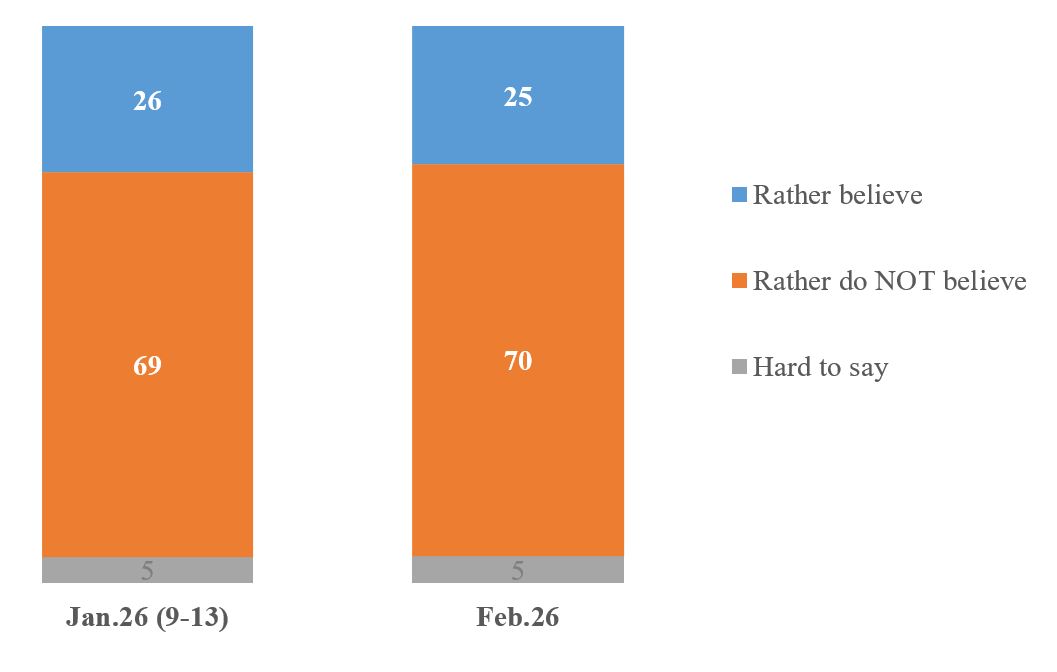
The vast majority of Ukrainians – 70% – do not believe that the current negotiations will lead to lasting peace in Ukraine. Believe – 25%. The remaining 5% were undecided. There have been no changes on this issue since mid-January 2026. It is worth recalling that in January 2026 we asked an additional open question why Ukrainians do not believe in the success of the negotiations – and primarily the respondents explained this by Russia and its position[1].
Graph 1. Do you believe or not that the current negotiations will lead to lasting peace in Ukraine?
Attitude towards the transfer of the entire Donbas under Russian control in exchange for security guarantees from the USA and Europe
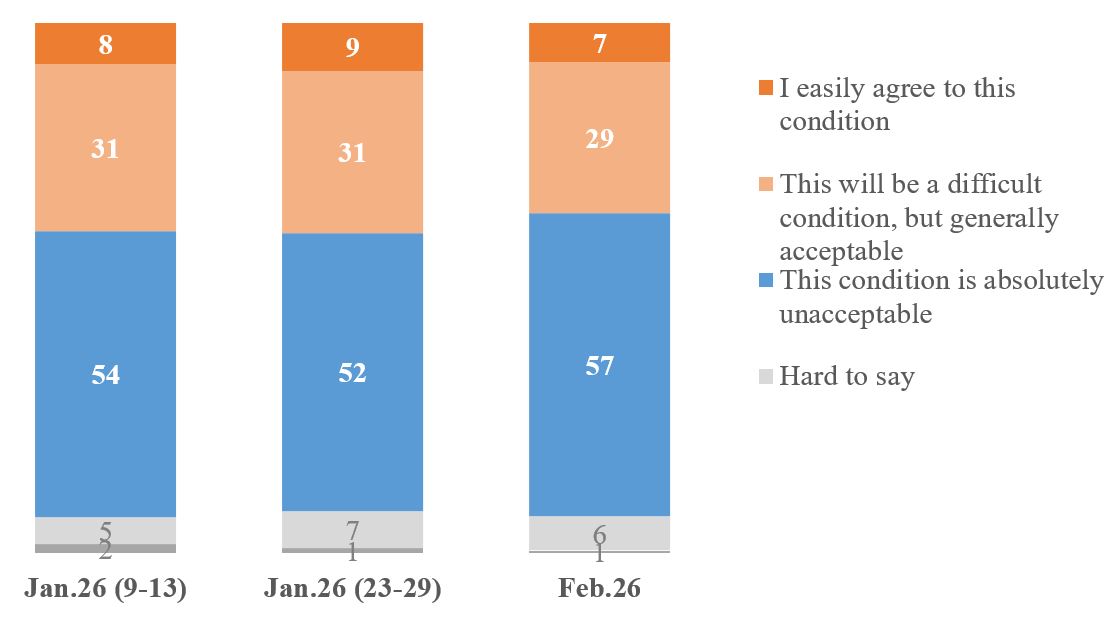
In mid-January 2026, KIIS first asked a question about the withdrawal of Ukrainian troops from Donbas (and the transition to Russian control) in exchange for security guarantees from the USA and Europe. We asked the question again in late January 2026 and again in mid-February 2026. The results are shown in the graph below. Currently, 57% of Ukrainians categorically reject the withdrawal of Ukrainian troops from Donbas in exchange for security guarantees from the USA and Europe. Overall, 36% are ready (although mostly reluctantly). The remaining 7% could not decide or refused to answer. At the end of January 2026, 52% were categorically against and 40% were generally ready to support such a proposal, in mid-January 2026, 54% and 38%, respectively. That is, overall, there have been no significant changes in public moods over the past month, in particular, we do not observe an increase in readiness to agree to such an offer (which was most likely one of the goals of the Russian terror campaign during the cold winter). On the contrary, if to analyze the balance of responses (% of those who strongly oppose minus % of those who generally agree), then in mid-February it is better than in January (+21% now vs. +12% at the end of January and +15% in mid-January). We would like to separately note that in this question we did not say anything about the official recognition of the territories of Donbas as part of Russia. Most likely, if we had directly predicted that Ukraine would officially recognize this and permanently abandon the territories, the level of support for the proposal would have been lower.
Graph 2. Now I will read a possible condition for achieving peace, and you tell me how acceptable it is to you. Use the scale “I easily agree with this condition”, “This will be a difficult condition, but generally acceptable”, “This condition is absolutely unacceptable”. Ukraine withdraws its troops from the territories of Donbas that it currently controls, i.e. from Kramatorsk, Sloviansk, etc., and these territories pass under Russian control. In return, the USA and Europe give Ukraine security guarantees
Attitude towards the transfer of the entire Donbas under Russian control in exchange for security guarantees from the USA and Europe – clarification of the procedure and format of security guarantees from the USA
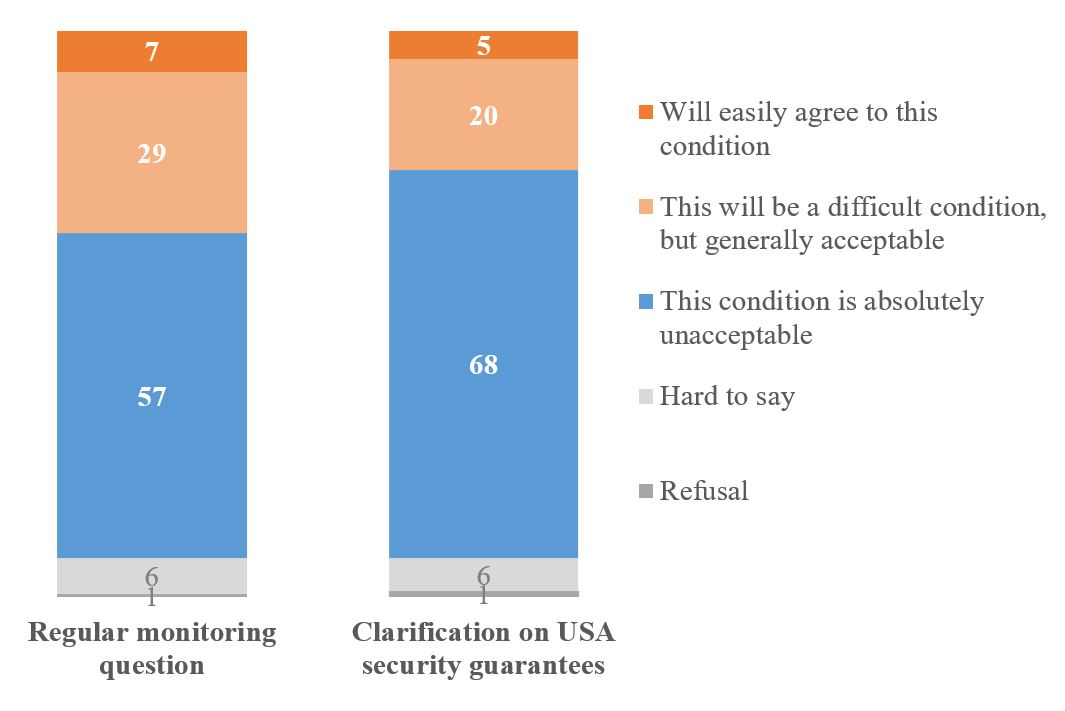
In mid-January 2026, KIIS asked respondents who generally agreed with the proposal an additional open-ended question about what security guarantees they expected at that time. As can be seen, a significant portion of respondents did indeed expect substantial security guarantees[2]. At the same time, fragmentary information about the possible format of security guarantees from the USA began to appear in the media. Therefore, in February 2026, we conducted an experiment and asked the other half of the sample (which was not asked the question in the formulation discussed above) a slightly different question, namely: "Ukraine withdraws its troops from the territories of Donbas that it currently controls, that is, from Kramatorsk, Sloviansk, etc., and these territories are coming under the control of Russia. And after Ukraine withdraws its troops from Donbas, the USA promises to provide security guarantees. At the same time, the USA will not station its troops in Ukraine, will not close the sky, and will not give Ukraine weapons for free.". That is, in the second question, first, we indicated the order of actions (Ukraine first withdraws troops, then supposedly there must be security guarantees from the USA). Second, we added clarifications regarding security guarantees from the USA. According to fragmentary information in the media, the USA does not plan to station its troops in Ukraine, close the sky or provide weapons for free. This information was voiced to respondents. So, if respondents are given information about the procedure and format of security guarantees from the USA, their readiness to approve the agreement drops from 36% to 25%. On the other hand, the number of those who categorically reject such a proposal increases from 57% to 68%.
Graph 3. Attitudes to the condition of transferring Donbas under Russian control in exchange for security guarantees: a regular monitoring question vs. a question with clarifying security guarantees from the USA
 Attitudes towards the transfer of the entire Donbas under Russian control in exchange for security guarantees from the USA and Europe – results in terms of socio-demographic categories
The table below shows the results (for both questions) broken down by socio-demographic categories. We suggest paying attention to the regional and age dimensions. In the case of both questions, there is a tendency that from the West to the East there are more people who are ready to exchange Donbas for security guarantees. Thus, in the case of a regular monitoring question, the share of those who categorically reject the offer decreases from 60% in the West and 62% in Kyiv to 45% in the East. At the same time, only in the East (this is Kharkiv (mainly) and Donetsk oblasts) is there conditional parity - 45% categorically reject and 44% are ready to accept. In other regions, there are more opponents of such an offer. In the case of a question with information about the procedure and format of security guarantees from the USA, the share of those who categorically reject it decreases from 74% in the West and 79% in Kyiv to 54% in the East. At the same time, in almost all regions, if the procedure and format of guarantees from the USA are clarified, there will be significantly more opponents of the proposal. In particular, in the East, 54% categorically reject such a proposal, and 38% are ready to accept it. That is, there is no parity in this format. The only region where, regardless of the wording, the situation almost does not change is the Lower Dnieper region (Dnipropetrovsk and Zaporizhzhia oblasts). In both formulations, 56% categorically reject the proposals. In terms of age categories, we see a similar situation – so, regardless of the wording of the question, the younger the respondents, the more of them are ready to approve such a proposal. In particular, in the case of a regular monitoring question, 55% of 18-29 year olds are ready to approve such a proposal, 50% of 30-44 year olds, and then the indicator drops to 25% among 45+ year olds. However, again, if we specify the security guarantees from the USA, their support drops significantly. For those aged 45+, the differences are minimal, since support for even the proposal in its basic formulation (without specifying the security guarantees) is relatively low. But for respondents aged 18-44, the decrease is significant. For example, for those aged 18-29, the readiness to approve the proposal drops from 55% to 32%. Among those aged 30-44, there is a decrease from 50% to 27%..
Table 1. Attitudes towards the condition of transferring Donbas under Russian control in exchange for security guarantees in terms of socio-demographic categories
A. Hrushetskyi, comments on the survey results:
Ukrainians continue to be critical of the current peace negotiations and the majority do not have optimistic expectations for them. The practical realities in Ukraine – the Russian pressure on the front despite their massive losses, the Russian terror of the civilian population and attempts to freeze and leave without electricity in the cold winter, the uncompromising genocidal statements of the Russian leadership and more – leave little reason for Ukrainians to believe in the Russian desire to end the war in the near future. In particular, Ukrainians understand that if the Russians are ready to end the war, then only on terms that would be the actual surrender of Ukraine (and they will not accept anything else). At the same time, Ukrainians remain open to difficult compromises and are ready to discuss them – but not at the price of capitulation. In particular, on the issue of Donbas, we see that more than half reject such a proposal, and those who agree with it – put forward tough demands for security guarantees. And we see that if the role of the USA is openly reduced to a minimum (there will be not only no troops on the ground, which few people expect anyway, but also no closed skies and free provision of weapons), support for such a difficult territorial solution will significantly decrease. Currently, there is a crisis of confidence in the USA leadership in Ukraine (but not in American citizens), which makes Ukrainians more cynical in their perception of their promises regarding security guarantees. Obtaining public approval (even if very painful and reluctant) for difficult decisions is possible only under the condition of realistic security mechanisms for Ukraine, which will be an effective safeguard against a new Russian invasion. Plus convincing prospects for the reconstruction and development of Ukraine, in particular, through membership in the EU. Both components are important, as they should give a sense of security now and hope for a better socio-economic future further. But in any case, the only obstacle to peace is Russia. Until Ukraine's key partners begin to more clearly distinguish between aggressor and victim and put appropriate pressure on the aggressor itself, Russia will continue its campaign of impunity for killing and destruction.
Annex 1. Formulation of questions from the questionnaire
PER 1000 RESPONDENTS – SAMPLE A Do you believe or not that the current negotiations will lead to lasting peace in Ukraine? READ. ADD “OR” BETWEEN STATEMENTS. RANDOMIZATION OF ORDER
Now I will read a possible condition for achieving peace, and you tell me how acceptable it is to you. Use the scale “I easily agree with this condition”, “This will be a difficult condition, but generally acceptable”, “This condition is absolutely unacceptable”.
[1] War and peace: thoughts and views of Ukrainians (results of a survey conducted on January 9-14, 2026) // https://kiis.com.ua/?lang=ukr&cat=reports&id=1579&page=2 [2] War and peace: thoughts and views of Ukrainians (results of a survey conducted on January 9-14, 2026) // https://kiis.com.ua/?lang=ukr&cat=reports&id=1579&page=2 [3] The composition of the macroregions is as follows: West – Volyn, Rivne, Lviv, Ivano-Frankivsk, Ternopil, Zakarpattia, Khmelnytskyi, Chernivtsi oblasts; Kyiv city – only Kyiv city (without the oblast); Center / North – Vinnytsia, Zhytomyr, Kyiv, Kirovohrad, Poltava, Sumy, Cherkasy, Chernihiv oblasts; South – Mykolaiv, Odesa, Kherson oblasts; Lower Dnieper region – Dnipropetrovsk, Zaporizhzhia oblasts; East – Donetsk and Kharkiv oblasts (formally, the macroregion also includes the Luhansk oblast, but due to the almost complete occupation, none of the respondents currently live there, although there are respondents who lived in this oblast until 2022).
2.3.2026
|
||||||||||||||||||||||||||||||||||||||||||||||||||||||||||||||||||||||||||||||||||||||||||||||||||||||||||||||||||||||||||||||||||||||||||||||||||||||||||||||||||||||||||||||||||||||||||||||||||||||||||||||||||||||||||||||||||||||||||||||||||||||||||||||||||||||||||||||
Our social media:
 KIIS page
 KIIS channel