

ESC or click to close
|
Press releases and reports
The most serious problems and challenges facing Ukraine and Ukrainians: results of a survey conducted on February 12-24, 2026
The press release was prepared by Anton Hrushetsky,executive director of KIIS
During February 12-24, 2026, the Kyiv International Institute of Sociology (KIIS) conducted its own all-Ukrainian public opinion survey "Omnibus", to which, on its own initiative, added questions about the most serious problems and challenges that Ukraine and Ukrainians face. Bythemethodoftelephoneinterviews (computer-assistedtelephoneinterviews, CATI) based on a random sample of mobile phone numbers (with random generation of phone numbers and subsequent statistical weighting) in all regions of Ukraine (the territory controlled by the Government of Ukraine), 1,003 respondents were surveyed. The survey was conducted with adult (aged 18 and older) citizens of Ukraine who, at the time of the survey, lived in the territory of Ukraine controlled by the Government of Ukraine. The sample did not include residents of territories temporarily not controlled by the Ukrainian authorities (at the same time, some of the respondents are IDPs who moved from the occupied territories), and the survey was not conducted with citizens who left abroad after February 24, 2022. Formally, under normal circumstances, the statistical error of such a sample (with a probability of 0.95 and taking into account the design effect of 1.3) did not exceed 4.1% for indicators close to 50%, 3.5% for indicators close to 25%, 2.5% for indicators close to 10%, 1.8% for indicators close to 5%. Under conditions of war, in addition to the specified formal error, a certain systematic deviation is added. Factors that may affect the quality of results in "wartime" conditions were previously cited by KIIS. In general, we believe that the obtained results are still highly representative and allow a fairly reliable analysis of the public moods of the population.
The most serious problems and challenges facing Ukraine and Ukrainians
Sociologists regularly study the question of which problems or challenges Ukrainians consider the most serious. At the same time, one of the limitations when studying such question s is the formation of a relevant list of challenges that can be offered to respondents (and from which respondents can choose). In this survey, we made the questions completely open-ended – we did not form a list in advance, but listened to and recorded the respondents’ answers “in their own words”. The respondents’ answers were then coded and the results (top answers) can be seen below in Graph 1. In particular, we also provide information on which answers were mentioned first (top of mind). Typically, what was mentioned first is also the most important. So, the majority of respondents – 65% – include war among the top challenges. At the same time, 53% of them named this challenge as the first. However, this means that almost half of the respondents to this question primarily mentioned other problems/challenges, rather than the war (and a third of respondents did not talk about the war at all). Perhaps, during the 4 years of full-scale war, it became for many Ukrainians the “norm of life”, the “usual context”. Accordingly, Ukrainians think about other challenges that should be solved taking into account such a “context”. For example, many spoke about the energy situation. Respondents could not directly say that this is a direct consequence of the war, but, apparently, for many this was assumed “by default”. It is also advisable to pay attention to other problems that Ukrainians talked about: corruption (29% include it in the top 3), low standard of living / low salaries and pensions (26%), the situation in the energy sector (24%), dissatisfaction with the Ukrainian authorities (19%), economic problems (13%). It is worth noting that at the time of writing these lines (early March), the situation in the energy sector has objectively become better, so perhaps fewer people would talk about it now (than during the survey in mid-February).
Graph 1. In your opinion, what are the most serious problems or challenges that Ukraine and Ukrainians are currently facing? Name up to 3 answers. open question, top answers
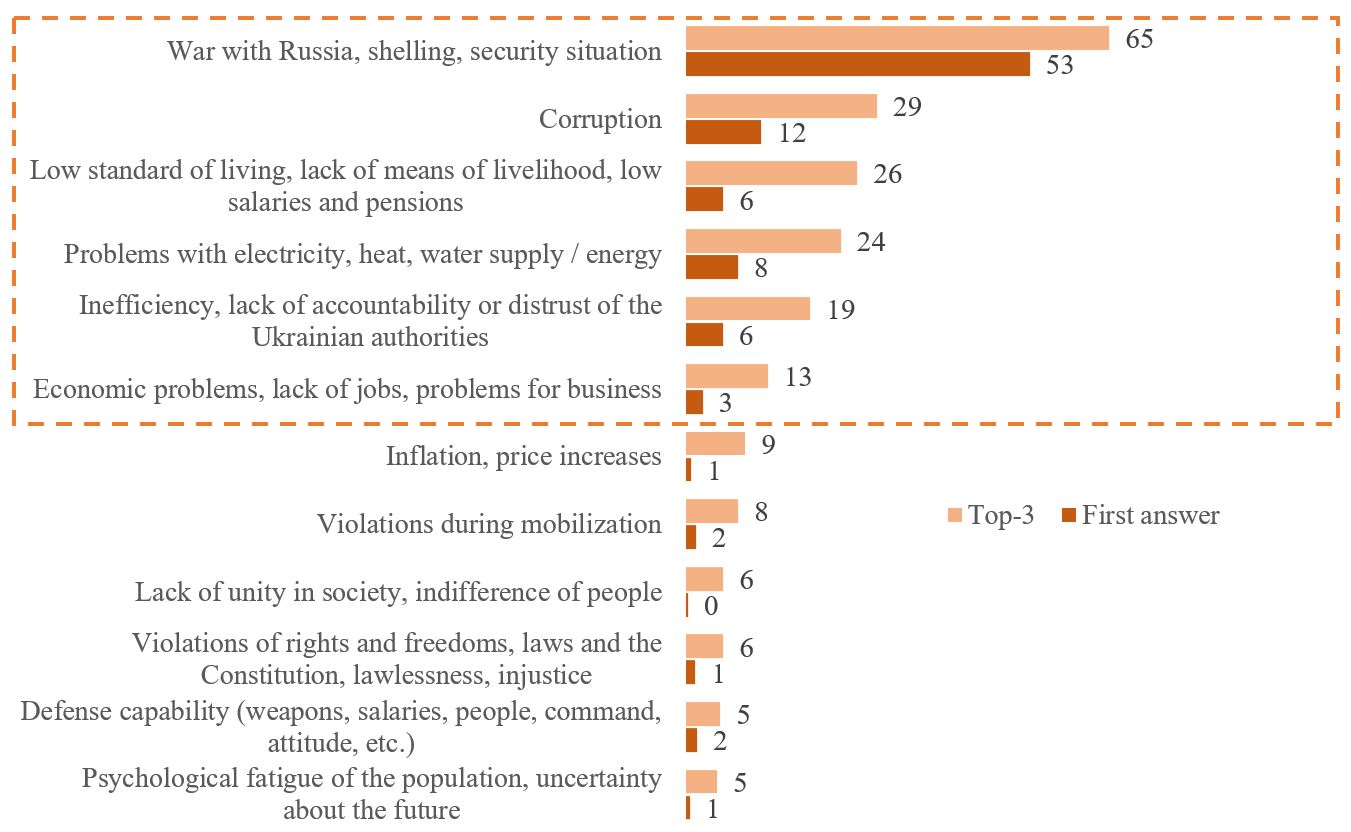
Other problems/challenges were mentioned (without prompting, spontaneously) less frequently. In particular, a full list of responses can be found in the Appendix. We would like to draw special attention to the following “media” challenges, which are often mentioned by public figures (experts, journalists, public activists, politicians, etc.), but which, as we see, were infrequently mentioned by respondents (which does not mean that respondents do not see problems in these areas, but it means that they are not what worries them in the first place). So, this is a question of problems in the field of mobilization, which were discussed by a total of 8% of respondents (and in these cases it was precisely about criticism of the TCR's activities). At the same time, 6% of respondents spoke about violations of citizens' rights and freedoms / lawlessness in general. Some of these respondents could also have meant mobilization. In any case, even with these respondents, a minority include mobilization among the priority problems. Another question is the development of authoritarianism / erosion of democracy. Among the top answers, only violation of rights and freedoms / lawlessness can be included in this (6%). Also, 1% of respondents spoke about restrictions on freedom of speech, and 0.3% spoke about the development of authoritarianism itself. That is, this challenge is not acute in the minds of citizens, at least not now. This is one of the reasons why, for example, Ukrainians currently mostly do not see the problem in the fact that the elections have been postponed. Perception of the most serious problems and challenges in a regional and age dimension
The table below shows the results in regional dimension[1]. As can be seen, the picture is quite similar among residents of all regions and the majority first of all talk about the war. It is important that although not all Ukrainian regions are on the front line, all Ukrainian regions feel the war and are aware of the problems and challenges associated with it.
Table 1. Perception of the most serious problems and challenges in the regional dimension open question, top answers (% ranked among top 3 problems/challenges)
And in the table below, the results are presented in terms of the age of the respondents. In general, the situation is similar among individual age categories, although some features are noticeable. Thus, the problem of corruption is more often mentioned by respondents aged 30-59. At the same time, the younger the respondents, the more they are concerned about economic problems. Among 18-29 year olds, every fourth (24%) is concerned about this (which is important in the context of retaining young people in the country). Also, younger respondents spoke more often about the problems of mobilization (although even among 18-29 year olds, 13% voiced this problem). You can also see some accents depending on age.
Table 2. Perception of the most serious problems and challenges in the age dimension open question, top answers (% ranked among top 3 problems/challenges)
A. Hrushetskyi, comments on the survey results:
In May 2024, we asked respondents what is a greater threat to the development of Ukraine - corruption or Russian aggression (i.e., respondents had to choose between these directly stated options). 48% answered that corruption is the greater threat, and 36% chose war (another 16% could not decide on their opinion). The results of the current survey show that if we do not offer Ukrainians a list of problems/challenges in advance (and do not focus on, for example, the same corruption), then the absolute majority really talk about war first of all (directly or indirectly - for example, when talking about problems in the energy sector). So can we calm down and assume that Ukrainians are reasonably aware of today's challenges? Unfortunately, no, since many problems still remain in the sphere of information security of Ukraine. For example, those who talk about the war may criticize primarily the Ukrainian authorities for the fact that the war has not yet ended (and not the Russian aggressor, who is both the cause of the war and a barrier to establishing peace). That is, a consensus in understanding what is the biggest problem of Ukraine does not mean a consensus in understanding its sources and ways to solve it. For example, in December 2025, 31% of respondents answered that the lack of electricity is primarily a consequence of the actions of the Ukrainian authorities (and not Russian shellings)[2]. Russia is investing significant resources to convince Ukrainians that “the enemy within is more dangerous than the enemy without.” Added to this are the voices of individual Ukrainian subjects, some of whom consciously and some not, play into these narratives. Of course, corruption remains a serious challenge for Ukraine (especially considering the high-profile events of 2025), but fighting it will make no sense in the event of a military defeat of Ukraine. That is, in any case, anti-corruption activities (which are relevant both in peacetime and in wartime) should still assume that objectively the No. 1 priority and the most serious challenge is war. The same applies to other social problems. All of them are not isolated from the military context and their solution cannot be considered without taking into account that Ukraine is waging an existential war with Russia.
Annex 1. Formulation of questions from the questionnaire
In your opinion, what are the most serious problems or challenges that Ukraine and Ukrainians are currently facing? Name up to 3 answers. OPEN QUESTION. THREE SEPARATE SCREENS FOR EACH POSSIBLE PROBLEM
[1] The composition of the macroregions is as follows: West – Volyn, Rivne, Lviv, Ivano-Frankivsk, Ternopil, Zakarpattia, Khmelnytskyi, Chernivtsi oblasts; Kyiv city – only Kyiv city (without the oblast); Center / North – Vinnytsia, Zhytomyr, Kyiv, Kirovohrad, Poltava, Sumy, Cherkasy, Chernihiv oblasts; South – Mykolaiv, Odesa, Kherson oblasts; Lower Dnieper region – Dnipropetrovsk, Zaporizhzhia oblasts; East – Donetsk and Kharkiv oblasts (formally, the macroregion also includes the Luhansk oblast, but due to the almost complete occupation, none of the respondents currently live there, although there are respondents who lived in this oblast until 2022). [2] Opinions and views of Ukrainians on issues of war and peace: December 2025 // https://www.kiis.com.ua/?lang=ukr&cat=reports&id=1572&page=3
4.3.2026
|
Our social media:
 KIIS page
 KIIS channel