

ESC or click to close
|
Press releases and reports
ATTITUDE OF UKRAINIANS TOWARDS PUBLIC HOLIDAYS AND MARCH 8 IN PARTICULAR
The press release was prepared by KIIS President Volodymyr Paniotto
In general, Ukrainians treat holidays with love and respect, only 2% of respondents do not treat any official holidays as important or favorite. The main trends indicate the stability of traditional religious holidays, the decline in popularity of some holidays of the Soviet past, and noticeable changes in attitudes towards state holidays, especially after the start of the full-scale Russian invasion in 2022. The majority of the population of Ukraine (approximately 66-67%) celebrates Christmas and Easter as the most popular holidays, followed by Independence Day of Ukraine (54%) and Defenders of Ukraine Day (53%). The attitude towards International Women's Day on March 8 has been deteriorating, its popularity has been decreasing, but in recent years it has stabilized at the level of 21-24%. If back in 2017 this holiday was one of the most beloved, celebrated as a favorite by about half of the population (49%), now only every fourth.
During January 9-14, 2026, the Kyiv International Institute of Sociology (KIIS) conducted its own all-Ukrainian public opinion survey, which, among other things, included a KIIS monitoring question about attitudes towards public holidays. Bythemethodoftelephoneinterviews(computer-assistedtelephoneinterviews, CATI) based on a random sample of mobile phone numbers (with random generation of phone numbers and subsequent statistical weighting) in all regions of Ukraine (the territory controlled by the Government of Ukraine), 601 respondents were surveyed. The survey was conducted with adult (aged 18 and older) citizens of Ukraine who, at the time of the survey, lived in the territory of Ukraine controlled by the Government of Ukraine. The sample did not include residents of territories temporarily not controlled by the Ukrainian authorities (at the same time, some of the respondents are IDPs who moved from the occupied territories), and the survey was not conducted with citizens who left abroad after February 24, 2022. Formally, under normal circumstances, the statistical error of such a sample (with a probability of 0.95 and taking into account the design effect of 1.3) did not exceed 5.3% for indicators close to 50%, 4.6% for indicators close to 25%, 3.2% for indicators close to 10%, 2.4% for indicators close to 5%. Under conditions of war, in addition to the specified formal error, a certain systematic deviation is added. Factors that may affect the quality of results in "wartime" conditions were previously cited by KIIS. In general, we believe that the obtained results are still highly representative and allow a fairly reliable analysis of the public moods of the population.
The most popular holidays of 2026According to the survey data (see Table 1), Easter (67%) and Christmas (66%) remain the most popular. They have consistently held leading positions in recent years, which indicates the significant role of religion in the cultural life of Ukrainians.
Graph 1. What holidays are the most popular (important or favorite) among the population of Ukraine, February 2026
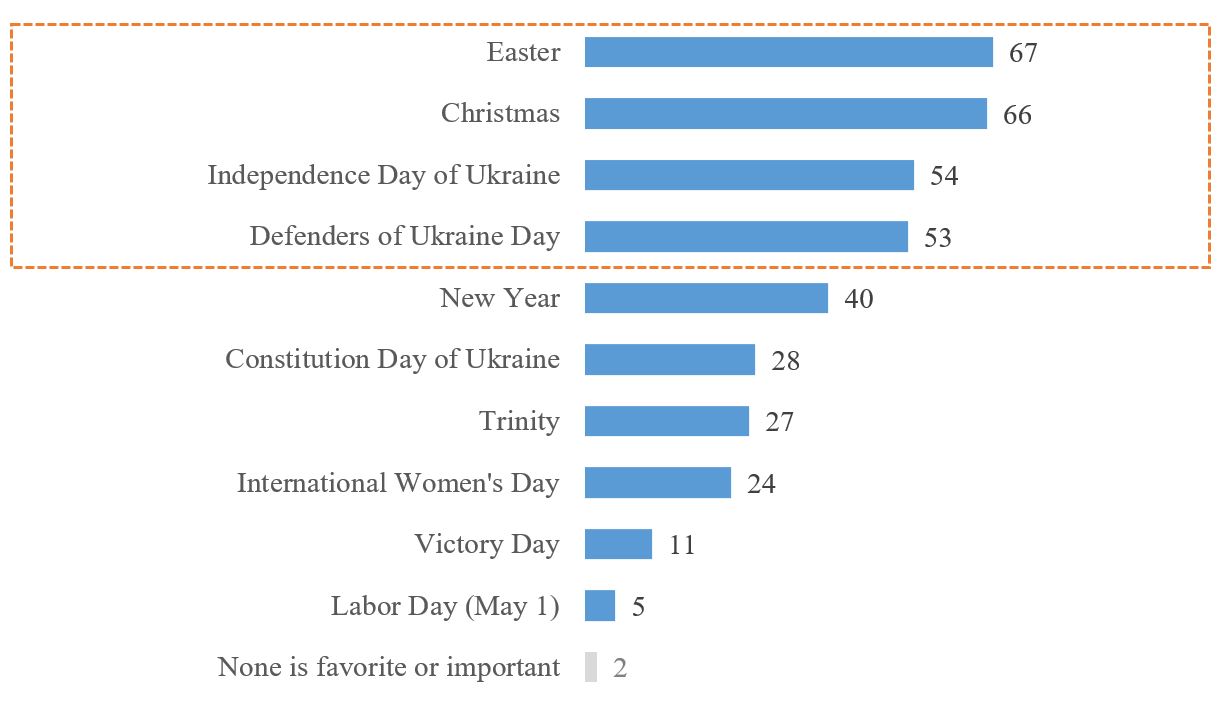
Next comes Independence Day of Ukraine (54%) as one of the main holidays of Ukrainians, which is a testament to national pride and patriotism. Equally popular is the Day of Defenders of Ukraine (53%), which indicates significant respect for military personnel and gratitude for their protection and heroic fight against the enemy in defending the country's independence and sovereignty. New Year is associated with Christmas and is traditionally popular among Ukrainians. But before its popularity was the same as Christmas (about 80%), and now it is 40%. This is followed by Constitution Day of Ukraine (28%), Trinity (27%) and International Women's Day (24%). Victory Day (11%) and Labor Day (May 1) 5% complete the list.
Dynamics of changes in the popularity of holidays (2013-2026)
A comparative analysis of data for some years is given in Table 1, complete data for all years is in the appendix)
Table 1. How the popularity of holidays has changed from 2013 to 2026, %
Let's first compare the situation with holidays compared to 2013 - the last pre-war year.
Table 2. Difference in holiday popularity in 2026 compared to 2013,%
A comparison of the indicators of 2013 and 2026 demonstrates a profound transformation of the symbolic space of Ukrainian society. 1. The biggest growth is in state holidays. The most noticeable growth occurred in attitudes towards public holidays:
These changes reflect the formation of a new model of national identity. If in 2013 Independence Day was not among the mass popular holidays, then after 2014, and especially after 2022, it became one of the key symbols of statehood. The emergence and rapid growth in popularity of Defenders' Day demonstrates a profound change in society's value orientations - from the post-Soviet calendar to the military-state one.
2. The biggest drop is the Soviet and "post-Soviet" holiday model. The largest decline was recorded for holidays that were central to the Soviet or post-Soviet tradition:
The decline in popularity of New Year, which used to be the country's main secular holiday, is particularly telling. Its decline is indicative of the gradual dismantling of the Soviet cultural matrix, in which New Year served as a replacement for Christmas. The decline in support for March 8 is also part of this process of rethinking traditions of Soviet origin.
3. Moderate decline in religious holidays. Religious holidays show a decline compared to 2013, but remain the most popular:
This decline does not mean a loss of significance, but rather reflects the conflicts surrounding the country's religious life (by the way, trust in the Church as an institution has noticeably decreased compared to the period before 2014), the military context, and the general "dilution" of festive intensity in the conditions of a long war (and is also partly influenced by the transition from surveys using mainly in-person to telephone interviews). Despite the decline, religious holidays currently remain in first place. Perhaps religious holidays are currently being reinterpreted as family and domestic (i.e., me as purely religious, and more as an opportunity to be with family), which allows them to remain among the most beloved. Thus, while in 2013 the Ukrainian holiday calendar was predominantly post-Soviet in structure, in 2026 it became clearly statist. We see:
Over these 13 years, there has been not just a change in the ratings of individual holidays, but a profound transformation of the symbolic structure of Ukrainian identity.
If to analyze the impact of the large-scale war and the dynamics during the 4 years of the war, we can identify the following trends. 1. Consolidation of national holidays. After peak mobilization indicators in 2023-2024, there is a stabilization and moderate growth in support for Independence Day and the Day of Defenders of Ukraine in 2026. This indicates a transition from the emotional effect of “rallied around the flag” to a more stable national identity. 2. Stability of religious holidays. Christmas and Easter remain the main symbolic events of the year, performing the function of cultural and psychological stabilization. 3. Further decline in support for holidays of Soviet origin. Victory Day and May 1 have minimal support indicators, reflecting the completion of the stage of rethinking the Soviet legacy. 4. New Year is gradually losing its status as a dominant holiday compared to the pre-war period, which is associated with a change in the cultural matrix and the growing role of Christmas.
Attitude towards International Women's Day
Graph 2 shows the general dynamics of attitudes towards this holiday.
Graph2. International Women's Day March 8, % of supporters
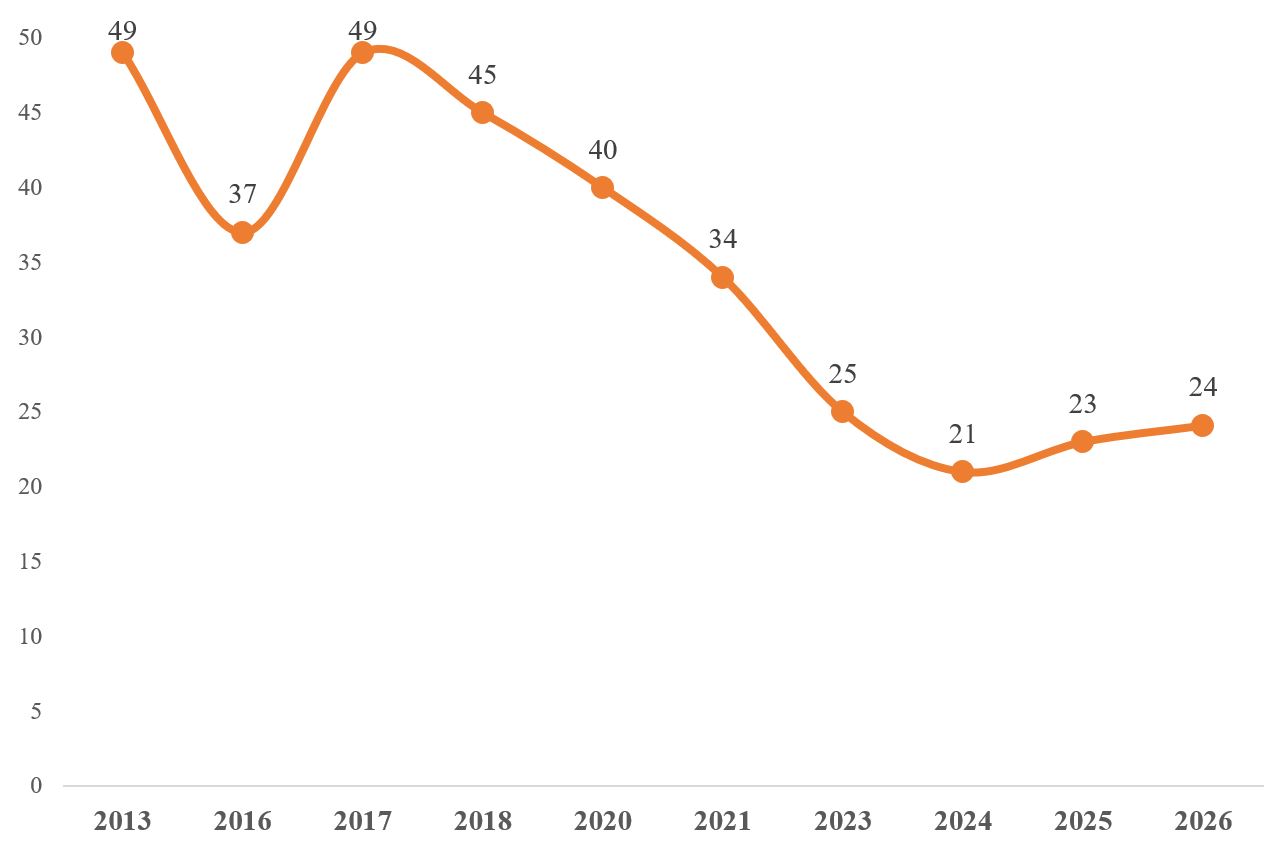
The popularity of March 8 has been steadily declining – from 49% in 2017 to 21% in 2024. However, in 2026, a slight (within the sampling error) increase was recorded – to 24%. This may indicate a certain stabilization of attitudes towards the holiday after a period of sharp decline. Regional differentiation remains: in the West, popularity is the lowest (18%), in the center it is about the same (22%), while in the South and East it is higher, 33% both there and there. Gender and age do not have a significant impact on the attitude towards this holiday. As for gender, this is a new phenomenon - there was a significant difference before. For example, in 2016, International Women's Day was a favorite holiday for 46% of women and only for 26% of men (now only 20% among women and 26% among men, i.e. formally even more popular among men, but this difference is insignificant, because our sample is not very large).
Volodymyr Paniotto, comment on the results of the survey regarding the celebration of March 8
The question about which holidays are the most important or favorite depends on the date of the survey. The closer to this holiday, the more often respondents mention it. Therefore, to study the dynamics, we usually ask about holidays every year at the same time (in the middle of January - February). In addition, in recent years, due to Covid, and now due to the war, we conduct the survey not by face-to-face interviews, but by telephone, which also has a certain impact on the results (see more details https://www.kiis.com.ua/?lang=ukr&cat=reports&id=1036&page=1&t=9). From time to time, due to the initiative of some deputies to cancel this holiday, discussions are held about whether it makes sense to do so. From my point of view, unity is more important than ever for our society, and unnecessary discussions on unprincipled issues only harm the fight against the enemy. We did not conduct focus groups on this issue, but the impression is that this holiday has actually lost its “Sovietness” and is approaching the main content for which it was introduced - supporting women's struggle for their rights. It should be said that the problems of gender equality have not yet been completely resolved in Ukraine, and therefore the cancellation of this holiday is probably inappropriate. In addition, in general, in order to cancel certain holidays that correspond to long-standing traditions, it is necessary to first convince the population and form a positive attitude towards this decision. As long as there are more than 10-15% of people who are supporters of this holiday, the initiative to cancel it is inappropriate.
Appendix 1. Formulation of questionnaire questions
Which of these Ukrainian public holidays are the most important or favorite for you? Please indicate no more than 5 holidays. NO MORE THAN 5 ANSWER OPTIONS
Appendix 2. Tables
Which of these holidays are the most important or favorite for you? Please list no more than 5 holidays. Dynamics in Ukraine as a whole from 2013 to 2026, %
* telephone survey (CATI), in previous years it was a F2F interview
5.3.2026
|
Our social media:
 KIIS page
 KIIS channel