

ESC or click to close
|
Press releases and reports
Attitude towards the US in general, Americans, and the US leadership: Results of a survey conducted on February 12-24, 2026
The press release was prepared by Anton Grushetskyi, executive director of KIIS
During February 12-24, 2026, the Kyiv International Institute of Sociology (KIIS) conducted its own all-Ukrainian public opinion survey “Omnibus”, to which, on its own initiative, added questions about the attitude towards the US in general, Americans and the US leadership. By the method of telephone interviews (computer-assisted telephone interviews, CATI) based on a random sample of mobile phone numbers (with random generation of phone numbers and subsequent statistical weighting) in all regions of Ukraine (the territory controlled by the Government of Ukraine), 2,004 respondents were surveyed. The survey was conducted with adult (aged 18 and older) citizens of Ukraine who, at the time of the survey, lived in the territory of Ukraine controlled by the Government of Ukraine. The sample did not include residents of territories temporarily not controlled by the Ukrainian authorities (at the same time, some of the respondents are IDPs who moved from the occupied territories), and the survey was not conducted with citizens who left abroad after February 24, 2022. During the interview, the respondent was asked one of the following questions: either attitude towards the US in general (696 respondents answered), or attitude towards Americans living in the US (668 respondents answered), or attitude towards the US leadership (640 respondents answered). Formally, under normal circumstances, the margin of error of a sample of 640-696 respondents (with a probability of 0,95 and taking into account the design effect of 1,3) does not exceed 5,1%. Under conditions of war, in addition to the specified formal error, a certain systematic deviation is added. Factors that may affect the quality of results in “wartime” conditions were previously cited by KIIS. In general, we believe that the obtained results are still highly representative and allow a fairly reliable analysis of the public moods of the population.
Attitude towards the US in general, Americans, and the US leadership
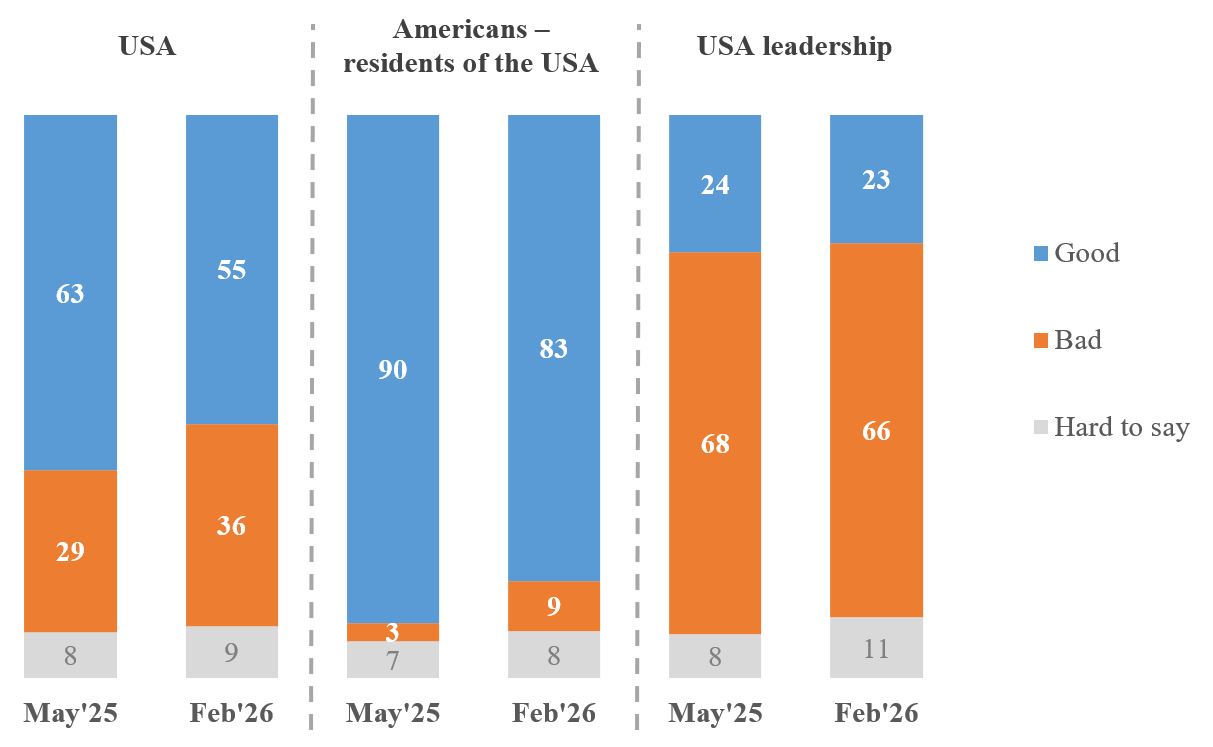
The majority of Ukrainians – 55% – continue to have a good attitude towards the US in general, although since May 2025 the figure has decreased from 63%. The share of those who have a bad attitude towards the US – 36%, and this figure has increased over the past half a year from 29%. At the same time, a diametrically opposite attitude towards US residents and the US leadership is observed. If 83% have a good attitude towards the US residents (9% have bad), regarding the US leadership 23% have a good attitude (66% have bad). Compared to May 2025, the attitude towards US residents has slightly worsened (from 90% to 83%), and in the case of the US leadership it remains at the same (low) level (in May 2025, 24% had a good attitude). However, we should note that the survey was conducted between February 12 and 24, 2026, before the start of the joint US-Israeli operation against Iran. Depending on how the operation ends, this may affect attitudes towards the US in general and towards the American leadership (to a lesser extent, an impact on attitudes towards ordinary Americans can be expected).
Graph 1. How do you generally feel about... the respondent was asked one of three questions
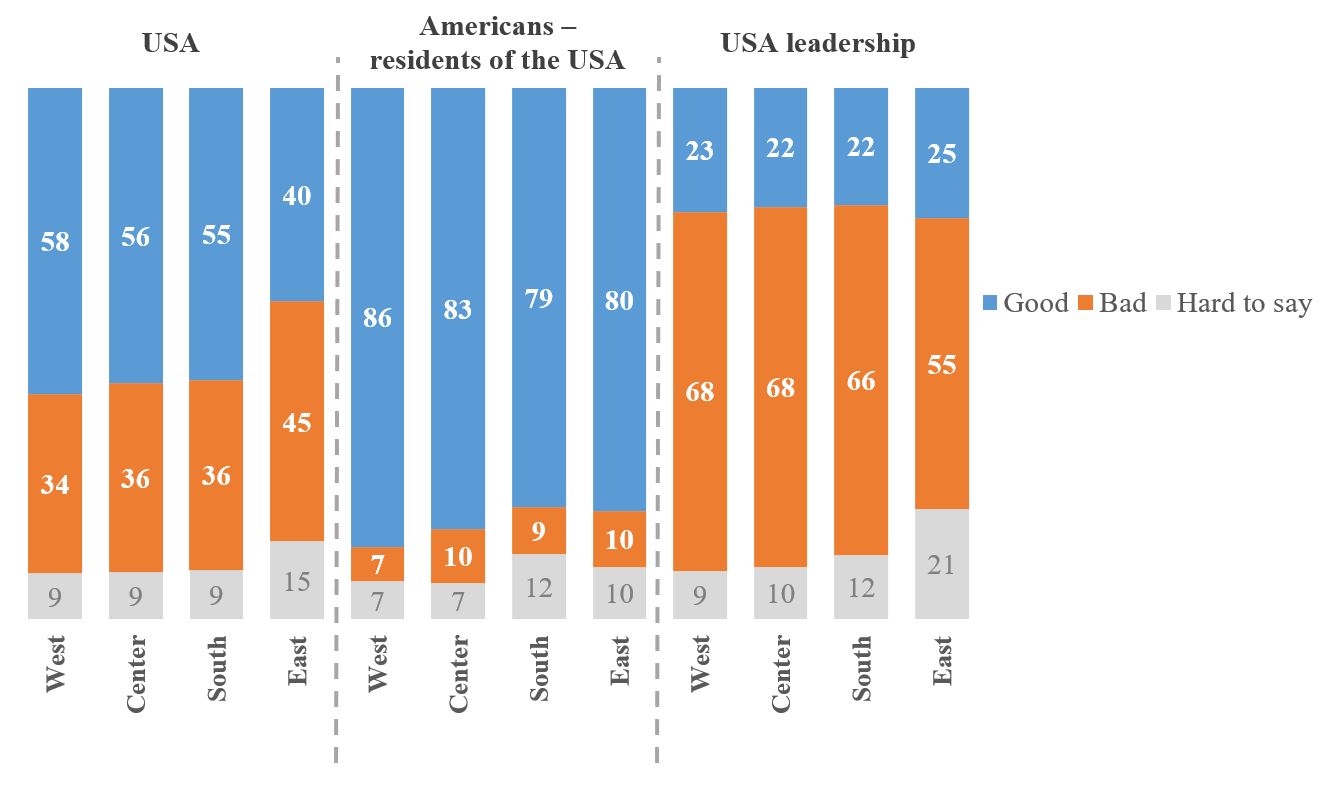
The graph below shows the data in a regional dimension[1]. In almost all cases, the figures do not differ significantly between regions. The only exception is the attitude towards the US in general in the East, where only 40% answered “good” (compared to 55-58% in other regions). However, in the case of attitudes towards Americans living in the US and the US leadership, respondents in the East do not differ significantly.
Graph 2. Attitudes towards the US in general, Americans and the US leadership with disaggregation by regions
Also, KIIS has been conducting a study of the attitude of the Ukrainian population towards certain ethnic groups since 1994. This study is conducted using the scale of the American sociologist Emory Bogardus (adapted by N. Panina). For each ethnic group from the list, respondents must answer how close a relationship they are willing to allow with representatives of each group. This is called social distance. The minimum social distance is 1 (agree to allow as a family member), the maximum is 7 (would not allow to enter Ukraine). Often, the level of social distance is interpreted as the level of prejudice towards a particular group. Prominent Ukrainian sociologists N. Panina and E. Golovakha, analyzing the results for all groups, state that values less than 4.0 indicate openness (tolerance), and values from 4 to 5 indicate national isolation (they want to communicate with representatives of their ethnic group in their family and with friends, and are ready to communicate with other groups with their neighbors and at work). The same interpretation can be applied to the analysis of individual groups. The last time KIIS asked this question was in September 2025 and KIIS is currently preparing the publication (for all groups we studied). Graph 3 below shows the results for Americans. For context: Ukrainian-speaking Ukrainians have the best attitude – 2.4, the worst – Russians living in Russia with a figure of 6.5. As you can see, since the beginning of the 1990s, the attitude towards Americans has been deteriorating and was relatively worst in the 2000s. Thus, the average indicator for the period 1994-1999 was 4.0 points, then it reached a maximum value of 5.1 points in 2006 and 2009. At the same time, since 2010, you can see a trend towards, albeit not very significant, improvement in the attitude. Although the trend towards improving attitudes was observed even before the full-scale invasion, the large-scale support of the United States had a positive impact on the perception of Americans. If in 2021 the indicator was 3.9, then in 2022 it was 3.7, and in 2023 (in September) it reached a historic level of 3.1 points. However, already in 2024 (apparently, against the background of the blocking of aid in the US Congress and unfulfilled expectations from 2023) the indicator deteriorated to 4.2 points. As of September 2025, it is 4.1 points. That is, despite the fact that D. Trump’s actions often cause criticism from the Ukrainian public, this figure has not changed significantly during his presidency.
Graph 3. Dynamics of attitudes towards Americans, 1994-2025 (Bogardus scale, mean result)
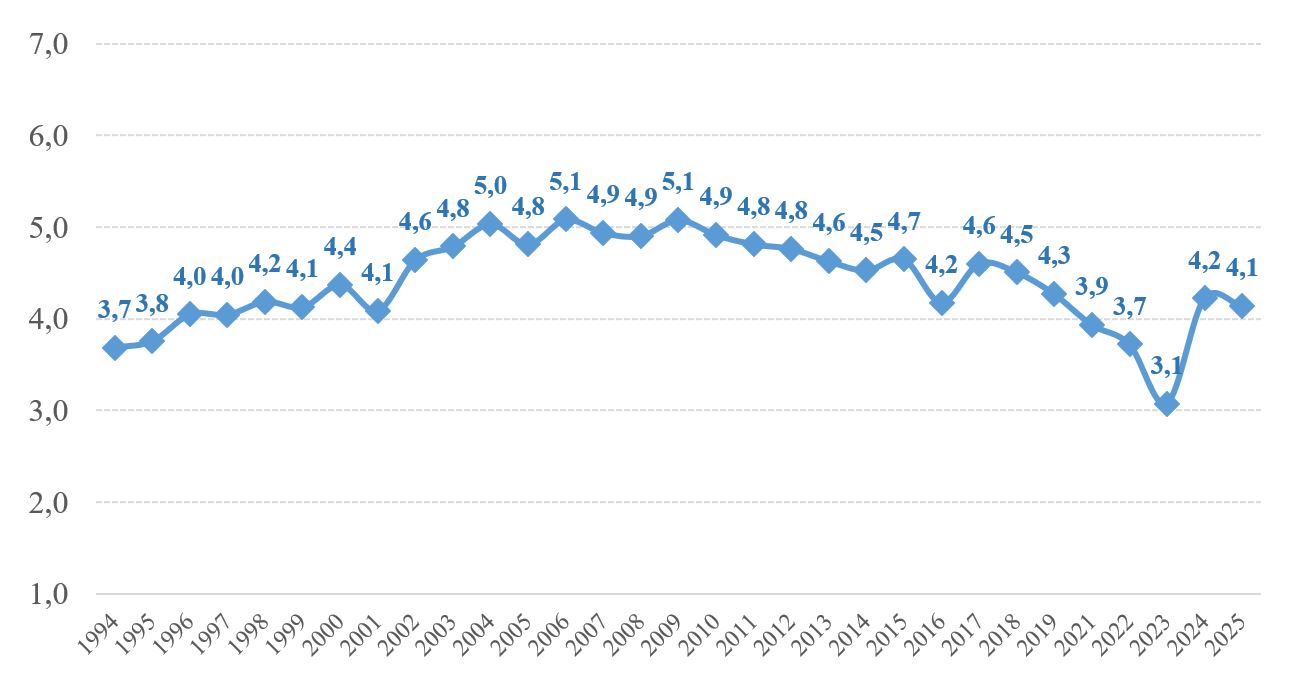 In any case, even the current score of 4.1 points indicates a fairly good attitude towards Americans.
A. Grushetskyi, comments on the survey results:
The US remains an important partner of Ukraine and maintaining constructive relations is beneficial, and beneficial for all parties. Recent events in the Middle East demonstrate that Ukraine can also offer the necessary experience and technology, so although Ukraine and the US are separated by an ocean, we have promising areas for mutually beneficial cooperation (which, however, does not cancel the fact that the US, under the Budapest Memorandum, assumed responsibility for Ukrainian security). An important dimension of interaction between Ukrainian and American societies is the formation of mutual trust. Our previous results showed that cautious optimism after the election of D. Trump as President of the United States quickly changed to a clearly critical attitude[2]. However, we still see that Ukrainians have a rather good attitude towards both the United States in general and ordinary Americans. It is also important to emphasize that the negative trend was also present before the election of D. Trump as President, that is, one should not reduce all the difficulties of Ukrainian-American interaction to his personality alone (although his influence is certainly there). In general, Ukrainians may criticize the actions of the American authorities and be dissatisfied with individual decisions, but they maintain a favorable attitude towards American society. It is important to remember that in democracies (like the USA and Ukraine) political leaders come and go. But our societies remain and it is important that a normal constructive and mutually polite atmosphere is maintained, which will strengthen both Ukraine and the USA.
Annex 1. Formulation of questions from questionnaire
SPLIT-SAMPLE (ONE OF THE THREE VERSIONS A, B OR C ASKED) How do you feel in general about … A. …theUSA? B. …Americans who are residents of the USA? C. …the US leadership?
[1] The composition of the macroregions is as follows: West – Volyn, Rivne, Lviv, Ivano-Frankivsk, Ternopil, Zakarpattia, Khmelnytskyi, Chernivtsi oblasts; Center – Vinnytsia, Zhytomyr, Kyiv, Kirovohrad, Poltava, Sumy, Cherkasy, Chernihiv oblasts, Kyiv city; South – Dnipropetrovsk, Zaporizhzhia, Mykolaiv, Odesa, Kherson oblasts; East – Donetsk and Kharkiv oblasts (formally, the macroregion also includes the Luhansk oblast, but due to the almost complete occupation, none of the respondents currently live there, although there are respondents who lived in this oblast until 2022). [2] Perception of European and USA policy towards Ukraine, trust in the EU, the USA and NATO and attitude towards D. Trump // https://www.kiis.com.ua/?lang=eng&cat=reports&id=1576&page=1
10.3.2026
|
Our social media:
 KIIS page
 KIIS channel