

ESC or click to close
|
Press releases and reports
Trust in President V. Zelenskyy and attitude towards holding elections: results of a survey conducted on March 1-8, 2026
The press release was prepared by Anton Grushetskyi, executive director of KIIS
During March 1-8, 2026, the Kyiv International Institute of Sociology (KIIS) conducted its own all-Ukrainian public opinion survey “Omnibus”, to which, on its own initiative, added questions about trust in V. Zelenskyy and about the national elections. By the method of telephone interviews (computer-assisted telephone interviews, CATI) based on a random sample of mobile phone numbers (with random generation of phone numbers and subsequent statistical weighting) in all regions of Ukraine (the territory controlled by the Government of Ukraine), 1,003 respondents were surveyed. The survey was conducted with adult (aged 18 and older) citizens of Ukraine who, at the time of the survey, lived in the territory of Ukraine controlled by the Government of Ukraine. The sample did not include residents of territories temporarily not controlled by the Ukrainian authorities (at the same time, some of the respondents are IDPs who moved from the occupied territories), and the survey was not conducted with citizens who left abroad after February 24, 2022. Formally, under normal circumstances, the statistical error of such a sample (with a probability of 0.95 and taking into account the design effect of 1.3) did not exceed 4.1% for indicators close to 50%, 3.5% for indicators close to 25%, 2.5% for indicators close to 10%, 1.8% for indicators close to 5%. Under conditions of war, in addition to the specified formal error, a certain systematic deviation is added. Factors that may affect the quality of results in "wartime" conditions were previously cited by KIIS. In general, we believe that the obtained results are still highly representative and allow a fairly reliable analysis of the public moods of the population.
Dynamics of trust in President V. Zelenskyy
The last time KIIS published the results of a survey on trust in President V. Zelenskyy was for the period January 23-29, 2026. After that, we asked the same question twice more: February 12-24 and March 1-8, 2026. The results are shown in the graph below. As can be seen, between the end of January and mid-February 2026, the level of trust in V. Zelenskyy decreased noticeably - from 61% to 53% (and at the same time, the number of those who did not trust him increased from 33% to 41%). There were no particularly high-profile events during this period, so it is difficult to say with certainty about specific reasons. Our additional analysis showed that the greatest decline in trust occurred not among certain demographic categories, but among those who were ready to approve the withdrawal of Ukrainian troops from the Donetsk oblast in exchange for security guarantees. Thus, among those who readily agreed to such a demand, trust fell from 30% to 23% (minus 7 percentage points) between the end of January and mid-February. Among those who reluctantly agreed, it fell from 58% to 43% (minus 15 percentage points), and among those who had an undecided attitude, it fell from 59% to 42% (minus 17 percentage points). In contrast, among those who categorically rejected such a proposal, trust was 68% at the end of January and 64% in mid-February, i.e. almost unchanged. That is, the main segment of the decrease in readiness to endute war is those who were prepared for a difficult exchange of control over the Donetsk oblast in exchange for security guarantees. Perhaps these people had increased expectations from the outcome of the negotiations at the end of January (and, in particular, taking into account that the Ukrainian delegation includes K. Budanov). However, when in February it became more obvious that the negotiations were not leading to real progress, this could have had a demoralizing effect on this segment of the population. However, as of early March, trust in V. Zelenskyy had returned to previous levels and was 62%. The level of distrust was 32%, and the balance of trust-distrust was +30%. In terms of attitude to the proposal for Donetsk oblast, among those who easily agreed with it, trust was 34%, and among those who reluctantly approved it – 54%. That is, in fact, there was a return to the situation at the end of January. Only among those who had an uncertain attitude, lower trust remained (44%), but there are not many such respondents in general. Among those who are categorically against, trust was 70%, that is, the same as at the end of January. Perhaps this segment, after the initial demoralization, has partially adapted to the current situation due to other contextual circumstances. In addition, the situation persists when, out of 62% of those who trust President V. Zelenskyy, 28% “completely” trust him, and the majority (34%) “rather” trust him. That is, there is a significant segment that is more susceptible to situational fluctuations (especially in conditions of dynamic international, military and domestic conditions), which may be reflected in fluctuations in trust in the President.
Graph 1. How much do you trust or distrust Volodymyr Zelenskyy?
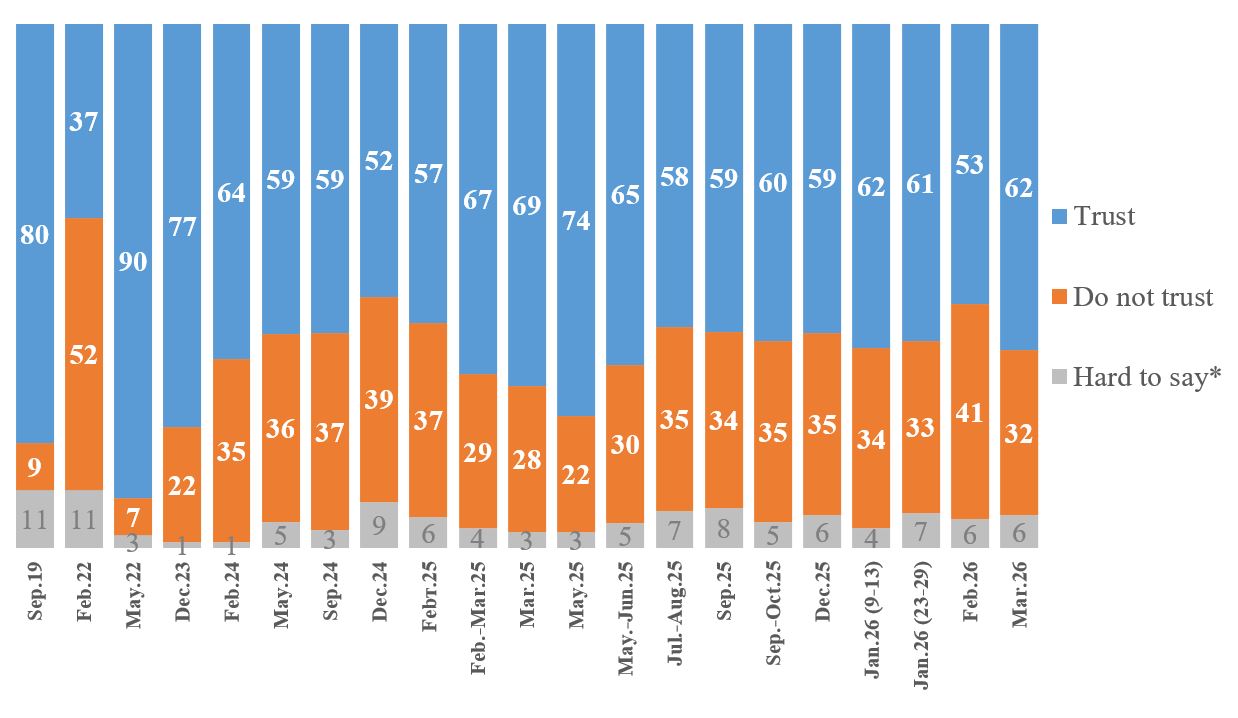 * The option “hard to say” was not read to respondents. It was only marked if the respondent requested it.
Attitudes towards holding national elections
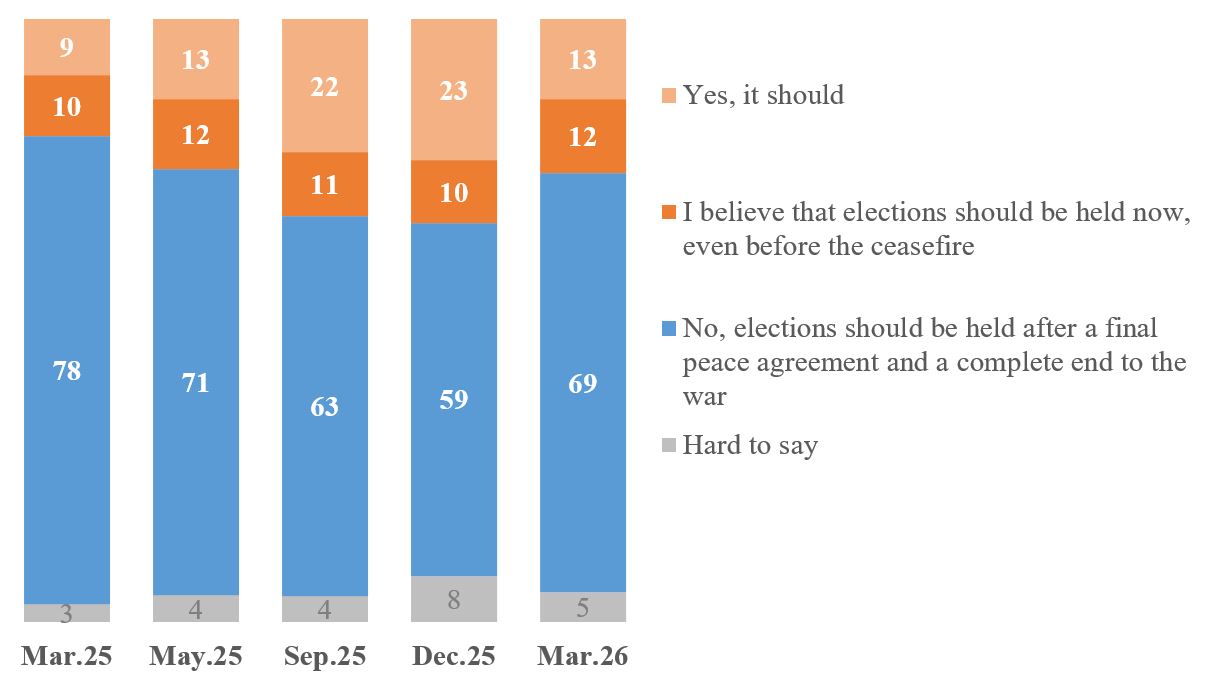
Only 12% of Ukrainians (10-12% during 2025) believe that elections should be held even before the end of hostilities. Another 13% believe that elections can be held after a ceasefire and security guarantees are received. Compared to December 2025, the share of such people has decreased from 23%. That is, there are even fewer people who are satisfied with elections after a ceasefire with security guarantees. Instead, from December 2025 to March 2026, from 59% to 69%, there are now more people who believe that elections should be held only after a final peace agreement and a complete end to the war.
Graph 2. Imagine that a ceasefire really takes place and Ukraine receives reliable security guarantees: more weapons, peacekeepers from a European country, etc. Should Ukraine then hold national elections after that?
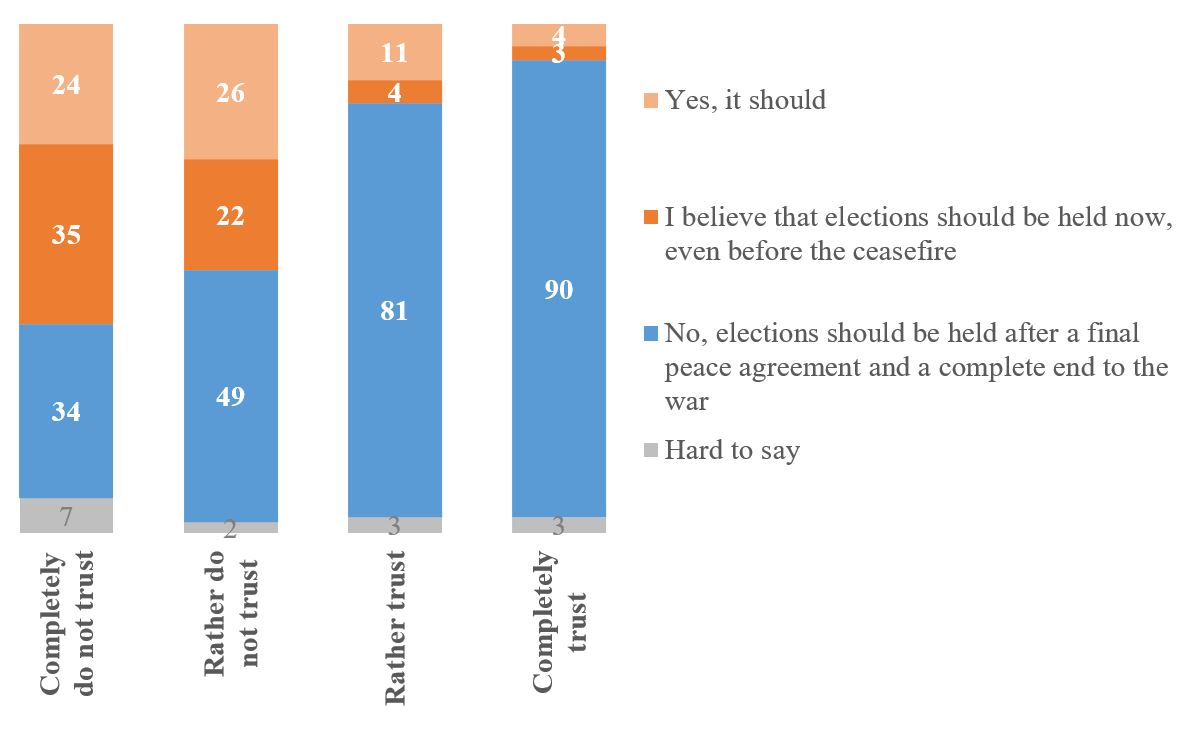
The graph below shows support for holding elections in terms of trust in the President. Thus, among those who trust V. Zelenskyy, the vast majority support holding elections only after a final peace agreement. Among those who “rather” do not trust the President, 49% believe that elections should be held after a final peace agreement, and 26% are ready to approve elections after a ceasefire with security guarantees. At the same time, even among them, a minority (22%) insist on elections even before the end of hostilities. Among those who “completely” do not trust V. Zelenskyy, the demand for elections is somewhat higher, but also a minority (35%) talk about elections before the end of hostilities. Instead, 24% talk about elections after a ceasefire with security guarantees, and 34% believe that elections should be held after a final peace agreement.
Graph 3. Attitude towards holding elections depending on trust in President V. Zelenskyy
A. Grushetskyi, comments on the survey results:
In general, the same trends persist. First, the majority of Ukrainians continue to trust V. Zelenskyy and he remains the legitimate head of state. Second, the vast majority continue to oppose holding elections in the near future (and even in the event of a truce with security guarantees). At the same time, thirdly, trust in V. Zelenskyy is not unconditional, which is reflected in a significant proportion of those who “rather” (rather than “completely”) trust him. Since many events are currently taking place (both outside and inside Ukraine), many citizens may react sensitively to them, and this may further affect the level of trust in the President.
Annex 1. Formulation of questions from the questionnaire
How much do you trust or do not trust Volodymyr Zelenskyy? READ
Imagine that a ceasefire actually takes place and Ukraine receives reliable security guarantees. Should Ukraine then hold national elections after that? READ
[1] The composition of the macroregions is as follows: Western macroregion - Volyn, Rivne, Lviv, Ivano-Frankivsk, Ternopil, Zakarpattia, Khmelnytskyi, Chernivtsi oblasts; Central macroregion - Vinnytsia, Zhytomyr, Sumy, Chernihiv, Poltava, Kirovohrad, Cherkasy, Kyiv oblasts, Kyiv city, Southern macroregion - Dnipropetrovsk, Zaporizhzhia, Mykolaiv, Kherson, Odesa oblasts, Eastern macroregion - Donetsk, Luhansk and Kharkiv oblasts.
18.3.2026
|
Our social media:
 KIIS page
 KIIS channel