

ESC or click to close
|
Press releases and reports
Use of artificial intelligence by the population of Ukraine
The press release was prepared by Volodymyr Paniotto, President of KIIS
During January 23-29, 2026, the Kyiv International Institute of Sociology (KIIS) conducted its own all-Ukrainian public opinion survey, which, among other things, included questions about the use of AI. By the method of telephone interviews (computer-assistedtelephoneinterviews, CATI) based on a random sample of mobile phone numbers (with random generation of phone numbers and subsequent statistical weighting) in all regions of Ukraine (the territory controlled by the Government of Ukraine), 1,003 respondents were surveyed. The survey was conducted with adult (aged 18 and older) citizens of Ukraine who, at the time of the survey, lived in the territory of Ukraine controlled by the Government of Ukraine. The sample did not include residents of territories temporarily not controlled by the Ukrainian authorities (at the same time, some of the respondents are IDPs who moved from the occupied territories), and the survey was not conducted with citizens who left abroad after February 24, 2022. Formally, under normal circumstances, the statistical error of such a sample (with a probability of 0.95 and taking into account the design effect of 1.3) did not exceed 4.1%. At the same time, an experiment was conducted for the question of trust in President V. Zelenskyy, where half of the respondents (i.e. about 500) were asked a regular direct question (to what extent the respondent trusts or does not trust him), and the other half were asked the “imagined acquaintance” method. Therefore, for this question, the error does not exceed 5.8%. Under conditions of war, in addition to the specified formal error, a certain systematic deviation is added. Factors that may affect the quality of results in "wartime" conditions were previously cited by KIIS. In general, we believe that the obtained results are still highly representative and allow a fairly reliable analysis of the public moods of the population.
Experience and frequency of using artificial intelligence
The use of artificial intelligence in modern society is an important indicator of the country's digital transformation. AI is increasingly used in various fields - from education and science to business and public administration. Therefore, the level of its distribution among the population allows us to assess the readiness of society for new technologies. The results of the January 2026 survey (see graph 1) indicate that the use of AI in Ukraine is already more noticeable, but still remains limited.
Graph 1. Artificial intelligence (AI) technologies are currently being actively developed. Do you personally use Artificial Intelligence for work or for your own needs? %
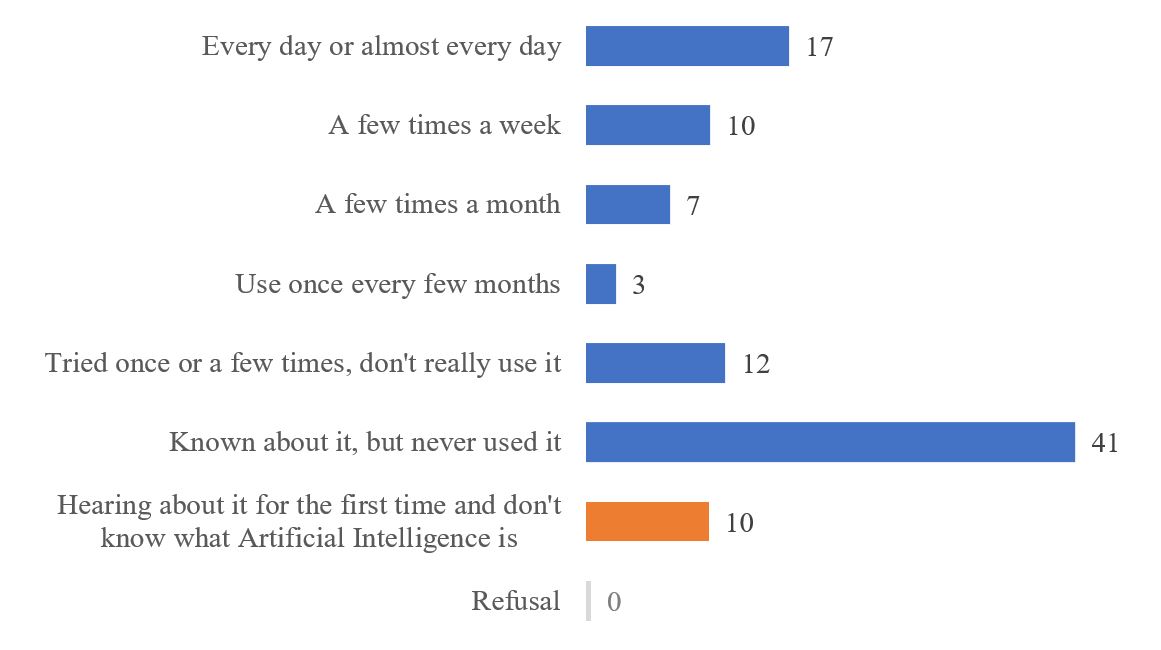
Over 60% of the population does not actually use AI, of them:
Thus, although the level of awareness is quite high (about 90% know about AI), actual implementation in everyday practice lags significantly behind. At the same time, about 37% of the population has at least some experience using AI (including at least occasional use). Among them:
That is, 27% of Ukrainians are regular users of AI (at least once a week). These data indicate that Ukraine is at the stage of active, but not yet mass implementation of artificial intelligence technologies. On the one hand, a high level of awareness has been formed, on the other hand, there is a significant gap between knowledge and practical use. At the same time, it is worth emphasizing that the share of daily users (17%) is already quite significant, which may indicate the formation of a core of active users who have integrated AI into their work or daily life. Dynamics of the use of artificial intelligence
A comparison of the results of the 2025 and 2026 surveys (see graph) shows that the use of artificial intelligence in Ukraine is gradually increasing, although the pace of this growth remains moderate so far.
Graph 2. Dynamics of the use of artificial intelligence, %
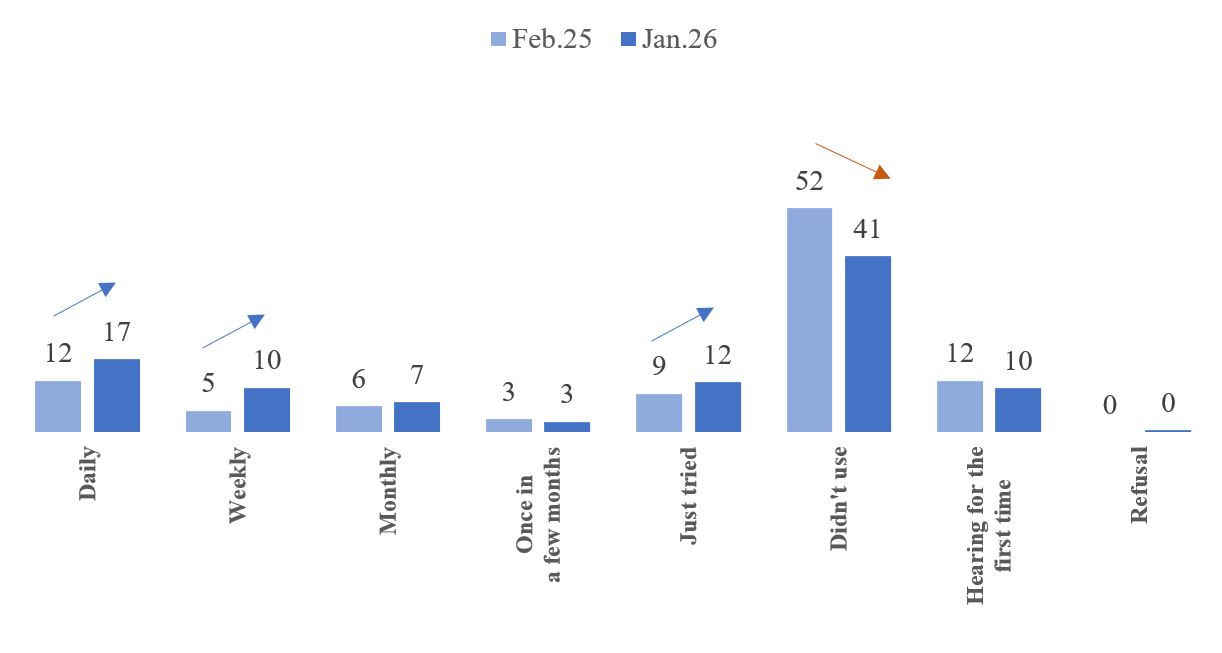
First of all, the share of people who do not use AI at all is decreasing. If in 2025 there were about 64% of them, then in 2026 - about 62%. In particular, the share of those who know about AI but have never used it has decreased from about 52% to 41%. At the same time, the share of users is growing. The increase is especially noticeable among regular users:
As a result, the share of regular users (at least once a week) increased from approximately 17% to 27%, i.e. by 10 percentage points. This is a fairly significant change in one year. At the same time, the share of those who have only “tried” AI changes little, which may indicate a gradual transition of part of this group to more active use. Overall, these results, as we noted above, demonstrate that Ukraine is entering a phase of diffusion of the new technology, but this process has not yet become widespread. A significant part of the population still remains outside the practical use of AI, despite the high level of awareness. From the perspective of diffusion theory, this is a typical dynamic. Often, the introduction of new technologies follows an S-shaped curve: first, slow growth (early adopter stage), then a sharp acceleration (mass adoption), and finally, a slowdown again when saturation is reached. Currently, judging by the data obtained, Ukraine is at the first stage of this curve – the stage of the initial, still relatively slow spread of technology, before possible faster growth in the coming years.
Who uses AI most oftenПочаток форми
Кінець форми Age has the greatest impact on AI usage (see graph 3).
Graph 3. The impact of age on AI usage (percentage of regular users), %
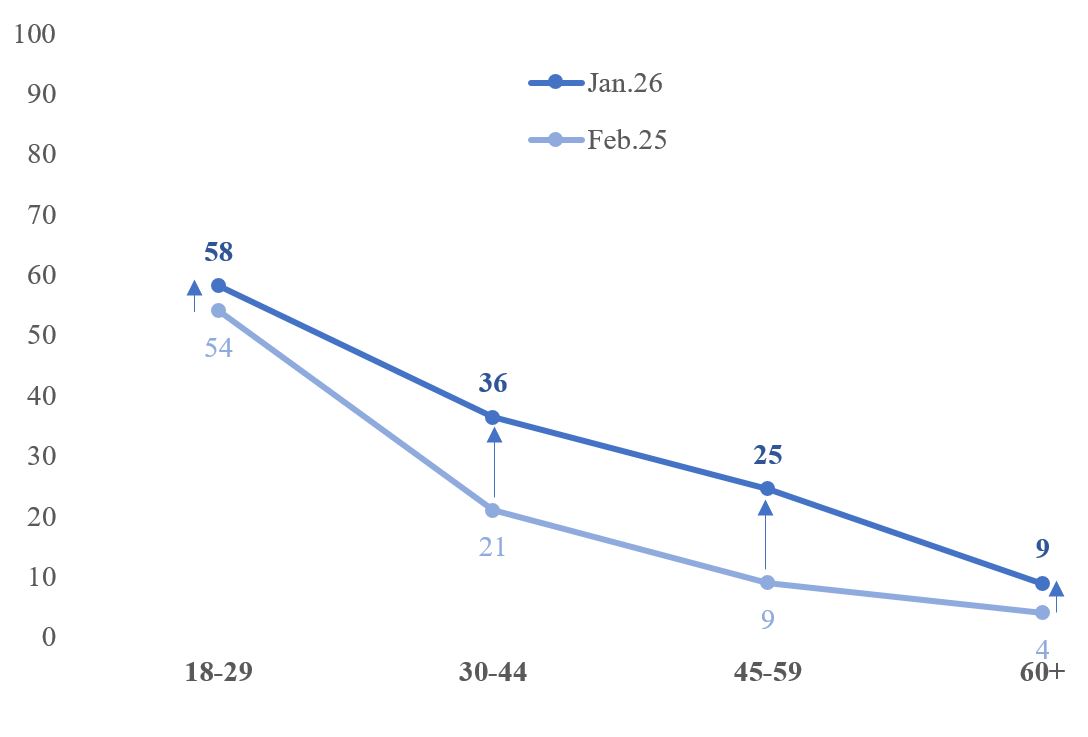
The highest level of regular use is among 18-29 year olds, with over half (58%) of this group regularly using AI. This compares to just 36% of 30-44 year olds, and just 9% of those aged 60 and over. This could indicate a significant digital divide between generations. At the same time, over the past year, the largest increase in users occurred among 30-44 year olds (from 21% to 36%) and among 45-59 year olds (from 9% to 25%). Among 18-29 year olds, the growth was at the trend level from 54% to 58%, and among 60+ year olds – from 4% to 9%. The graph below shows usage by settlement type.
Graph 4. Impact of settlement type on AI usage (percentage of regular users), %
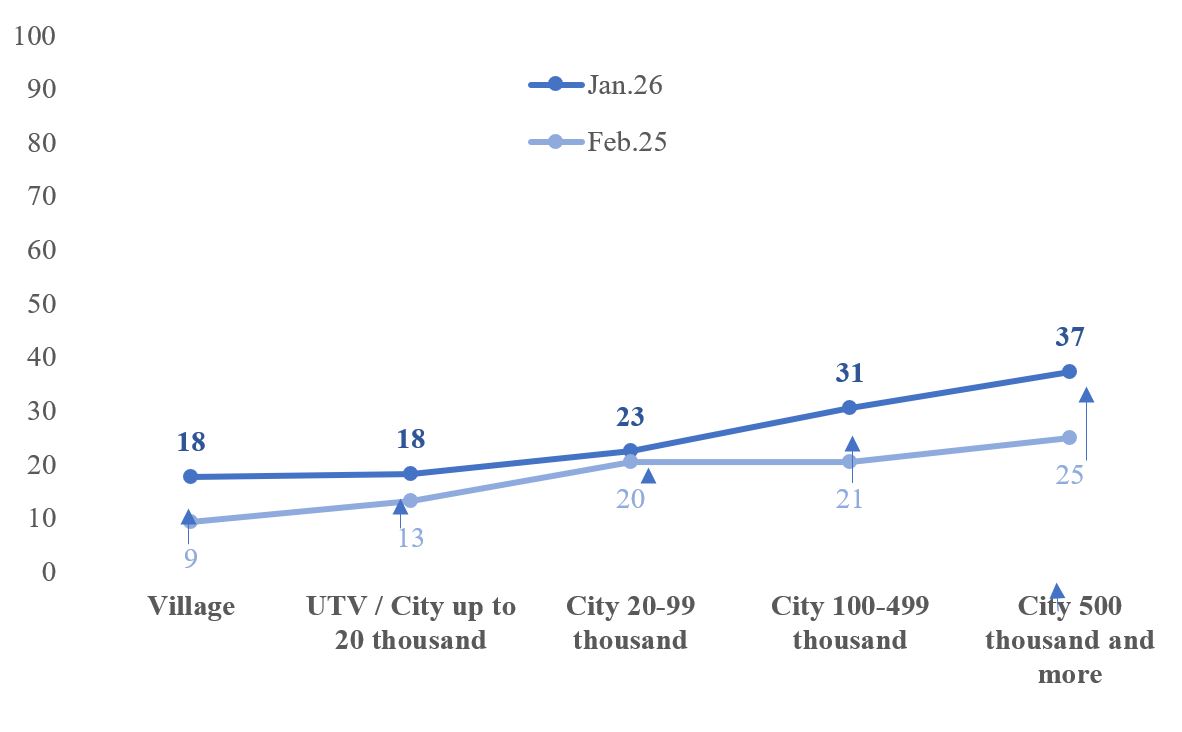
As can be seen, the share of users is higher in larger cities. The share of regular users decreases from 37% in the largest cities with a population of 500 thousand and more to 18% in villages and UTV / small towns. At the same time, there is a trend of increasing usage everywhere over the past year. Such data may also indicate the presence of a digital divide depending on the type of settlement. However, if in 2025 the share of regular users in the largest cities was 2.7 times higher than the share of regular users in villages (25% to 9%), now it is 2.1 times higher (37% to 18%). That is, the gap is noticeable, but at least it has narrowed somewhat over the past year.
The graph below shows usage in terms of education. The data is calculated among respondents aged 25+ (since most people complete their educational trajectory by the age of 25 and we can better see the connection between education and AI usage).
Graph 5. Impact of education on AI usage (percentage of regular users), % (among respondents aged 25+)
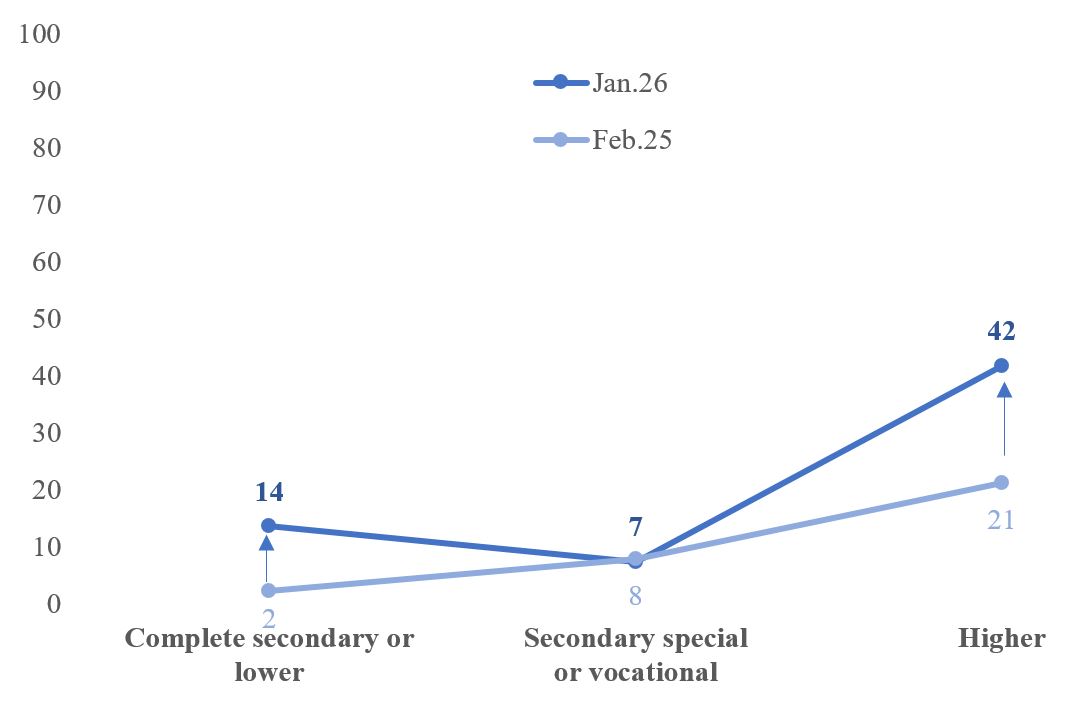
Thus, there is a significant gap by education. While among respondents with higher education, 42% are regular users (up from 21% in 2025), among those with secondary specialized or vocational education - 7% (practically unchanged since 2025). Among those who have just graduated from school, the usage rate is 14% (up from 2%).
Gender has no significant impact on AI usage. We also note that in 2025 there was a significant gap by welfare (those with higher welfare used more often). In the current survey, we did not ask about welfare, but the same gap is evident.
Comment by V. Paniotto:In today's world, where technologies are rapidly changing the way we live and work, Ukraine must actively use artificial intelligence (AI) to ensure development and recovery from war. AI has great potential to increase the efficiency of the economy, public administration, education and science, as well as to strengthen the country's competitiveness on the global stage. As the results of the research show, the use of AI in Ukraine is only gaining momentum. A significant proportion of the population has not yet used these technologies in practice, although the level of awareness is already quite high. 27% of Ukrainians are regular users of AI (at least once a week), which indicates the formation of a core of active users, but not yet the mass distribution of the technology. In an international context, this indicator is quite comparable to the level of AI use in many Western countries, where the share of regular users is usually within 20-30%, although in some countries it is already significantly higher. That is, Ukraine is not an outsider, but it is not yet among the leaders. At the same time, there is significant potential for growth. Experience in other countries shows that the spread of new technologies can occur very quickly once a certain critical level of use is reached. In order to take advantage of these opportunities, Ukraine needs to develop digital infrastructure, invest in research and development in the field of AI, implement educational programs to improve the digital skills of the population, and stimulate the use of AI in business and the public sector. At the same time, it is important to consider potential risks. AI may lead to the displacement of some professions and increase inequality. Therefore, its implementation should be accompanied by a policy of retraining, employment support and reduction of social imbalances. Thus, AI is not only a technological opportunity, but also a serious challenge, and its future development largely depends on how effectively Ukraine can integrate these technologies.
Appendix 1. Formulation of questions from the questionnaire
Currently, technologies based on Artificial Intelligence (AI) are actively developing. Do you personally use AI for work or for your own needs? Do you …
26.3.2026
|
Our social media:
 KIIS page
 KIIS channel