

ESC or click to close
|
Press releases and reports
Dynamics of the attitude of the Ukrainian population to sociological surveys
The press release was prepared by Volodymyr Paniotto, President of KIIS
From November 26 to December 29, 2025, the Kyiv International Institute of Sociology (KIIS) conducted its own all-Ukrainian public opinion survey "Omnibus", to which, on its own initiative, added a question about trust in the results of surveys from sociological organizations that have been working for a long time. By the method of telephone interviews (computer-assistedtelephoneinterviews, CATI) based on a random sample of mobile phone numbers (with random generation of phone numbers and subsequent statistical weighting) in all regions of Ukraine (the territory controlled by the Government of Ukraine), 1,001 respondents were surveyed. The survey was conducted with adult (aged 18 and older) citizens of Ukraine who, at the time of the survey, lived in the territory of Ukraine controlled by the Government of Ukraine. The sample did not include residents of territories temporarily not controlled by the Ukrainian authorities (at the same time, some of the respondents are IDPs who moved from the occupied territories), and the survey was not conducted with citizens who left abroad after February 24, 2022. Formally, under normal circumstances, the statistical error of such a sample (with a probability of 0.95 and taking into account the design effect of 1.3) did not exceed 4.1% for indicators close to 50%, 3.5% for indicators close to 25%, 2.5% for indicators close to 10%, 1.8% for indicators close to 5%. Under conditions of war, in addition to the specified formal error, a certain systematic deviation is added. Factors that may affect the quality of results in "wartime" conditions were previously cited by KIIS. In general, we believe that the obtained results are still highly representative and allow a fairly reliable analysis of the public moods of the population.
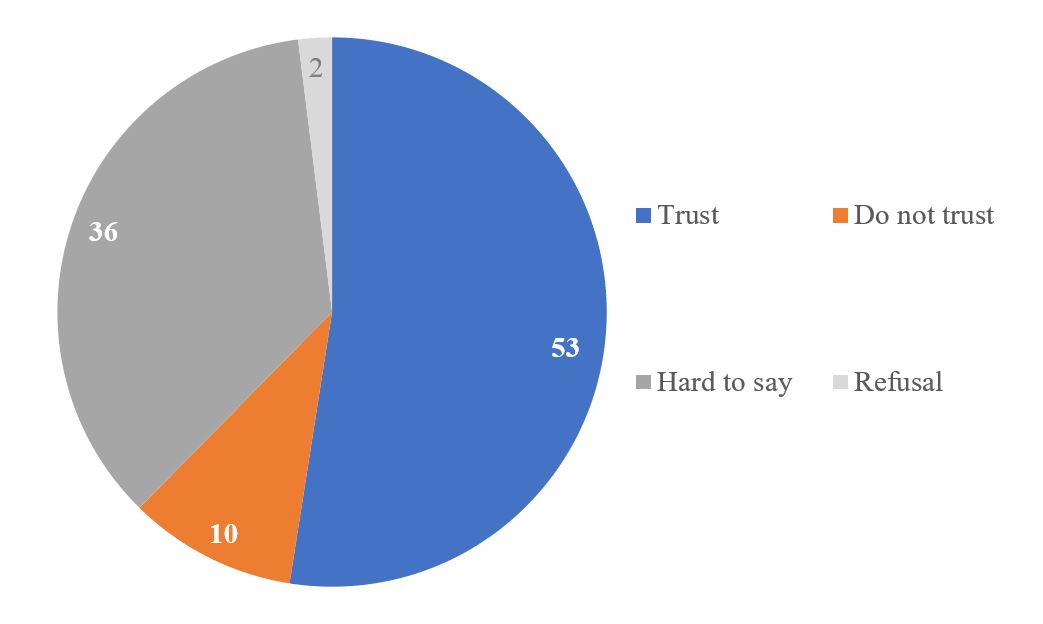
KIIS usually studies the public's trust in sociological surveys once a year, in December. We ask the question "Do you trust the results of sociological surveys of organizations that have been operating for a long time and publish the results of their research?". The options “yes”, “no” and “hard to say” are read to the respondent (i.e. we immediately read out the option “hard to say” and offer it to respondents among the available options). The December 2025 survey showed that 53% of respondents trust the data of sociological organizations that have been operating for a long time, 10% do not trust, and the rest do not have a definite opinion on this matter (see graph 1).
Graph 1. Do you trust the results of sociological surveys by organizations that have been operating for a long time and publish the results of their researches?
 The level of trust in sociologists is somewhat affected by age: trust among the age category 18-29 is 72%, 30-39 years old – 54%, and among older age groups (40+) – 49%. Gender, education, type of settlement do not have a significant impact on the level of trust in sociologists. Dynamics of changes in trust and distrust in sociological centers is shown on graph 1.
Graph2. Dynamics of the level of trust and distrust in the results of surveys from sociological centers that have been operating for a long time, 2002-2025, %
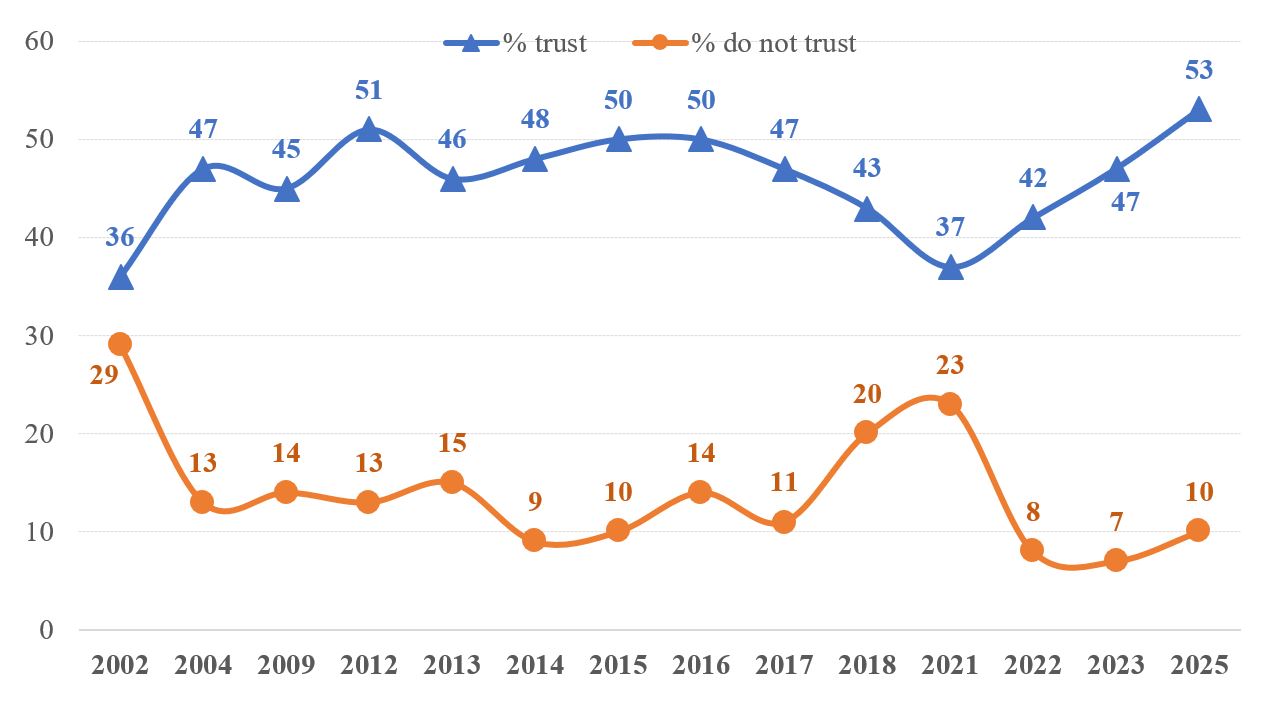
As we see, the level of trust in the results of sociological surveys of organizations that have been operating for a long time and publishing the results of their researches among the population of Ukraine over the past 20 years initially increased significantly (from 36% in 2002 to 47% in 2004), and then remained more or less stable with some fluctuations (49% plus or minus 2%) until 2016, but then began to decline and in 2021 dropped to 37%. However, data for 2022-2025 show significant changes in public opinion. In 2022, the level of trust in the results of sociological surveys increased to 42%, and in 2025 - to 53%. At the same time, the level of distrust decreased to 10% in December 2025 (compared to 23% according to the last survey before the invasion). This jump in trust can be explained by the growing need of the population for reliable information in times of crisis. It can also be one of the manifestations of “rallying around the flag” - an increase in trust in the authorities and social institutions, including sociological organizations, during the war. The dynamics of changes can be seen more clearly on the graph 3.
Graph3. Balance of trust and distrust in survey results from sociological centers that have been operating for a long time (percentage of those who trust, minus percentage of those who do not trust), 2002-2025
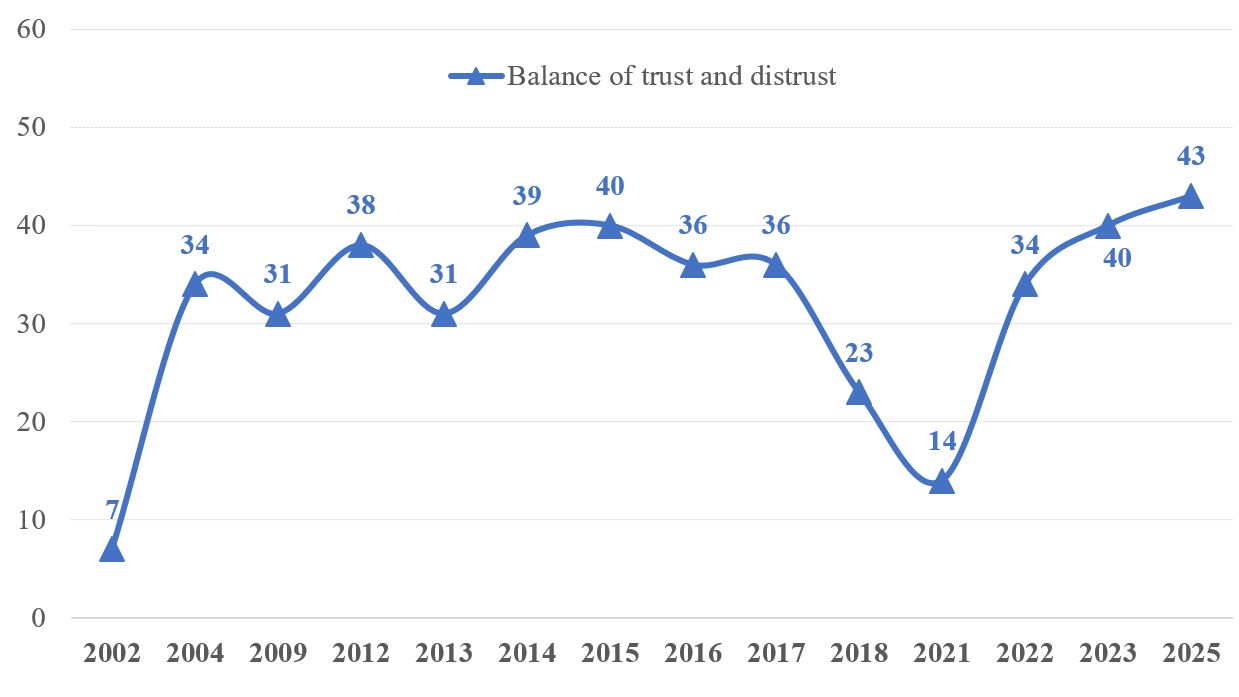
We see an increase in the balance of trust, a stable period, and a drop from 36% to 14% in 2021. After the start of a full-scale war, the balance of trust and distrust regained its position, increasing from +14% in 2021 to +34% in 2022 and to +43% in 2025. These changes emphasize the importance of sociological surveys for the population as a tool for measuring and understanding public opinion during periods of social challenges.
Comment by V. Paniotto:Trust in sociological surveys is not only a matter of the reputation of individual research centers. It is an important element of the functioning of a democratic society. Sociology acts as a “mirror” of public opinion: it allows society to see itself, and the authorities to understand the mood of the population. In Ukraine, sociological research, primarily exit polls, has also become an essential element of elections: they verify the results of the vote and reduce the possibilities for fraud. Thus, in 2004, an exit poll showed fraud in the second round of the presidential election and became the trigger of the Orange Revolution and the basis for a second round of voting. In a war situation, this function becomes even more critical. When uncertainty and a shortage of reliable information increase, society especially needs tools that provide an objective picture. At the same time, it is important to understand that trust in sociological surveys is not constant – it depends on both the quality of the research and the political context. There are two key reasons for its decline in recent years. First, the emergence of pseudo-sociological surveys. In Ukraine, especially during election periods, unprofessional “sociological services” regularly appear, publishing commissioned or falsified data. It is often difficult for the average citizen to distinguish a professional organization from a pseudo-sociological one, which undermines trust in the entire industry. Secondly, the peculiarities of political culture. If the results of surveys do not correspond to the expectations or political sympathies of people or politicians, instead of questioning their own ideas, a significant part of the audience tends to blame sociologists. Combined, these two factors led to a decline in trust, which is clearly visible in the data: from a level of about 50% in the 2010s to 37% in 2021. If to compare trust in sociology with trust in other social institutions[1], the situation looks quite indicative. According to KIIS data in 2025, about 53% trust sociological surveys, while only 10% do not trust them. This is a fairly high balance of trust (+43 pp). For comparison, the Armed Forces of Ukraine have the highest level of trust - usually over 90% (balance about +80%), the President - trust is at 60% and the balance is +30% (with fluctuations). The government, parliament, courts - have significantly lower indicators, often in the range of 20-40% trust with a negative balance. Against this background, sociological surveys have higher trust than most political institutions and are second only to institutions related to war and security (the Armed Forces of Ukraine, volunteers). Of course, this comparison is inaccurate, because the question about sociological centers was asked separately, not together with other institutions, which created a different context and the wording was somewhat different. But we can say that professional sociological centers occupy a good position in the structure of public trust - much better than one would expect given the constant information attacks and criticism.
Appendix 1. Formulation of questions from the questionnaire and table Do you trust the results of sociological surveys by organizations that have been operating for a long time and publish the results of their researches?
31.3.2026
|
Our social media:
 KIIS page
 KIIS channel