

ESC or click to close
|
Press releases and reports
Religious self-identification of the population of Ukraine: dynamics and importance of question formulation
The press release was prepared by Anton Grushetskyi, executive director of KIIS
From September 19 to October 5, 2025, the Kyiv International Institute of Sociology (KIIS) conducted its own all-Ukrainian public opinion survey "Omnibus", to which, on its own initiative, added a monitoring question about the religious self-identification of the population of Ukraine. By the method of telephone interviews (computer-assistedtelephoneinterviews, CATI) based on a random sample of mobile phone numbers (with random generation of phone numbers and subsequent statistical weighting) in all regions of Ukraine (the territory controlled by the Government of Ukraine), 2,015 respondents were surveyed. The survey was conducted with adult (aged 18 and older) citizens of Ukraine who, at the time of the survey, lived in the territory of Ukraine controlled by the Government of Ukraine. The sample did not include residents of territories temporarily not controlled by the Ukrainian authorities (at the same time, some of the respondents are IDPs who moved from the occupied territories), and the survey was not conducted with citizens who left abroad after February 24, 2022. Formally, under normal circumstances, the statistical error of a sample of 2,015 respondents (with a probability of 0.95 and taking into account the design effect of 1.3) does not exceed 2.9%. At the same time, an experiment was conducted and for one question (to which Orthodox Church do they belong) 4 different formulations were prepared, which were asked to different subsamples of respondents, about 500 respondents each. The error for such a subsample does not exceed 5.8%. Under conditions of war, in addition to the specified formal error, a certain systematic deviation is added. Factors that may affect the quality of results in "wartime" conditions were previously cited by KIIS. In general, we believe that the obtained results are still highly representative and allow a fairly reliable analysis of the public moods of the population.
Dynamics of religious self-identification
There are different approaches to determining the religious self-identification of the population. In our usual monitoring surveys, we apply the following approach: first, respondents are asked the question “To which denomination or religion, if any, do you belong?”, where Orthodoxy / Greek Catholicism / etc. are listed. Then, if the respondent answered that he considers himself Orthodox, an additional question is asked “And to which Orthodox Church do you belong?” and only two options are read to the respondent: “The Orthodox Church of Ukraine (created after the unification Council of the Ukrainian Orthodox Church of the Kyiv Patriarchate, the Ukrainian Autocephalous Orthodox Church and part of the hierarchs of the Ukrainian Orthodox Church of the Moscow Patriarchate)” and “The Ukrainian Orthodox Church – Moscow Patriarchate”. The option “Orthodox Church without specification” was not read, but could be marked if the respondent himself insisted on it. At the same time, according to our observations, the wording of the second question regarding which Orthodox Church Ukrainians identify with can have a significant impact on the respondents’ answers. First of all, this concerns the debatable point of how appropriate it is to add the clarification of “Moscow Patriarchate” to “UOC”. On the one hand, representatives of this Church distance themselves from ties with Moscow and do not use the mention of the Moscow Patriarchate in their name. On the other hand, the State Service of Ukraine for Ethnopolitics and Freedom of Conscience (SEFC) published an expert report according to which the UOC allegedly maintains ties with Moscow (and many people simply continue to believe that the UOC maintains subordination to Moscow). At the same time, in sociological surveys, questions should be clear and transparent for respondents, that is, when we ask about, for example, “OCU” or “UOC”, respondents should understand who or what exactly we are asking about. That is why, since 2020, we have been asking questions in a more cumbersome form, which provided additional information about the OCU. At the same time, until 2022, there were no questions about the use of “Moscow Patriarchate” in the name of the UOC. After 2022, we retained the wording of the question for the correct analysis of the dynamics, since the questions should be asked in the same wording, and since there is no unambiguous argumentation, how respondents should read the option about the UOC so that it is clear who we are asking about, and so that at the same time it is correct. At the same time, this time we conducted a methodological experiment and prepared 4 versions of the question, which was asked to different random subsamples of respondents. One version is our usual monitoring version, the other three are new experimental ones. First, below we will consider the dynamics of religious self-identification according to our usual approach, and then - the results of our experiment. So, Table 1 shows the dynamics of religious self-identification of the population of Ukraine during 2020-2025. As can be seen, compared to July 2022, religious self-identification has almost not changed. The largest number of Ukrainians – 63% – continue to consider themselves Orthodox. Among them, the largest number – 50% among all respondents – consider themselves to be members of the Orthodox Church of Ukraine. Another 9% consider themselves to be members of the Orthodox Church “without specifying” and 3% – to be members of the Ukrainian Orthodox Church of the Moscow Patriarchate. Next come atheists (16%) (it is worth noting that among the “other” answers, some respondents said that they were “agnostics”, “do not belong to any Church”, that is, they did not want to classify themselves as “atheists”, but they named identifications that were close to some extent) and those who classify themselves as members of the Ukrainian Greek-Catholic Church (6%). No more than 2% of respondents chose other options. In 2020-2024, 70-72% considered themselves Orthodox, that is, in 2025 their share decreased (to 63%). The downward trend is observed for both the OCU and the UOC. Instead, from 12% in 2024 to 16% in 2025, there were more people who considered themselves atheists (and compared to the period before 2022, their share doubled – from 7-8% in 2020-2021 to 16% in 2025). In other cases, there were no statistically significant changes. At present, it is difficult to unequivocally assume whether the identified changes will be fixed or whether we will continue to see dynamics. In any case, KIIS will continue to ask this question to understand how the situation in Ukrainian society is changing.
Table 1. To which denomination/religion does the respondent belong
* Of these 4%, 1% in 2025 said they were agnostic, and another 1% said they did not belong to any religion.
The table below shows the data in terms of region[1]. In all regions, the majority of respondents consider themselves Orthodox and in all regions, the majority of Orthodox consider themselves to be members of the OCU (with the number of those who consider themselves to be members of the UOC increasing from West to East – from 0% to 10% among all respondents in the respective regions). In addition, as before, if in the West 19% consider themselves members of the UGCC, then in other regions – no more than 1%.
Table 2. To which denomination/religion does the respondent belong: regional dimension
And the table below shows the data in terms of age. If to count together atheists and agnostics / those who do not belong to any religion, then among young people aged 18-29, such people make up 34%. Then the indicator drops to 19% among 30-44 year olds, to 16% among 45-59 year olds and to 12% among 60+ year olds.
Table 3. To which denomination/religion does the respondent belong: age dimension
Results of an experiment on evaluation of the impact of question wording
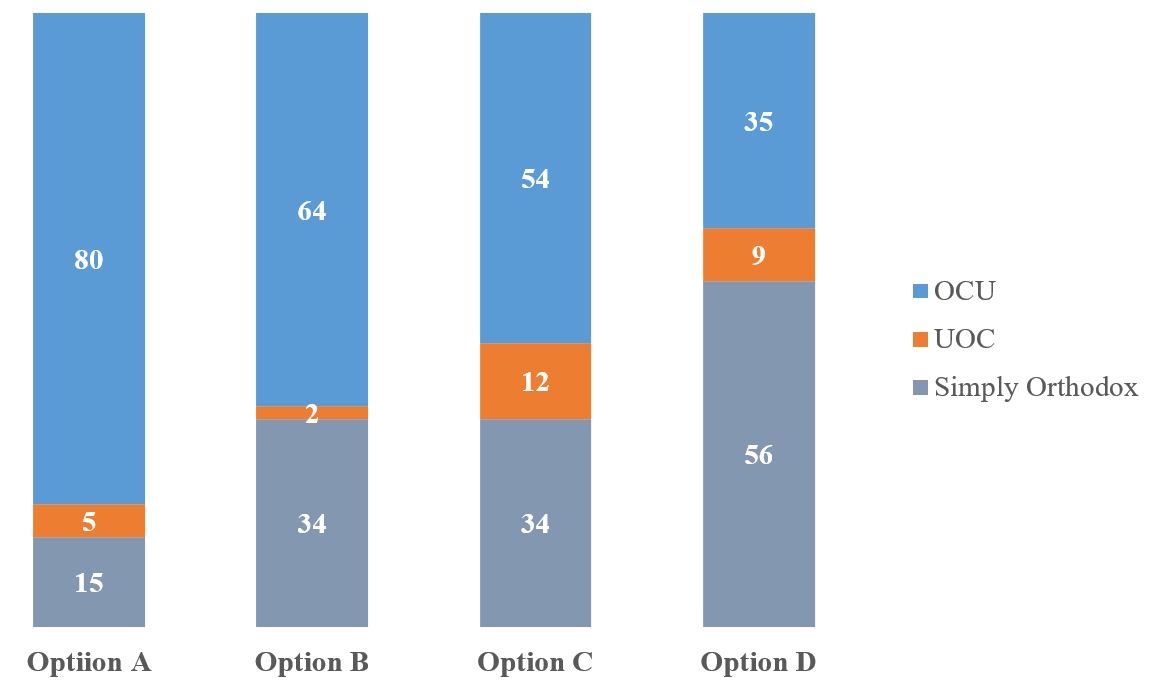
As we mentioned at the beginning, we conducted an experiment with 3 alternative wordings (in addition to our usual monitoring question – we consider it option A). The difference was as follows (compared to option A): Option B – we also read the option “simply Orthodox”, i.e. this option was immediately heard by respondents among the available options:
Option C – we read only the names of the Churches and their leaders, without additional information about the OCU and without mentioning the Moscow Patriarchate for the UOC. The option “just Orthodox” was not read:
Option D – we read only the names of the Churches and their leaders, without additional information about the OCU and without mentioning the Moscow Patriarchate for the UOC. At the same time, the option “simply Orthodox” was also read:
To better visualize the impact of the question wording, the graph below shows the results only for Orthodox Christians, i.e. how the Orthodox membership (if taken as 100%) changes depending on the question wording. So, if in the usual monitoring version (with additional information about both Churches and without reading the option “just Orthodox”) 80% consider themselves to be members of the OCU, 5% – of the UOC, and 15% – on their own initiative ask to be included to simply Orthodox. If we immediately read the option “just Orthodox”, then their share increases to 34%. In this case, both the OCU (a decrease in the share to 64%) and the UOC (a decrease in the share to 2%) “lose”. If do not read additional information and only indicate the leaders, then 54% choose the OCU, 12% - the UOC, 34% - on their own initiative ask to included to simply Orthodox. If to immediately read the option "simply Orthodox" in such a question, then their share will increase to 56% (and both the OCU and the UOC will suffer losses).
Graph 1. Which Orthodox Church do they belong to (% among Orthodox)
Difference between the OCU and the UOC
In addition, respondents who were asked questions C and D (i.e. who were not provided with additional information about the Churches) were asked an additional open-ended question, “How does the Ukrainian Orthodox Church, headed by Onuphrius, differ from the Orthodox Church of Ukraine, headed by Epiphanius?”. The majority of respondents (and these were those who consider themselves Orthodox) – 65% – answered that they could not answer this question. Among those who could, the majority (23% out of 35%) said that the UOC has ties with Russia/is subordinate to the Moscow Patriarchate (i.e., there was a greater negative emphasis on this fact). Another 9% talked about different Patriarchates, calendars, language, etc. (these answers looked more neutral, although some of them most likely also included negative ones). Other answers were mentioned less frequently.
Graph 2. And how does the Ukrainian Orthodox Church, headed by Onuphrius, differ from the Orthodox Church of Ukraine, headed by Epiphanius? open question, % among Orthodox Christians (who answered options C and D) 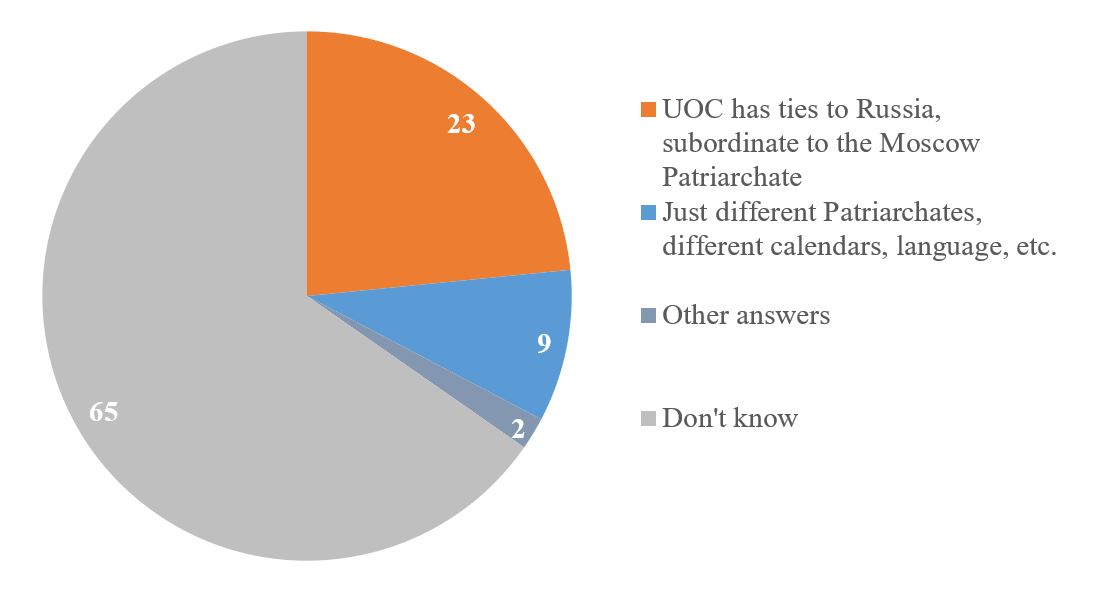
A. Grushetskyi, comments on the survey results:
The results obtained show a high dependence of the religious structure of Ukrainian society on how we ask questions. Therefore, different researchers often have different results and fiercely argue about what the “real” religious structure of Ukraine currently looks like. This situation raises two interrelated questions: why exactly does this happen (i.e. why do we see such different results for different formulations) and what is the more correct approach? Some experts may answer the first question that parishioners of the UOC, due to fear of persecution, are afraid to answer about their affiliation and therefore, when possible, choose the more “safe” option of “simply Orthodox.” However, there are also other explanations. For example, the level of religious awareness of Ukrainians is actually not very high, many people do not understand the difference between the “OCU” and the “UOC”, and religion in general does not play such an important role in their lives. Therefore, when there is additional information-markers, such people are guided by them, and when there is none, they tend to the option “just Orthodox”, which is actually the equivalent of “hard to say” in a situation of low awareness and low importance for respondents. Additional comprehensive research is needed to provide a clear answer to this question. At the same time, the set of other relevant results suggests that the second explanation – lower religious awareness/importance – plays a greater role (rather than the alleged fear of persecution). So, formally the top 2 public holidays for Ukrainians are Easter and Christmas[2]. This can be interpreted as high religiosity, although according to the author's observations, these holidays already have a largely family and more secularized tone. We regularly ask questions about trust in institutions, and, for example, in 2012, 62% trusted the Church (which was the leader in trust among all institutions). In 2025, 44% trusted the Church, 28% did not trust it, and 28% had an uncertain attitude (although trust in 2025 is slightly higher than in 2024, but still significantly lower than in 2012)[3]. We do not say which Church specifically we are asking about, but the decline in trust indicates that fewer people have associations with the word “Church” that would stimulate talking about “trust.” Also, in the current press release, we see that a third of young people consider themselves atheists/agnostics. And two-thirds of Orthodox cannot tell the difference between the UOC and the OCU. In other words, all this indicates that the role of religion in the lives of many Ukrainians is actually not as deep as it might seem (and quite likely has other, more secularized shades – for example, in the context of Ukrainian national identity). In the context of the persecution, KIIS in 2025-2026 asked questions about the state of democracy in Ukraine and additionally, in an open form, Ukrainians could name signs of a movement towards authoritarianism or signs of a lack of democracy. In such more neutral questions, respondents could certainly speak freely about the problems they see and that concern them. However, only a few respondents spoke about alleged oppression of the UOC. In the case of the question of which approach to studying the religious structure of the population is best, there is also no clear answer and different researchers can quite legitimately use different tools. However, it is important to be aware of the advantages and limitations of each approach and to determine priorities for yourself. For example, if additional information about the OCU and the UOC is avoided, then in conditions where two-thirds cannot tell the difference, this will make the question less understandable for respondents. The mention of the “Moscow Patriarchate” is expected to cause negative connotations. There is also often a question of tracking dynamics, when it is necessary to maintain the wording of the question so that it is possible to correctly compare with previous years. For example, another reputable company, the Razumkov Center, conducted its regular survey on religion in Ukraine in November 2025[4]. The survey was conducted by the personal interviews (face-to-face) method (our survey was conducted by telephone interviews). The Razumkov Center also used two questions (as we did), but in a slightly different formulation. In particular, the first question had the option “I am simply a Christian,” which was chosen by 10% of respondents. However, in the case of the UOC, there was also additional information “Moscow Patriarchate.” Overall, the results were close to the results of KIIS (for the KIIS monitoring question) – a total of 58% considered themselves Orthodox, of which 42% considered themselves to be part of the OCU, 5% to the UOC, and 10% considered themselves simply Orthodox. We (KIIS) have slightly more Orthodox in general and those who belong to the OCU in particular, but the same number of those belonging to the UOC and “simply Orthodox.” This may be a consequence, firstly, of the presence of the option “I am just a Christian” in the Razumkov Center survey, which in its absence may “switch” to Orthodox, and then more likely be distributed in favor of parishioners of the OCU. Thus, the results of the Razumkov Center survey are quite close to our results. However, there are still differences due to methodological features. This provides useful information for discussions between researchers and experts. At the same time, in any case, it is important that this discussion be calm and constructive, without emotional unfounded accusations.
Appendix 1. Formulation of questions from the questionnaire
To which denomination or religion, if any, do you belong? READ 1-9
NEXT QUESTION, IF YOU CHOSEN “1” IN THE PREVIOUS ONE. RANDOMLY CHOOSE ONE OF THE OPTIONS A, B, C OR D
А. And which Orthodox Church do you belong to? READ OPTIONS 1-2. MARK OPTION 3 ONLY IF THE RESPONDENT HIMSELF INSISTS ON IT
B. And which exact Orthodox Church do you belong to? READ ALL OPTIONS 1-3.
C. And which exact Orthodox Church do you belong to? READ OPTIONS 1-2. DO NOT INDICATE ANYTHING ABOUT THE CHURCHES, THAT IS, DO NOT PROVIDE ANY ADDITIONAL INFORMATION (FOR EXAMPLE, DO NOT SAY WHICH PATRIARCHATE, ETC.) MARK OPTION 3 ONLY IF THE RESPONDENT HIMSELF INSISTS ON IT
D. And which exact Orthodox Church do you belong to? READ ALL OPTIONS 1-3. DO NOT INDICATE ANYTHING ABOUT THE CHURCHES, MEANING: DO NOT PROVIDE ANY ADDITIONAL INFORMATION (FOR EXAMPLE, DO NOT SAY WHAT PATRIARCHY, ETC.)
IF THE RESPONDENT WAS ASKED OPTION C OR D
And how does the Ukrainian Orthodox Church, headed by Onuphrius, differ from the Orthodox Church of Ukraine, headed by Epiphanius? GET A SPECIFIC ANSWER. DO NOT ACCEPT GENERAL ANSWERS SUCH AS, FOR EXAMPLE, “SIMPLE DIFFERENT CHURCHES” OR “DIFFERENT LEADERS”. FIND OUT WHAT, IN THE RESPONDENT’S OPINION, MAKES THESE CHURCHES DIFFERENT DO NOT SUGGEST ANYTHING ABOUT THE CHURCHES, MEANING NOT TO PROVIDE ANY ADDITIONAL INFORMATION (FOR EXAMPLE, DO NOT SAY WHAT PATRIARCHATE, ETC.)
_____________________________________________________________________________________ [1] The composition of the macroregions is as follows: Western macroregion - Volyn, Rivne, Lviv, Ivano-Frankivsk, Ternopil, Zakarpattia, Khmelnytskyi, Chernivtsi oblasts; Central macroregion - Vinnytsia, Zhytomyr, Sumy, Chernihiv, Poltava, Kirovohrad, Cherkasy, Kyiv oblasts, Kyiv city, Southern macroregion - Dnipropetrovsk, Zaporizhzhia, Mykolaiv, Kherson, Odesa oblasts, Eastern macroregion - Donetsk, Luhansk and Kharkiv oblasts. [2] Attitude of Ukrainians towards public holidays and in particular towards March 8 // https://www.kiis.com.ua/?lang=ukr&cat=reports&id=1591&page=1 [3] Trust in public institutions // https://www.kiis.com.ua/?lang=ukr&cat=reports&id=1578&page=1 [4] Level of religiosity, confessional and church division, and inter-church relations in Ukrainian society (November 2025) // https://razumkov.org.ua/napriamky/sotsiologichni-doslidzhennia/riven-religiinosti-konfesiinyi-i-tserkovnyi-rozpodil-ta-mizhtserkovni-vidnosyny-v-ukrainskomu-suspilstvi-lystopad-2025r
7.4.2026
|
Our social media:
 KIIS page
 KIIS channel