

ESC or click to close
|
Press releases and reports
Sympathies of Ukrainians in the USA-Israeli-Iran conflict
The press release was prepared by Anton Grushetskyi, executive director of KIIS
From April 20 to 27, 2026, the Kyiv International Institute of Sociology (KIIS) conducted its own all-Ukrainian public opinion survey, to which, on its own initiative, added a question about who Ukrainians sympathize with more - the USA-Israel or Iran. By the method of telephone interviews (computer-assistedtelephoneinterviews, CATI) based on a random sample of mobile phone numbers (with random generation of phone numbers and subsequent statistical weighting) in all regions of Ukraine (the territory controlled by the Government of Ukraine), 1,005 respondents were surveyed. The survey was conducted with adult (aged 18 and older) citizens of Ukraine who, at the time of the survey, lived in the territory of Ukraine controlled by the Government of Ukraine. The sample did not include residents of territories temporarily not controlled by the Ukrainian authorities (at the same time, some of the respondents are IDPs who moved from the occupied territories), and the survey was not conducted with citizens who left abroad after February 24, 2022. Formally, under normal circumstances, the statistical error of such a sample (with a probability of 0.95 and taking into account the design effect of 1.3) did not exceed 4.1% for indicators close to 50%, 3.5% for indicators close to 25%, 2.5% for indicators close to 10%, 1.8% for indicators close to 5%. Under conditions of war, in addition to the specified formal error, a certain systematic deviation is added. Factors that may affect the quality of results in "wartime" conditions were previously cited by KIIS. In general, we believe that the obtained results are still highly representative and allow a fairly reliable analysis of the public moods of the population.
KIIS regularly monitors the thoughts and views of Ukrainians regarding events in the Middle East. For example, in December 2023, after the “Hamas” terrorist attack on October 7, we asked Ukrainians the question "Which side of the Israeli-Palestinian conflict do you sympathize with more?". Then 69% of Ukrainians expressed support for Israel, 1% for Palestine (among the remaining 18% expressed support for both sides, and 12% could not decide on their opinion)[1]. Then, in July-August 2025, after the 12-day war between Israel and Iran, KIIS asked Ukrainians who they sympathized with in that war. And already 42% of Ukrainians gave their sympathies to Israel, 3% - to Iran. And another 42% did not sympathize with either side (the remaining 13% were undecided or did not know anything about the conflict)[2]. And finally, now, in April 2026, we asked about sympathies in the current conflict. Since the fighting is now being waged jointly by the USA and Israel, we asked, “In the conflict between, on the one hand, the USA and Israel and, on the other hand, Iran, do your sympathies lie with…?”.
Sympathies in the USA-Israeli-Iran conflict
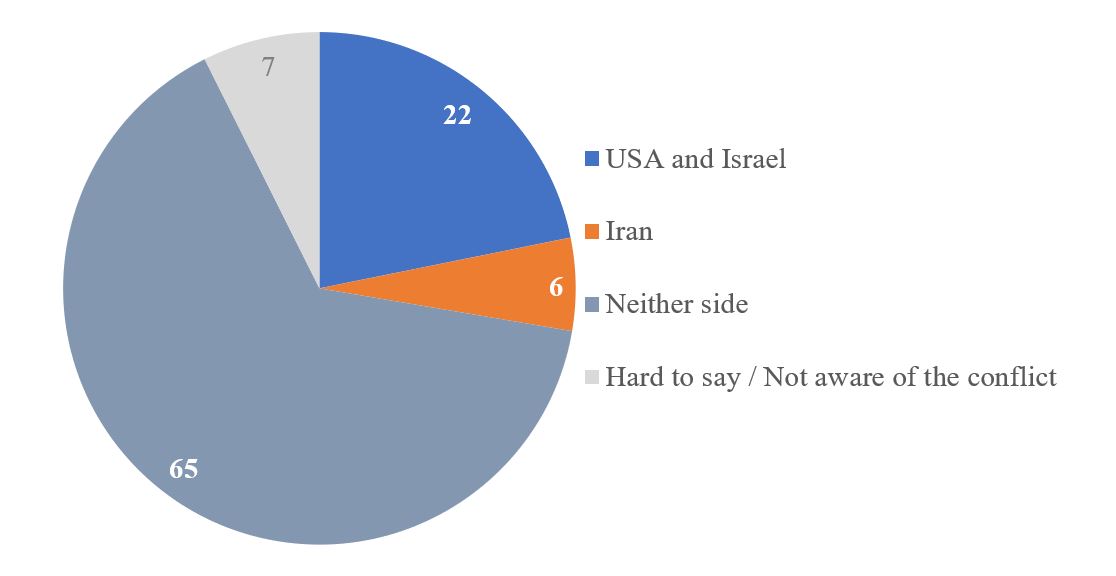
So, the majority of Ukrainians – 65% – say they do not support any side. At the same time, 22% expressed support for the USA and Israel, and 7% for Iran. Another 7% could not answer the question (or did not know about the conflict).
Graph 1. In the conflict between, on the one hand, the USA and Israel and, on the other hand, Iran, do your sympathies lie with…?
 The table below shows the data in terms of individual population categories. As can be seen, the majority among all the categories do not support either side (although there are some differences - for example, more educated respondents were more likely to say they sided with the USA-Israeli side, although even among them 61% do not support either side).
Table 1. In the conflict between, on the one hand, the USA and Israel and, on the other hand, Iran, do your sympathies lie with…?
A. Grushetskyi, comments on the survey results:
Our surveys show that since 2023, sympathy for Israel has been declining. From overwhelming support after the horrific terrorist attack on October 7, 2023, to overwhelming disapproval of joint USA-Israeli action against the regime in Iran now. At the same time, we emphasize that if in 2023 and 2025 we asked only about Israel, now we ask about joint actions of the USA and Israel. Given the rather significant criticism of the USA leadership by the Ukrainian population, the current results could reflect a more critical attitude towards D. Trump, and to a lesser extent it concerned Israel. In any case, the Iranian regime is undoubtedly an enemy of Ukraine for its cooperation with Russia and its responsibility for the numerous victims among the Ukrainian population. However, the current war has obviously dragged on, Iran has found the weaknesses of its opponents (primarily the Strait of Hormuz), and there is currently no way to end the conflict in the near future. As a result, the price of oil has increased, the USA is easing sanctions against Russia, which supports the possibility of the Russian state to wage war against Ukraine. Therefore, the “unpopularity” of the USA-Israeli war against Iran among the Ukrainian public is quite understandable. At the same time, this situation once again shows that allied or at least constructive partnership relations between Ukraine and Israel are absolutely natural. Our enemies are common. Russia is not an ally and is not a reliable partner of Israel, but in fact is a warmonger and sower of chaos in the Middle East. Therefore, it is very unfortunate when the impression is created that the Israeli leadership prefers relations with hostile Russia (which openly supports Israel's enemy Iran!) and ignores the potential of relations with Ukraine or even resorts to unfriendly actions (such as the possible participation of Israeli ports in receiving grain stolen from the occupied territories of Ukraine). Moreover, KIIS surveys show a consistently favorable attitude of Ukrainians towards Jewish residents of Ukraine. For example, in September 2025, in terms of social distance, Jewish residents of Ukraine were right after Ukrainians themselves[4], that is, the attitude is completely tolerant and open. Ukrainian Jews are participating in the fight against Russian aggression (for example, the activities of Chief Rabbi Moshe Azman). Recently, President V. Zelenskyy signed a law that directly establishes criminal liability for manifestations of anti-Semitism. That is, both at the level of Ukrainian society and at the level of state institutions, we see a favorable attitude and a willingness to cooperate. It is fair to expect that the leadership of Israel will also be willing to partner with Ukraine. At the same time, we call on Ukrainians not to give in to emotions and to calmly react to problems in relations between Israel and Ukraine, and especially not to slide into caustic comments “on the verge of correctness” (or even beyond the verge). It is necessary to distinguish between the leadership of Israel and Israeli society, where there are many sympathizers and true friends of Ukraine. Again, Governments come and go. Societies remain. Ukraine and Israel retain significant potential for cooperation and we must work so that further, in more favorable conditions, we can fully realize our common prospects. Only our enemies benefit from conflicts and tensions in relations.
Appendix 1. Formulation of questions from the questionnaire
In the conflict between, on the one hand, the USA and Israel and, on the other hand, Iran, your sympathies are on the side of... RANDOMIZATION OF THE ORDER OF STATEMENTS 1-2
[1] Who do Ukrainians sympathize with in the Israeli-Palestinian conflict: results of a telephone survey conducted November 29-December 9, 2023 // https://www.kiis.com.ua/?lang=ukr&cat=reports&id=1334&page=1 [2] Who do Ukrainians sympathize with in the Israel-Iran conflict? // https://kiis.com.ua/?lang=ukr&cat=reports&id=1544&page=1 [3] The composition of the macroregions is as follows: West – Volyn, Rivne, Lviv, Ivano-Frankivsk, Ternopil, Zakarpattia, Khmelnytskyi, Chernivtsi oblasts; Kyiv city – only Kyiv city (without the oblast); Center / North – Vinnytsia, Zhytomyr, Kyiv, Kirovohrad, Poltava, Sumy, Cherkasy, Chernihiv oblasts; South – Mykolaiv, Odesa, Kherson oblasts; Lower Dnieper region – Dnipropetrovsk, Zaporizhzhia oblasts; East – Donetsk and Kharkiv oblasts (formally, the macroregion also includes the Luhansk oblast, but due to the almost complete occupation, none of the respondents currently live there, although there are respondents who lived in this oblast until 2022). [4] Interethnic prejudices in Ukraine: September-October 2025 // https://kiis.com.ua/?lang=ukr&cat=reports&id=1603&page=1
29.4.2026
|
Our social media:
 KIIS page
 KIIS channel