

ESC or click to close
|
Press releases and reports
Opinions and views of Ukrainians on war and peace: results of a survey conducted during April 20-27, 2026
The press release was prepared by Anton Grushetskyi, executive director of KIIS
During April 20-27, 2026, the Kyiv International Institute of Sociology (KIIS) conducted its own all-Ukrainian public opinion survey, to which, on its own initiative, added questions about war and peace. By the method of telephone interviews (computer-assistedtelephoneinterviews, CATI) based on a random sample of mobile phone numbers (with random generation of phone numbers and subsequent statistical weighting) in all regions of Ukraine (the territory controlled by the Government of Ukraine), 1,005 respondents were surveyed. The survey was conducted with adult (aged 18 and older) citizens of Ukraine who, at the time of the survey, lived in the territory of Ukraine controlled by the Government of Ukraine. The sample did not include residents of territories temporarily not controlled by the Ukrainian authorities (at the same time, some of the respondents are IDPs who moved from the occupied territories), and the survey was not conducted with citizens who left abroad after February 24, 2022. Formally, under normal circumstances, the statistical error of such a sample (with a probability of 0.95 and taking into account the design effect of 1.3) did not exceed 4.1% for indicators close to 50%, 3.5% for indicators close to 25%, 2.5% for indicators close to 10%, 1.8% for indicators close to 5%. Under conditions of war, in addition to the specified formal error, a certain systematic deviation is added. Factors that may affect the quality of results in "wartime" conditions were previously cited by KIIS. In general, we believe that the obtained results are still highly representative and allow a fairly reliable analysis of the public moods of the population.
Attitude towards the transfer of the entire Donetsk oblast under Russian control in exchange for security guarantees from the USA and Europe
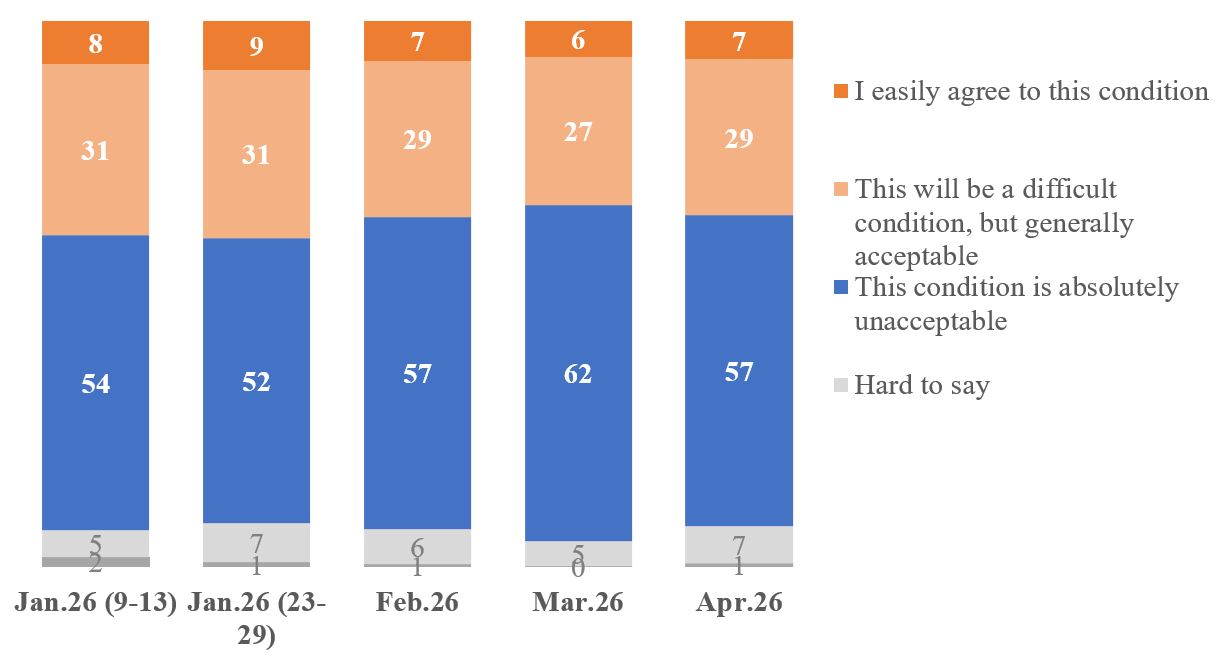
Since January 2026, KIIS has been asking the question whether Ukrainians are ready to withdraw troops from the Donetsk oblast in exchange for security guarantees from the USA and Europe. Thus, 57% of respondents consider it categorically unacceptable to transfer the entire Donetsk oblast under Russian control in exchange for security guarantees. At the same time, 36% are ready for such a concession (although most of them admit that this is a difficult condition). Another 7% could not decide on their opinion. Compared to the beginning of March 2026, there have been slightly fewer people who are categorically against it, from 62% to 57%. The share of those who agreed at the beginning of March was 33%, now it is 36%. The current indicators (at the end of April) have returned to the February level. In general, it can be seen that over the entire period of observation, public opinion on this issue has not changed significantly and the majority of Ukrainians have consistently criticized such an initiative. At the same time, we recall that our experiment in mid-February showed that if to specify the security guarantees from the USA and directly state that they will not include the deployment of their troops in Ukraine, the closure of the skies, and the free provision of weapons, then support for the proposal is significantly lower[1].
Graph 1. Now I will read a possible condition for achieving peace, and you tell me how acceptable it is to you. Use the scale “I easily agree with this condition”, “This will be a difficult condition, but generally acceptable”, “This condition is absolutely unacceptable”. Ukraine withdraws its troops from the territories of Donbas that it currently controls, i.e. from Kramatorsk, Sloviansk, etc., and these territories pass under Russian control. In return, the USA and Europe give Ukraine security guarantees
 Who is disrupting efforts to achieve peace
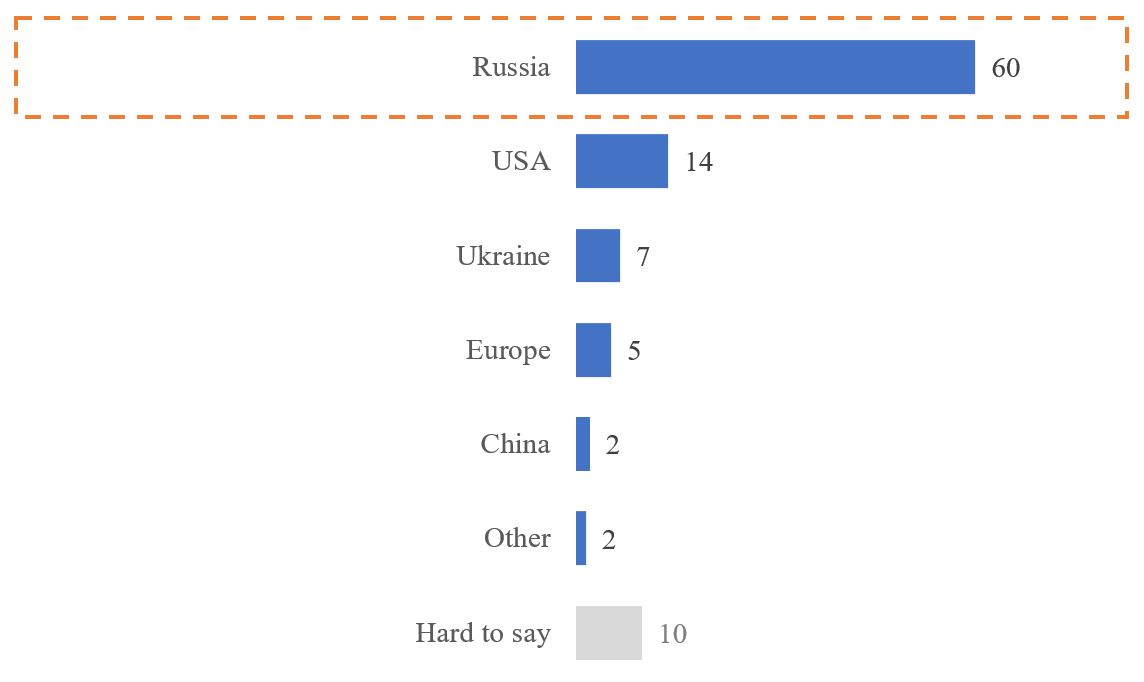
The majority of Ukrainians – 60% – believe that Russia is the biggest obstacle to efforts to end the war. The USA is next – 14% believe they are most responsible for the failure to end the war. Blame primarily Ukraine – 7%, Europe – 5%.
Graph 2. Who is currently most obstructing and disrupting efforts to end the war? The respondent could only choose one answer
When Ukrainians wait for the war to end
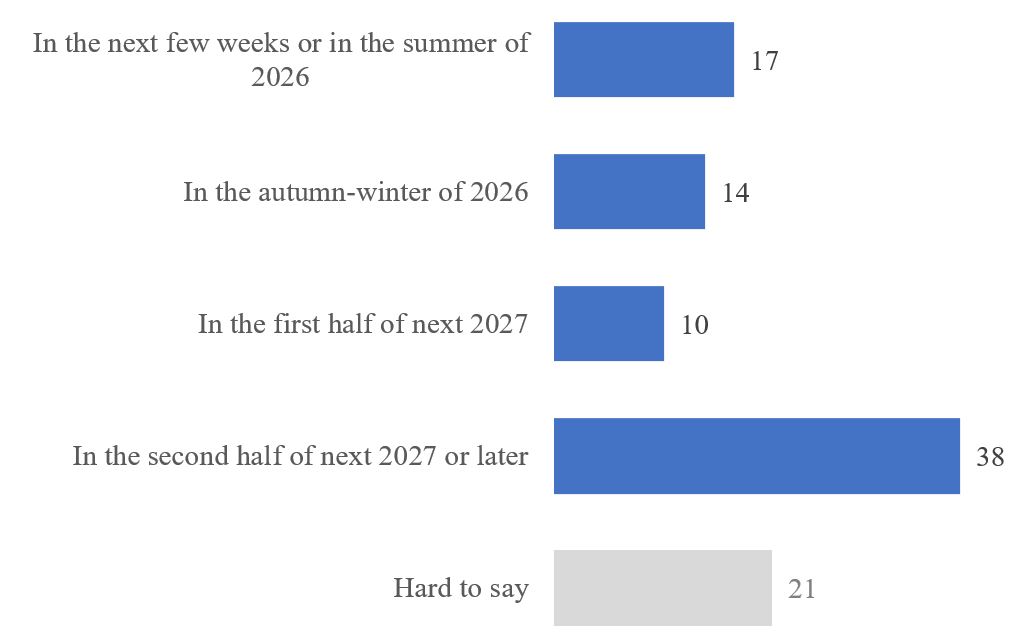
Only 17% of Ukrainians expect the war to end at least by the summer of 2026. Another 14% expect it to end by the end of the year, i.e. a total of 31% believe that hostilities will end by the end of 2026. Instead, almost half (48%) expect completion next year, 2027 (with 38% of them talking about the second half of 2027). As before, a significant share (21%) has no definite opinion on this issue. Thus, Ukrainians are mostly prepared for the war to continue for a long time.
Graph 3. In your opinion, when might the war end?
How much longer are Ukrainians ready to endure war
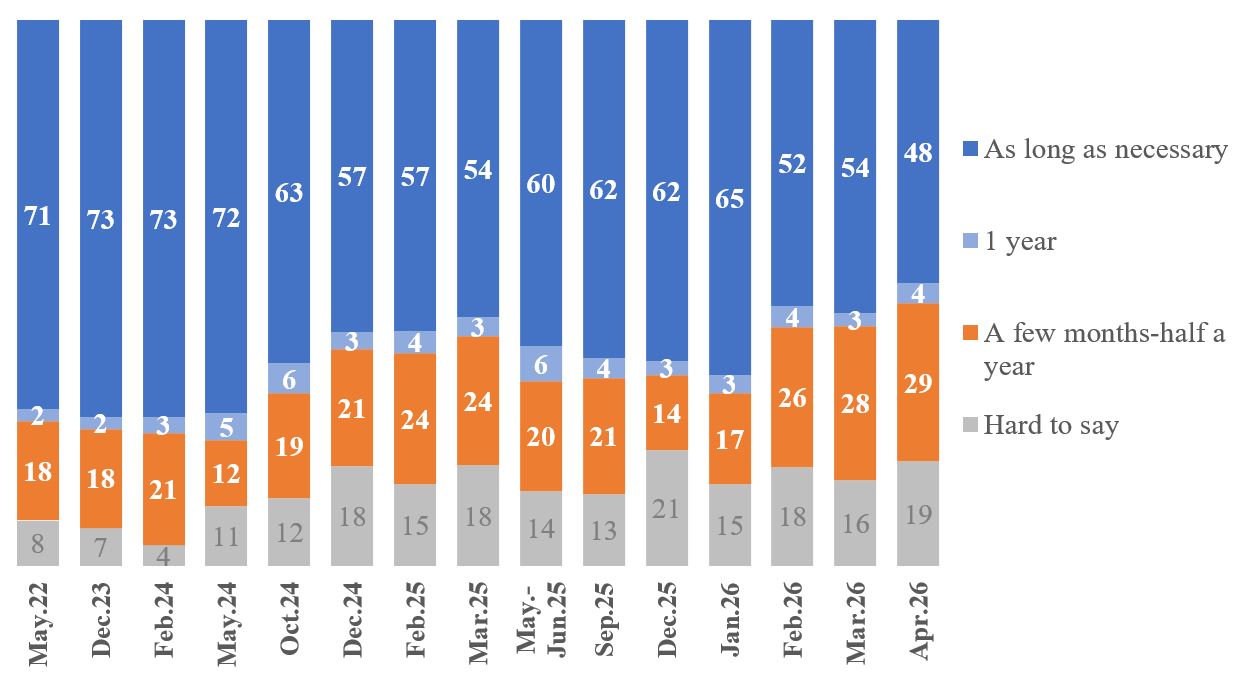
The negative dynamics of a decrease in the share of those who are ready to endure war as long as necessary continues in April. If at the beginning of March there were 54% of them, then at the end of April – 48%. Another 4% are ready to endure 1 year, meaning a total of 52% are now talking about a relatively long period (in March – 57%). At the same time, the share of those who are ready to endure a short period (several months to half a year) has not changed – 28% in March and 29% in April. Instead, there is a trend towards increasing uncertainty – if in March 16% could not answer this question, then now – 19%. At the same time, we note that even among those who are ready to endure only a short period, a significant part categorically rejects unacceptable demands for peace. So, among them, 44% consider the offer of exchanging Donbas for security guarantees from the USA and Europe to be absolutely unacceptable. The situation is similar among those who have an uncertain opinion about their “safety margin” – among them, 49% categorically reject such an offer. (For comparison, among those who are ready to endure as long as necessary – 69% categorically reject the offer.)
Graph 4. How much longer are you ready to endure war?
 Trust in security guarantees from Europe and the USA
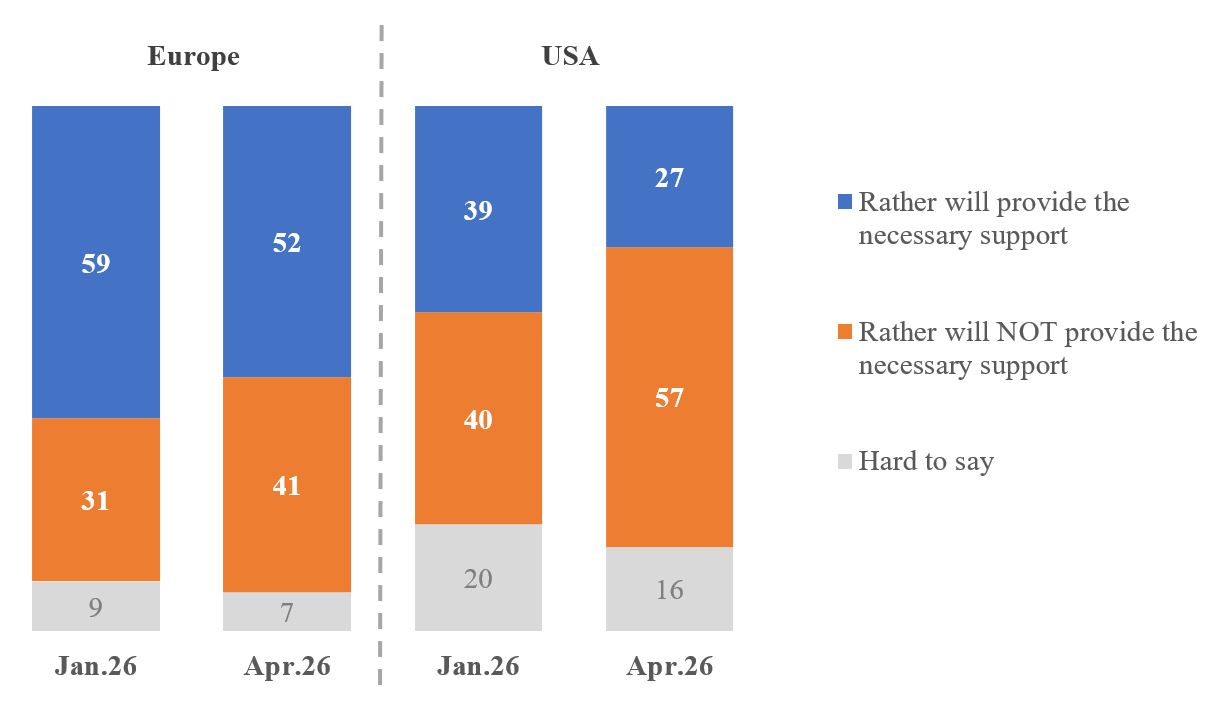
Compared to January 2026, trust in security guarantees from both Europe and the USA has decreased among Ukrainians. Thus, if at the beginning of the year 59% of Ukrainians expected that in the event of a repeated attack, Europe would provide the necessary support to repel the attack, now it is 52%. On the other hand, from 31% to 41%, there are more people who do not believe that Europe will provide the necessary support. At the same time, there are still more Ukrainians who believe in security guarantees from Europe. In the case of the USA, the changes are more radical. If in January we observed parity between those who believe and those who do not, now, in April, the majority of Ukrainians do not believe that the USA will provide the necessary support. The share of those who do not believe has increased from 40% to 57%. In contrast, the number of those who trust security guarantees from the USA has decreased from 39% to 27%. It is worth noting separately that in the case of the USA, compared to Europe, there are twice as many people who hesitated and were unable to answer the question – 16% versus 7%.
Graph 5. Imagine that a ceasefire is declared behind the current front line and the USA and Europe provide Ukraine with security guarantees. And if Russia does attack Ukraine again, do you think Europe will provide the necessary support to repel the attack?" / "What about the USA?
 A. Grushetskyi, comments on the survey results:
Ukrainian public opinion on war and peace issues has remained relatively stable over the recent period, although there is some dynamism that is worth paying attention to. First, few Ukrainians have optimistic expectations about the end of the war in the near future. Most Ukrainians either talk about 2027 (and mostly about its second half), or simply answer that in the current conditions it is unknown. Moreover, over the recent period, since the beginning of the USA-Israeli war against Iran, the diplomatic process, which did not arouse enthusiasm among Ukrainians, has almost stopped. Secondly, the majority of Ukrainians identify Russia’s position as the main barrier to peace. Only a minority (12%) share the narrative that Ukraine and/or Europe are disrupting peace agreements. That is, hostile propaganda (and the specific media policy of some Ukrainian so-called “allies”), on the one hand, is not successful in convincing Ukrainians to see an obstacle to peace in Ukraine/Europe. On the other hand, however, these 12% are several million of our fellow citizens. In absolute terms, this is a large number of people, which indicates that from the point of view of information security in Ukraine, many risks remain. Thirdly, the high uncertainty, which most likely became even more noticeable due to the consequences of the war in Iran, is weighing on more than a few Ukrainians. Although slightly, there are fewer of those who categorically reject the offer to exchange the Donetsk oblast for security guarantees, and those who claim to be ready to endure the war as long as necessary. This does not mean that others (who speak of a shorter period of their own margin of safety) are ready for any end to the war. No, and we show that, for example, almost half of them are categorically against the exchange of the Donetsk oblast for security guarantees. And in the case of the offer itself, the majority still continue to reject it. Fourth, there is a noticeable erosion of trust in possible security guarantees from Europe and the USA, especially the USA. In fact, most Ukrainians do not believe that the USA will provide the necessary support in the event of a second Russian attack (although at the beginning of the year there was parity in Ukrainian assessments). In such an atmosphere, it is futile to expect Ukrainians to approve a peace agreement where the sustainability of future peace would be based on security guarantees from the USA. Currently, the USA operation in Iran has not only provided significant economic benefits to Russia (which helps it continue to kill Ukrainians), but has also further shaken faith in the reliability of American support. At the same time, the decline in trust in security guarantees from Europe is also very worrying. The feeling of a European shoulder of support and a European perspective of a prosperous future is one of the most important pillars of Ukrainian resilience. Disappointment in Europe can lead to a significant deterioration in the moral and psychological disposition to continue the resistance, and to the fact that populist forces with anti-European rhetoric will raise their heads.
Appendix 1. Formulation of questions from the questionnaire
How much longer are you ready to endure war? READ
In your opinion, when might the war end? READ
Now I will read out a possible condition for achieving peace, and you tell me how acceptable it is to you. Use the scale “I easily agree with this condition”, “This will be a difficult condition, but generally acceptable”, “This condition is absolutely unacceptable”. Ukraine withdraws its troops from the territories of Donbas that it currently controls, i.e. from Kramatorsk, Sloviansk, etc., and these territories pass under Russian control. In return, the USA and Europe give Ukraine security guarantees
Who is currently most hindering and disrupting efforts to end the war? READ. ORDER RANDOMIZATION
Imagine a ceasefire being declared along the current front line and the USA and Europe providing security guarantees to Ukraine. And if Russia does attack Ukraine again, do you think Europe will provide the necessary support to repel the attack? READ. ADD “OR” BETWEEN STATEMENTS. RANDOMIZATION OF ORDER
What about the USA? YOU CAN NOT READ IT AGAIN
[1] Perception of negotiations and attitude to the offer to exchange Donbas for security guarantees: results of a survey conducted on February 12-24, 2026 // https://www.kiis.com.ua/?lang=ukr&cat=reports&id=1589&page=1 [2] The composition of the macroregions is as follows: West – Volyn, Rivne, Lviv, Ivano-Frankivsk, Ternopil, Zakarpattia, Khmelnytskyi, Chernivtsi oblasts; Kyiv city – only Kyiv city (without the oblast); Center / North – Vinnytsia, Zhytomyr, Kyiv, Kirovohrad, Poltava, Sumy, Cherkasy, Chernihiv oblasts; South – Mykolaiv, Odesa, Kherson oblasts; Lower Dnieper region – Dnipropetrovsk, Zaporizhzhia oblasts; East – Donetsk and Kharkiv oblasts (formally, the macroregion also includes the Luhansk oblast, but due to the almost complete occupation, none of the respondents currently live there, although there are respondents who lived in this oblast until 2022).
30.4.2026
|
Our social media:
 KIIS page
 KIIS channel