

ESC or click to close
|
Press releases and reports
Dynamics of trust in President V. Zelenskyy: results of a survey conducted on April 20-27, 2026
The press release was prepared by Anton Grushetskyi, executive director of KIIS
During April 20-27, 2026, the Kyiv International Institute of Sociology (KIIS) conducted its own all-Ukrainian public opinion survey, to which, on its own initiative, added a question about trust in President V. Zelenskyy. By the method of telephone interviews (computer-assistedtelephoneinterviews, CATI) based on a random sample of mobile phone numbers (with random generation of phone numbers and subsequent statistical weighting) in all regions of Ukraine (the territory controlled by the Government of Ukraine), 1,005 respondents were surveyed. The survey was conducted with adult (aged 18 and older) citizens of Ukraine who, at the time of the survey, lived in the territory of Ukraine controlled by the Government of Ukraine. The sample did not include residents of territories temporarily not controlled by the Ukrainian authorities (at the same time, some of the respondents are IDPs who moved from the occupied territories), and the survey was not conducted with citizens who left abroad after February 24, 2022. Formally, under normal circumstances, the statistical error of such a sample (with a probability of 0.95 and taking into account the design effect of 1.3) did not exceed 4.1% for indicators close to 50%, 3.5% for indicators close to 25%, 2.5% for indicators close to 10%, 1.8% for indicators close to 5%. Under conditions of war, in addition to the specified formal error, a certain systematic deviation is added. Factors that may affect the quality of results in "wartime" conditions were previously cited by KIIS. In general, we believe that the obtained results are still highly representative and allow a fairly reliable analysis of the public moods of the population.
Dynamics of trust in President V. Zelensky
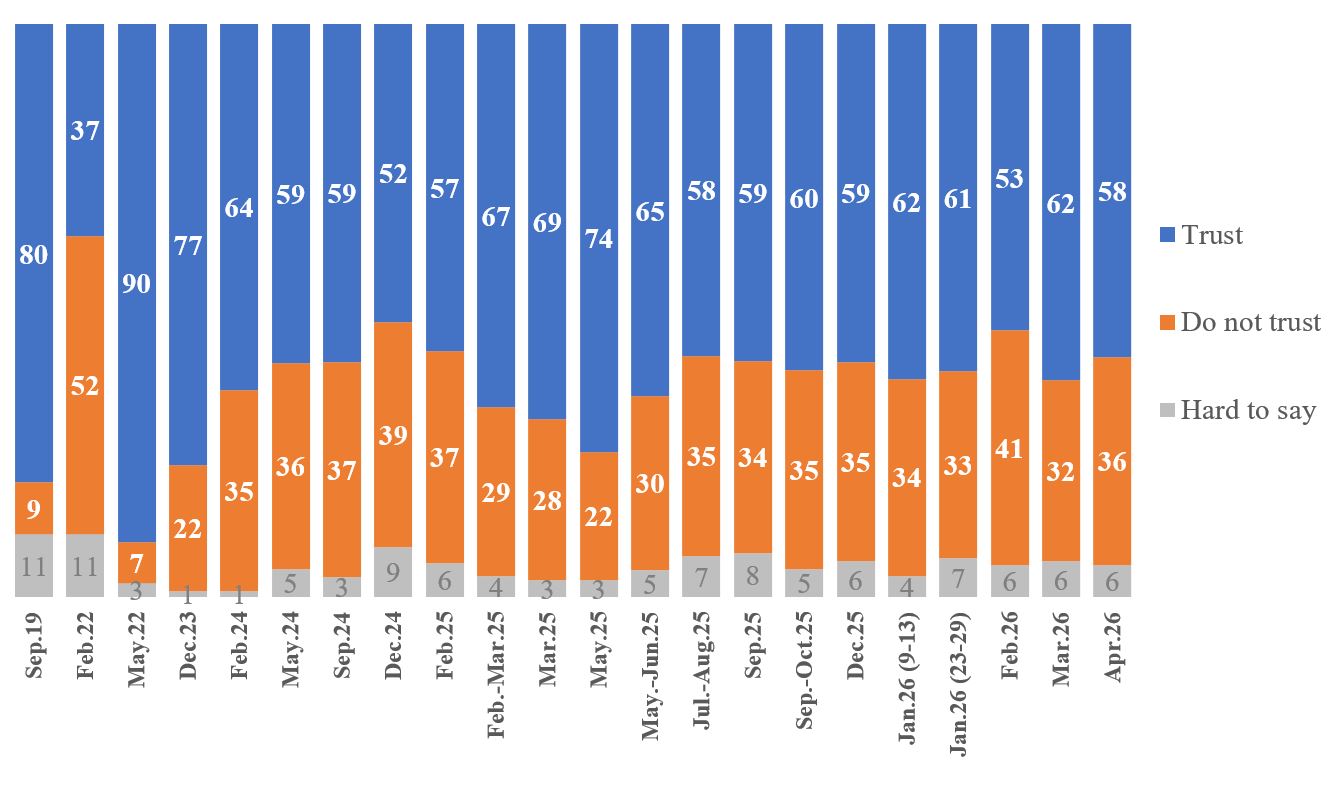
KIIS continues to monitor the dynamics of trust in President V. Zelenskyy. We remind that we usually ask the question “To what extent do you trust or do not trust Volodymyr Zelenskyy?” and read the following options: “completely trust”, “rather trust”, “rather do not trust” and “completely do not trust” (we do not read the option “hard to say”, but it can be marked if the respondent insists on it). So, 58% now trust the President, 36% do not trust him (balance of trust-distrust - +22%). Compared to March 2026, the level of trust has slightly decreased. Thus, the share of those who trust V. Zelenskyy has decreased from 62% to 58%, and the share of those who do not trust him has increased from 32% to 36%. Accordingly, the balance of trust-distrust was +30% in March compared to +22% now. In addition, it should be taken into account that among the 58% who trust V. Zelenskyy, 25% trust him “completely”, and the remaining 33% trust him “rather”. At the same time, for balance, it is important to understand that among those who do not trust him, there is a division – 18% do not trust him “completely”, and 18% do not trust him “rather”.
Graph 1. To what extent do you trust or do not trust Volodymyr Zelenskyy?
How Ukrainians see the future of V. Zelenskyy after the war
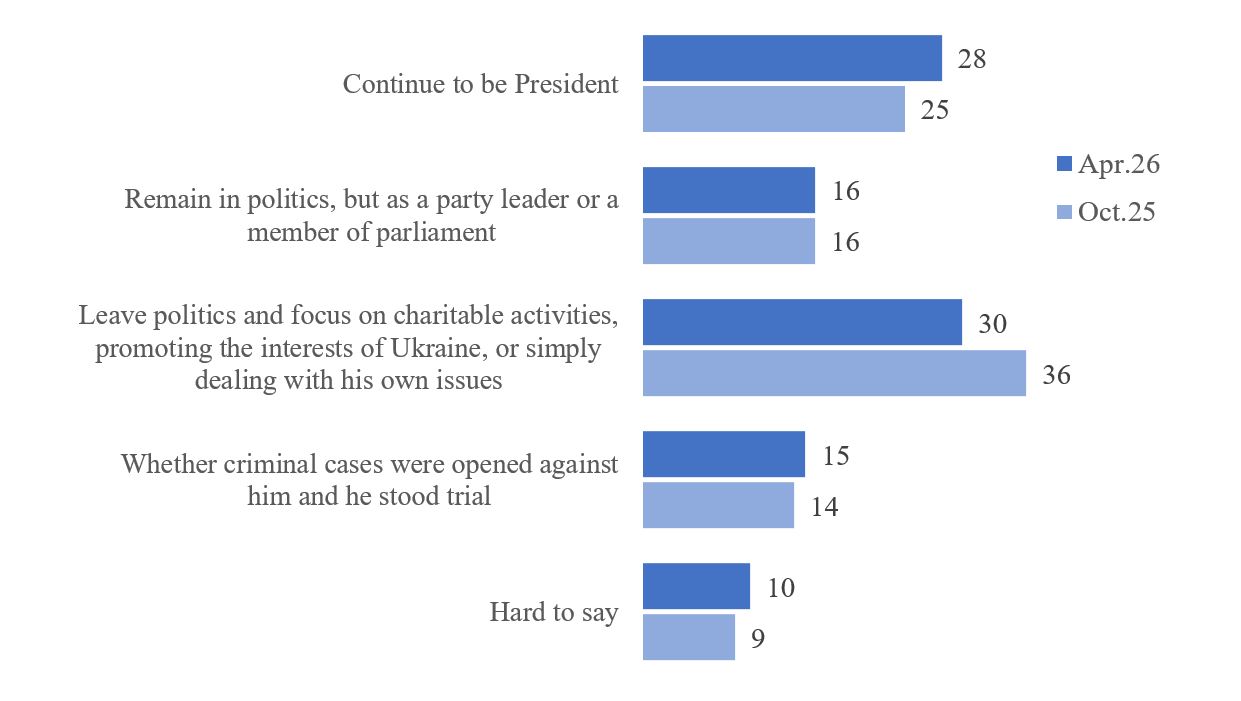
A separate additional question concerned how Ukrainians see V. Zelenskyy's future activities after the war. In September-October 2025, we asked this question for the first time (in addition to V. Zelenskyy, we also asked about P. Poroshenko)[1], now it has been repeated. As can be seen, want to see V. Zelenskyy as President even after the war – 28% (a slight increase from 25% in early October 2025). Another 16% (the same as before) believe that he can simply remain in politics – as a party leader or a member of parliament. At the same time, 30% (down from 36% previously) say that V. Zelenskyy should leave politics (and focus on charitable activities, promoting Ukraine's interests abroad, or simply on his own issues). Believe that V. Zelenskyy should be subject to criminal prosecution – 15% (unchanged compared to the results in early October 2025).
Graph 2. What would you like to see Volodymyr Zelenskyy's future activities after the war is over? Do you want him to….
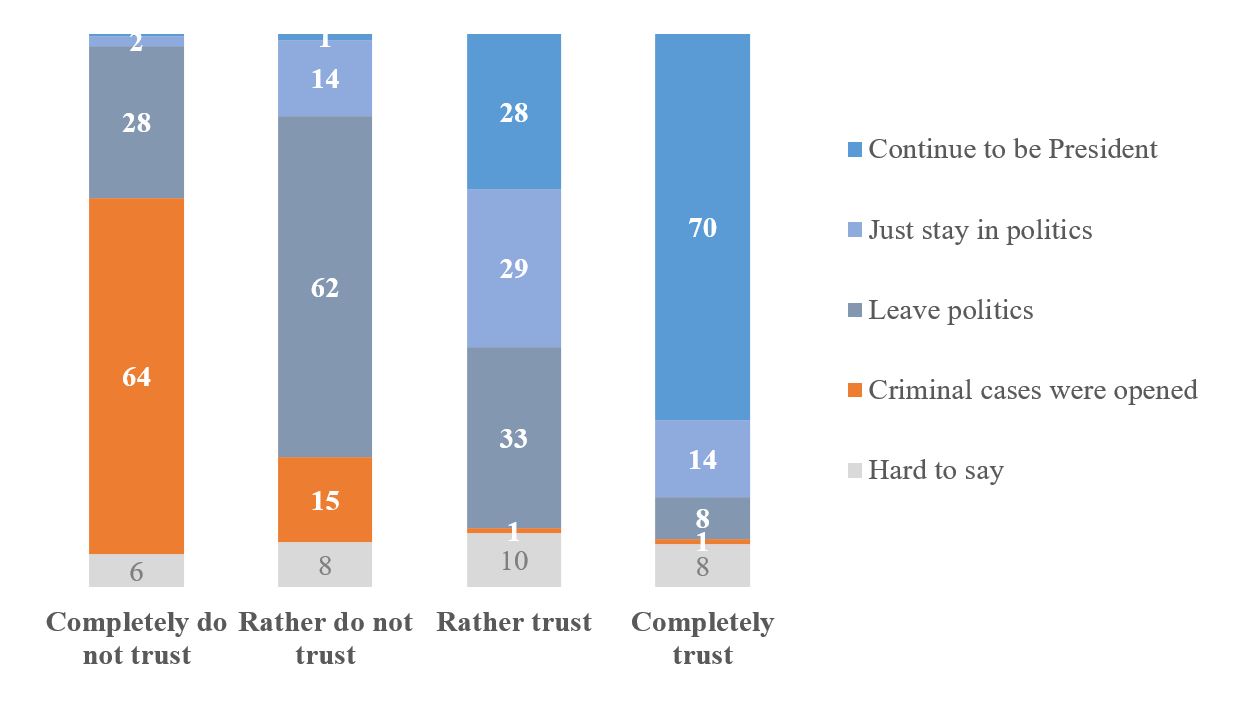
This question illustrates the importance of differentiating trust/distrust into the “completely”/“rather” segments. So, in fact, only among those who “completely” trust the majority (70%) want to see V. Zelenskyy continue as President. Among those who “rather” trust, only 28% want to see him continue as President (and the rest said either to participate in politics in another position or to leave politics). Among those who “rather” do not trust, a majority (62%) believe he should leave politics, but relatively few (15%) insist that he should face criminal prosecution. In contrast, among those who “completely” do not trust, a majority (64%) insist on criminal prosecution.
Graph 3. How do people see V. Zelenskyy's future activities after the war, depending on the level of trust
Additional re-survey with respondents who said they do not trust V. Zelenskyy
For a more in-depth analysis of distrust in V. Zelenskyy, we randomly selected 50 respondents who answered during the interview that they did not trust him (28 - did not trust him “completely”, 22 - did not trust him “rather”). We contacted them again and asked four questions. So, respondents were asked an open question about why they did not trust. As can be seen in the table below, respondents gave quite different reasons. Relatively most respondents (40%) gave explanations according to which the roots of their distrust are quite long-standing, and often traceable to the period before 2022 or even 2019. Some of them gave specific explanations (for example, the withdrawal of troops), but a significant part simply limited themselves to stating that they simply did not trust V. Zelensky for a long time. For example, one respondent answered that "has negative attitude towards Zelenskyy and his activities since the Kvartal 95". This is followed by explanations such as the war (he did not end it, it is still ongoing) (32%), the fact that he did not fulfill his election promises (28%), corruption (20%), and personnel policy (18%). It should be noted separately that among the 10 respondents who spoke about corruption, 2 respondents specifically mentioned the Mindich “case” (the remaining 8 spoke about corruption in general and did not mention the “Mindich case”). The following explanations for distrust were mentioned somewhat less frequently, but are also worth paying attention to: incompetence (12%), TCR activities/mobilization (10%), decrease in living standards (10%). Among other interesting/useful observations: 8% of such respondents (who do not trust) indicate that they support certain actions of the President. For example, as one respondent said, he "didn't support him in the elections, but he supports him as President, because during a war, the president needs support and it doesn't matter whether he voted for him or not". It is also important not only what respondents mentioned as reasons for distrust, but also what respondents did not say. That is, something can be considered an important reason for distrust, but in fact if respondents do not mention it, then it is not so important at the moment. Thus, only 4% (2 out of 50 respondents) noted that they were upset that V. Zelenskyy did not fulfill his promise to raise the status of the Russian language. None of the respondents said anything about the activities of the UOC. That is, these issues are not important points for those who do not trust him. However, for the sake of balance, it is important to note that no one also said that they were dissatisfied, for example, with insufficient pressure on the UOC (for its ban, the transition of parishes to the OCU, etc.) or insufficient Ukrainization. And issues related to alleged authoritarian tendencies are also not important. For example, only 1 out of 50 respondents (2%) spoke about restrictions in the media sphere, and only 1 more respondent (2%) claimed that V. Zelenskyy “clings to power.” And none of the respondents cited the lack of elections as a reason for distrust.
Table 1. Why exactly do you not trust Volodymyr Zelenskyy?? % among those who do not trust V. Zelenskyy
To our second additional question – "How has the opinion of Volodymyr Zelenskyy changed over the last 1-2 months / since the beginning of spring?" – 70% said their attitude has not changed. However, 26% say their attitude has worsened. There are also a few (4%) who note an improvement in their attitude (although they continue to do not trust the President). That is, it is important to emphasize that for the majority of those who do not trust the President, the distrust is quite stable and crystallized. And as a third question, we asked in an open-ended form "What events over the last 1-2 months / since the beginning of spring were most memorable and influenced the perception of Volodymyr Zelenskyy?". The absolute majority of respondents (43 out of 50) gave only general, non-specific answers, that is, they could not name any vivid event related to V. Zelenskyy in the recent period. For example, "don't follow all the President's actions, so my attitude hasn't changed in such a short time," "can't name any events related to the President in the last few months," or "don't follow politics because I'm disappointed in the President.". Among relatively specific events, 4 respondents (out of 50) mentioned the actions of the TCR, 1 respondent each mentioned the signing of the Law to Combat Anti-Semitism, the fact that N. Shufrych has the right to vote in parliament, and the fact that the President does not like criticism of the authorities. Another 1 respondent mentioned a conditional positive event - the President's refusal to withdraw from Donbas. And finally, our fourth question was whether these respondents wanted V. Zelenskyy to be replaced as President as soon as possible, or for him to serve as President until the end of the war. So, 46% (among those who do not trust and whom we additionally surveyed) believe that “Volodymyr Zelenskyy, even despite possible mistakes and problems, should remain President until the end of the war.” At the same time, 42% insist that “Volodymyr Zelenskyy should resign as soon as possible, even despite the fact that hostilities are still ongoing, someone new should lead Ukraine.”. The rest could not decide on their opinion. Moreover, among the 28 respondents who “completely do not trust” V. Zelenskyy, 16 (i.e., the majority) want him replaced as soon as possible. And among the 22 respondents who “rather do not trust” them, 5 (i.e., the minority) insist on his replacement as soon as possible. In general, this shows that among those who do not trust, about half want to get rid of V. Zelenskyy as soon as possible. At the same time, the other half, despite their distrust, believes that he should still remain in the position of President until the end of the war. Taking into account those who currently trust him, this shows that for the vast majority of Ukrainians, V. Zelenskyy retains legitimacy as head of state.
A. Grushetskyi, comments on the survey results:
V. Zelenskyy retains a fairly high level of trust among Ukrainians and legitimacy as the head of state during the war. Even among those who trust him, only the segment that “completely do not trust” (and this is half among all those who do not trust him) mostly insists on replacing V. Zelenskyy with someone else as soon as possible, even in conditions of war (and also insists on criminal prosecution). The segment that simply “rather do not trust” does not insist on elections until the end of the war, and after the war tolerantly expects V. Zelenskyy to simply leave politics (without prosecution). That is, currently in Ukraine only a small minority has a strong critical attitude towards V. Zelenskyy and insists on any actions to remove him from the post of President. At the same time, as we noted earlier, trust in V. Zelenskyy is also not unconditional. Only the segment that “completely trust” mostly wants to see him as President after the war. That is, a significant part of Ukrainians trust V. Zelenskyy, but as the leader of the country in the conditions of an existential war. And at the same time, they are waiting for a new generation of leaders – after the war. We would like to separately note the following important point. The fact that after the war, most Ukrainians want to see someone else as President does not mean that Ukrainians would not vote for V. Zelenskyy now if elections were organized in the near future. Obviously, if elections are held “in the near future,” as Russia insists (and in which it has the support of some of Ukraine’s allies), then these will be elections “during the war,” not “after the war.” In a “post-war” situation, if Ukraine receives reliable security guarantees and the prospect of EU membership along with reconstruction and prosperity, it will be quite possible to ask for a new generation leader who (or which) will lead the country through reforms and changes to the dreamed-of happy future. But “during war,” the agenda and selection criteria for Ukrainians will most likely be different and will reflect the need for a “national leader-protector.” And V. Zelenskyy is one of only a few figures in Ukraine who fits this image.
Appendix 1. Formulation of questions from the questionnaire
How much do you trust or do not trust Volodymyr Zelenskyy? READ
What would you like to see Volodymyr Zelenskyy's future activities after the end of the war? Do you want him to… ЗАЧИТАТИ
[1] Dynamics of trust in President Volodymyr Zelenskyy and how his activities and those of Petro Poroshenko are perceived after the war // https://kiis.com.ua/?lang=rus&cat=reports&id=1561&page=1 [2] The composition of the macroregions is as follows: West – Volyn, Rivne, Lviv, Ivano-Frankivsk, Ternopil, Zakarpattia, Khmelnytskyi, Chernivtsi oblasts; Kyiv city – only Kyiv city (without the oblast); Center / North – Vinnytsia, Zhytomyr, Kyiv, Kirovohrad, Poltava, Sumy, Cherkasy, Chernihiv oblasts; South – Mykolaiv, Odesa, Kherson oblasts; Lower Dnieper region – Dnipropetrovsk, Zaporizhzhia oblasts; East – Donetsk and Kharkiv oblasts (formally, the macroregion also includes the Luhansk oblast, but due to the almost complete occupation, none of the respondents currently live there, although there are respondents who lived in this oblast until 2022).
4.5.2026
|
Our social media:
 KIIS page
 KIIS channel