

ESC or click to close
|
Press releases and reports
Level of optimism, need for unpopular decisions to obtain Western funding, perception of threats: results of a survey conducted April 20-27, 2026
The press release was prepared by Anton Grushetskyi, executive director of KIIS
During April 20-27, 2026, the Kyiv International Institute of Sociology (KIIS) conducted its own all-Ukrainian public opinion survey, to which, on its own initiative, added questions about optimism about the future of Ukraine, need for unpopular decisions to obtain Western funding, and threats to the country's development. By the method of telephone interviews (computer-assistedtelephoneinterviews, CATI) based on a random sample of mobile phone numbers (with random generation of phone numbers and subsequent statistical weighting) in all regions of Ukraine (the territory controlled by the Government of Ukraine), 1,005 respondents were surveyed. The survey was conducted with adult (aged 18 and older) citizens of Ukraine who, at the time of the survey, lived in the territory of Ukraine controlled by the Government of Ukraine. The sample did not include residents of territories temporarily not controlled by the Ukrainian authorities (at the same time, some of the respondents are IDPs who moved from the occupied territories), and the survey was not conducted with citizens who left abroad after February 24, 2022. Formally, under normal circumstances, the statistical error of such a sample (with a probability of 0.95 and taking into account the design effect of 1.3) did not exceed 4.1% for indicators close to 50%, 3.5% for indicators close to 25%, 2.5% for indicators close to 10%, 1.8% for indicators close to 5%. Under conditions of war, in addition to the specified formal error, a certain systematic deviation is added. Factors that may affect the quality of results in "wartime" conditions were previously cited by KIIS. In general, we believe that the obtained results are still highly representative and allow a fairly reliable analysis of the public moods of the population.
Dynamics of the level of optimism about the future of Ukraine
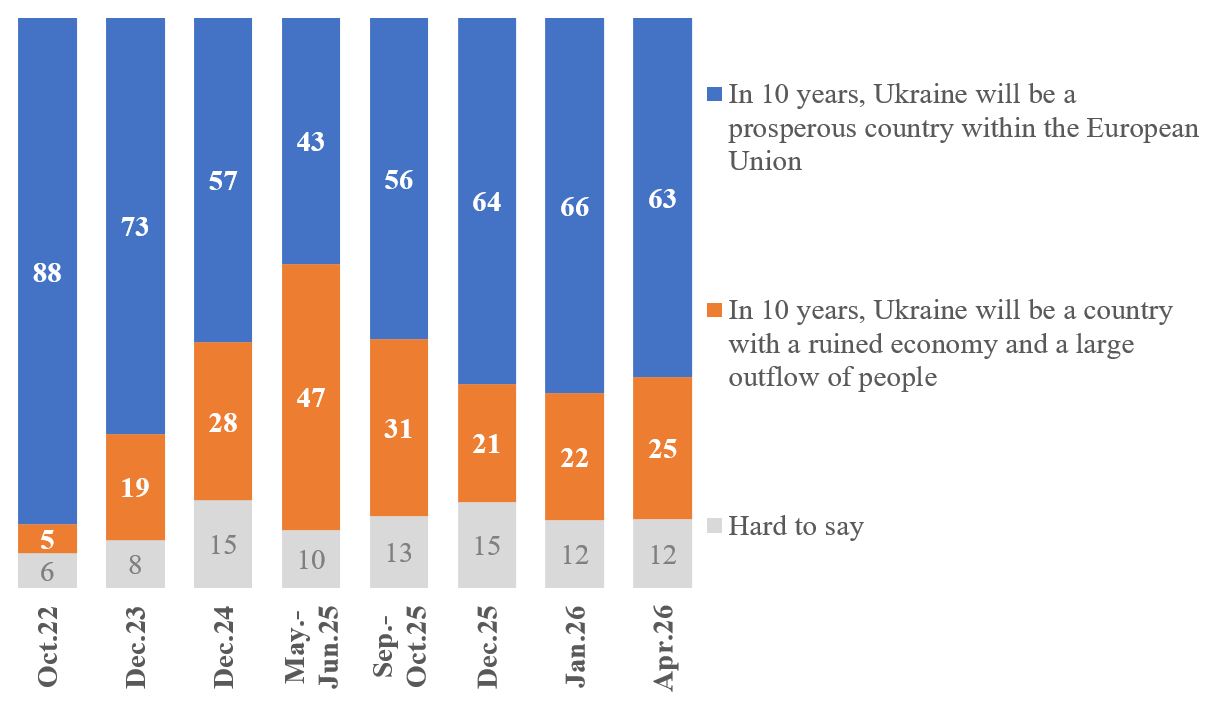
KIIS continues to monitor the level of optimism about the future of Ukraine. We remind you that we offer respondents to choose from two statements, each of which describes a possible future in 10 years. One of the statements optimistically describes Ukraine as a prosperous EU member, the other statement, on the contrary, is a pessimistic description of a ruined country. That is, we measure the conditionally strategic / long-term optimism of Ukrainians. We last asked the question about the level of optimism in January 2026. So, the level of optimism has decreased slightly since January 2026, but remains quite high. Thus, 63% of Ukrainians are optimistic about the future of Ukraine (in January – 66%). On the other hand, the share of pessimists is 25% (it was – 22%).
Graph 1. How do you see the future of Ukraine in 10 years?
Need to approve unpopular decisions to obtain Western funding
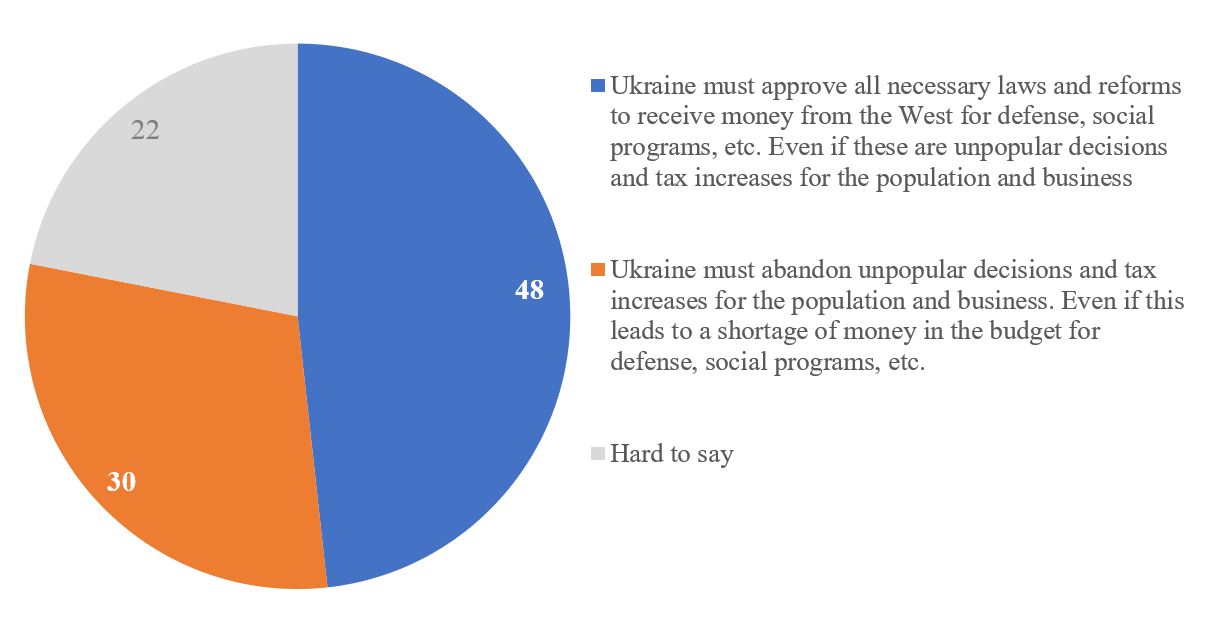
There has been much discussion over the past few months that Ukraine should approve many unpopular decisions in order to be able to receive Western funding. In this survey, we asked respondents what Ukraine should do and also proposed two possible scenarios with corresponding risks/downsides. One scenario is to approve all reforms and decisions in order to receive money and be able to finance defense, social programs, etc. (the positive side), but – this also includes raising taxes (the negative side). Another scenario is that Ukraine abandons unpopular decisions, which “saves” citizens from tax increases (positive side), but this also means a lack of money to finance defense, social programs, etc. (negative side). So, 48% of respondents chose the option that Ukraine must approve all necessary decisions, even unpopular ones and tax increases, to receive funding. Instead, every third respondent (30%) believes that unpopular decisions and tax increases should be abandoned, even if this means a lack of money for defense or social programs. A significant share of respondents (22%) could not decide on their opinion.
Graph 2. What do you think about the interaction between Ukraine and Western partners in providing money to Ukraine?
The table below shows the distribution of answers to this question in terms of trust in President V. Zelenskyy and attitude to the proposal to withdraw troops from Donetsk oblast in exchange for security guarantees. As can be seen, only among those who “completely do not trust” V. Zelenskyy are there slightly more people who support the rejection of unpopular decisions. At the same time, both among those who “rather do not trust” and among those who trust (“rather” or “completely”), the opinion that Ukraine should approve everything in order to receive funding prevails. Also, the share of those who support the rejection of unpopular decisions prevails among respondents who easily agree with the proposal to withdraw Ukrainian troops from the Donetsk oblast in exchange for security guarantees. Even among those for whom this proposal is “difficult but acceptable,” the share of those who believe that it is necessary to approve all decisions to receive funding prevails. And among those who categorically reject such a proposal, there are more those who support the approval of all decisions (although a quarter of those who categorically reject such requirements, on the contrary, are ready to risk defense financing and say that Ukraine should abandon unpopular decisions).
Table 1. Need to approve unpopular decisions to obtain Western funding in terms of trust in the President and attitude to the proposal regarding Donetsk oblast
What is a greater threat to Ukraine's development - corruption in government or Russian military aggression
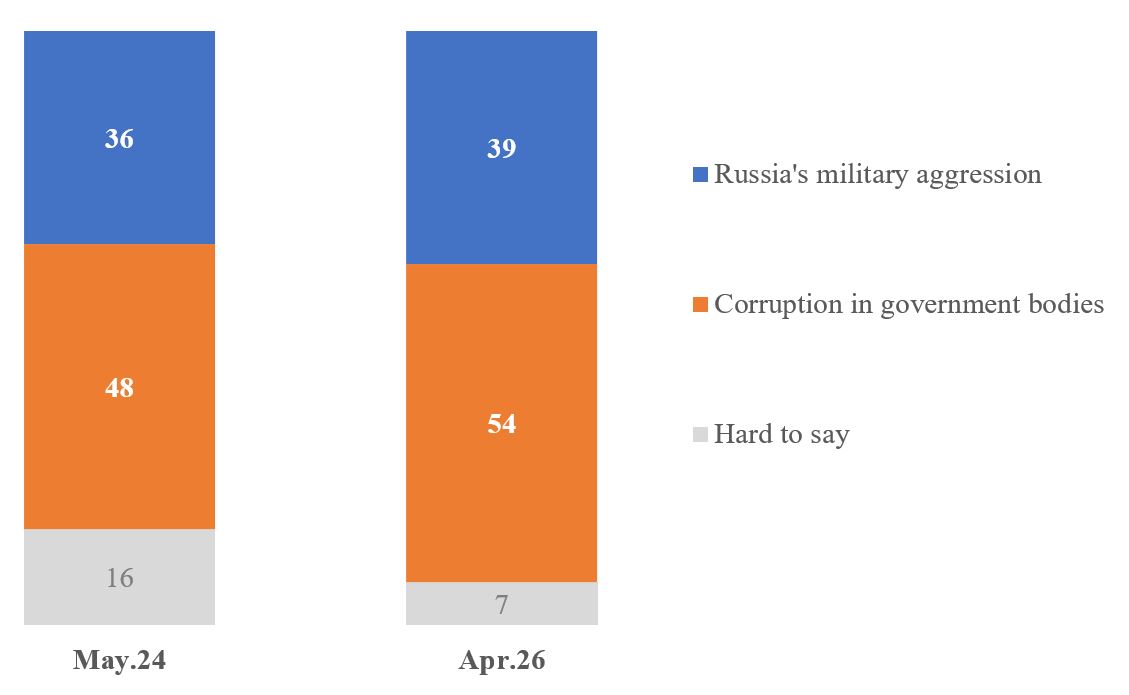
In February 2026, KIIS in an open form asked questions about what are the biggest challenges for Ukraine and Ukrainians[1]. In this format, 65% name war among the top challenges, and 29% name corruption. That is, in the “without prompting,” “spontaneously” format, Ukrainians mostly really talk about the war and related problems. At the same time, in the current survey, we repeat our question from May 2024, when we directly asked respondents which was the greater threat – corruption in power or military aggression by Russia. That is, respondents had to choose between these two challenges for the country. If respondents are asked to choose the greater threat between corruption and military aggression, 54% choose corruption. Military aggression is considered a greater threat (compared to corruption) by 39% of respondents. Ще 7% не змогли визначитися із відповіддю. Compared to May 2024, there were fewer people who were undecided. And instead, there were slightly more people who chose both meaningful answers. So, as we see, if we focus people's attention on two classes of problems – war and corruption – then in this format corruption "wins".
Graph 3. And what do you consider to be a greater threat to the development of Ukraine – …?»
The table below also shows the distribution of answers to this question in terms of trust in the President and attitude to the “peace proposal”. The less respondents trust V. Zelenskyy, the more often they talk about corruption as a more important problem than war. Thus, among those who “completely do not trust” V. Zelenskyy, the opinion that corruption is a greater threat is absolutely dominant (76% versus 16% who talk about war). Among those who “rather do not trust”, the opinion about corruption also prevails, but to a lesser extent (56% versus 37%). Among those who “rather trust”, we observe parity of opinions, and among those who “completely trust”, there are slightly more of those who consider war to be a greater threat (52% versus 42% who talk about corruption). In terms of the “peace proposal,” the view on the priority importance of corruption is absolutely dominant among those who “easily agree” to the withdrawal of troops from the Donetsk oblast in exchange for security guarantees. Among those for whom the proposal is “difficult, but acceptable,” and for whom it is “absolutely unacceptable,” the view on corruption is slightly dominant (in both cases).
Table 2. What is the greater threat to the development of Ukraine in terms of trust in the President and attitude to the proposal regarding Donetsk oblast
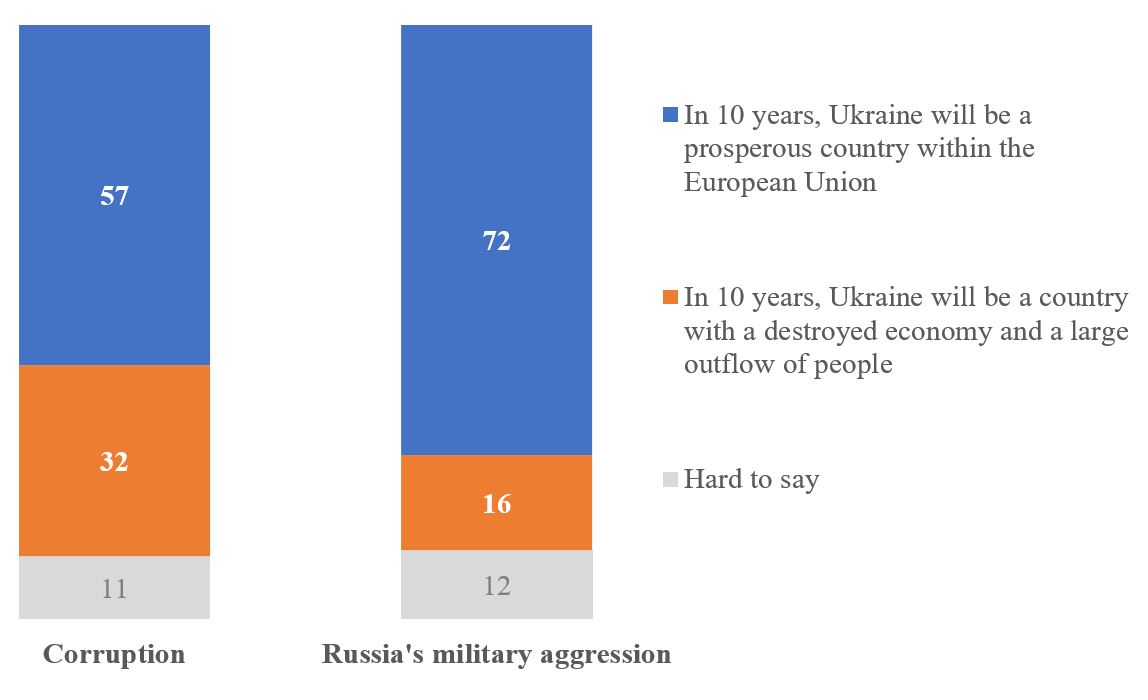
Earlier in this press release, we analyzed the level of optimism among Ukrainians. In the graph below, we show how those for whom corruption or war is a greater threat see the future. So, among those for whom war is a greater threat, there are noticeably more optimistic people about the future of the country – among them 72% are optimists and 16% are pessimists. In contrast, among those who primarily talk about corruption, 57% are optimists and 32% are pessimists.
Graph 4. How see the future of Ukraine in 10 years, depending on what consider to be the greater threat
A. Grushetskyi, comments on the survey results:
Ukrainians remain quite optimistic – especially considering the current challenges. That is, despite the extremely difficult winter, despite the geopolitical and economic “earthquake” caused by the war in Iran, despite Russia’s continued terror, despite the uncertainty of our relations with our allies, and despite all the other challenges, most Ukrainians remain surprisingly optimistic about the future. Russia has not managed to break the will of Ukrainians and impose a gloomy worldview of the joyless years ahead. On the contrary, for most Ukrainians, the light at the end of the tunnel remains bright and motivates them to continue the resistance ("Fate will smile on us again, brother Ukrainians!"). And also in this context we see that among Ukrainians the dominant (though not absolutely, but still) statist opinion prevails, that unpopular decisions and tax increases are a necessary step for Ukraine’s survival. Of course, the fact that a third of Ukrainians are ready to risk the stability of defense financing and social programs is a worrying result and requires the attention of all stakeholders concerned about Ukraine’s fate. However, at present public opinion is more likely on the side of those who recognize the critical importance of cooperation with the West in order to obtain vital financing. We hope that these results will be a strong signal to Ukrainian actors – politicians from the government and opposition, journalists, experts, civil society – that society is open to difficult decisions. And therefore, all those who consider themselves responsible should stop playing populism and pursuing narrow selfish goals (especially in media activity), and instead move on to state-oriented decisions that will strengthen Ukraine and give it the opportunity to survive the war. At the same time, it is impossible to avoid the issue of corruption. This issue is an extremely strong trigger, especially for a psychologically exhausted society. As we have shown, when we ask an open question, people are aware of the truly existential risks of war and call it the greatest challenge. However, when we directly read the word “corruption” to respondents, it evokes strong emotions and stereotypes (and often it “clouds” any reasoning). We see that even among those who “completely trust” the President, almost half consider corruption to be a greater threat to Ukraine than war. Objectively, this is a false view, since the war that Russia is waging is aimed at wiping Ukraine and Ukrainians off the face of the earth, it is a risk of the death of the entire Ukrainian nation. We fully support the decisive fight against corruption and expect the authorities to take appropriate practical and communication steps. The Ukrainian authorities do not have enough trust in society to consider corruption issues as secondary or as something that can "suffer" untill the end of the war. Therefore, adequate communication from the authorities, demonstrating a genuine commitment to the fight against corruption, is an urgent necessity. At the same time, other actors should also be aware of the importance of context and the narrative we are “promoting” regarding corruption. Our goal should be long-term institution-building and the development of a society that minimizes corruption (because it is utopian to expect that corruption can be overcome in a short period of time and it is also utopian to expect that it can be completely eradicated). There are still many high-profile investigations waiting for us on this path, but the fight against corruption should not be reduced to just outbursts of hatred on social media against specific personalities. Also, anti-corruption activities (in particular, in its media dimension) should take into account the principle of “do no harm to defense”. There will be no point in a heated fight against corruption if it turns into writing memoirs abroad after a military defeat. In this regard, we remind that the Russian enemy knows perfectly well the weaknesses of Ukrainian information security. The issue of corruption is one of the most sensitive (along with mobilization and several other topics), so the Russians are happy to use it to try to undermine Ukraine from within. Our many years of research show that personal experience of corruption either remains stable or decreases (in the long term, there is definitely a significant improvement). Another issue is corruption at the highest levels, but here Ukrainians judge based mainly on information from the media and social networks. Ordinary people often judge the growth of corruption based on high-profile cases and cannot distinguish where there is an increase in corruption and where there is evidence of the fight against it. That is why it is so important to have adequate communication from all sides – from the authorities, the opposition, and the public. Of course, we cannot completely exclude the influence of the Russian enemy, whose goal is to weaken Ukraine, just as we cannot exclude the influence of irresponsible Ukrainian political and public figures who put their own interests above the state's (and hide behind the "fight against corruption"). However, we must try to minimize the problems and risks. We must appeal to the fact that, no matter how imperfect our institutions and our fight against corruption, we are still moving forward. We are not hopelessly corrupt, we are making efforts - especially during a full-scale war. This is the approach that will maintain hope for a better future and motivate people to continue the resistance.
Appendix 1. Formulation of questions from the questionnaire
How do you see the future of Ukraine in 10 years? READ. RANDOMIZATION OF THE ORDER
What do you think about the interaction between Ukraine and Western partners in providing money to Ukraine? READ. ADD "OR" BETWEEN STATEMENTS. RANDOMIZATION OF THE ORDER
And what do you consider to be a greater threat to the development of Ukraine – …? READ. ADD "OR" BETWEEN STATEMENTS. RANDOMIZATION OF THE ORDER
[1] The most serious problems and challenges facing Ukraine and Ukrainians: results of a survey conducted on February 12-24, 2026 // https://www.kiis.com.ua/?lang=ukr&cat=reports&id=1590&page=1 [2] The composition of the macroregions is as follows: West – Volyn, Rivne, Lviv, Ivano-Frankivsk, Ternopil, Zakarpattia, Khmelnytskyi, Chernivtsi oblasts; Kyiv city – only Kyiv city (without the oblast); Center / North – Vinnytsia, Zhytomyr, Kyiv, Kirovohrad, Poltava, Sumy, Cherkasy, Chernihiv oblasts; South – Mykolaiv, Odesa, Kherson oblasts; Lower Dnieper region – Dnipropetrovsk, Zaporizhzhia oblasts; East – Donetsk and Kharkiv oblasts (formally, the macroregion also includes the Luhansk oblast, but due to the almost complete occupation, none of the respondents currently live there, although there are respondents who lived in this oblast until 2022).
6.5.2026
|
Our social media:
 KIIS page
 KIIS channel