

ESC or click to close
|
Press releases and reports
Trust in President V. Zelenskyy and other public figures: results of a survey conducted on May 7-June 3, 2026
The press release was prepared by Anton Grushetskyi,executive director of KIIS
From May 7 to June 3, 2026, the Kyiv International Institute of Sociology (KIIS) conducted its own all-Ukrainian public opinion survey, to which, on its own initiative, added a question about trust in President V. Zelenskyy and other public figures. By the method of telephone interviews (computer-assistedtelephoneinterviews, CATI) based on a random sample of mobile phone numbers (with random generation of phone numbers and subsequent statistical weighting) in all regions of Ukraine (the territory controlled by the Government of Ukraine), 1,015 respondents were surveyed. The survey was conducted with adult (aged 18 and older) citizens of Ukraine who, at the time of the survey, lived in the territory of Ukraine controlled by the Government of Ukraine. The sample did not include residents of territories temporarily not controlled by the Ukrainian authorities (at the same time, some of the respondents are IDPs who moved from the occupied territories), and the survey was not conducted with citizens who left abroad after February 24, 2022. Formally, under normal circumstances, the statistical error of such a sample (with a probability of 0.95 and taking into account the design effect of 1.3) did not exceed 4.1% for indicators close to 50%, 3.5% for indicators close to 25%, 2.5% for indicators close to 10%, 1.8% for indicators close to 5%. Under conditions of war, in addition to the specified formal error, a certain systematic deviation is added. Factors that may affect the quality of results in "wartime" conditions were previously cited by KIIS. In general, we believe that the obtained results are still highly representative and allow a fairly reliable analysis of the public moods of the population.
During the survey, we wanted to find out whether Ukrainians trust individual Ukrainian public figures from various spheres. We formed a list of 18 political, socio-political and military figures, and for each of them we asked whether Ukrainians “completely do not trust”, “rather do not trust”, “rather trust”, “completely trust” (the option “hard to say” was not read, but respondents could name it on their own initiative). We already conducted a similar survey in January 2026, which allows us to analyze the dynamics for most of the individuals on the list[1]. An important methodological point is that for each figure, in addition to the surname and first name, we gave a short description. This is due to the fact that some figures are not clearly recognizable by name, and this can lead to confusion. We have already shown earlier that in the case of, for example, Yu. Svyrydenko, different trust indicators can be obtained if (not) saying that she is the Prime Minister[2]. In general, many people can "remember" a specific person thanks to the information-"clue" and, accordingly, for this figure we will have more reliable indicators of trust (although the information-"clue" itself plays a really important role, which can affect perception in addition to recognition). First, we will separately consider trust in President V. Zelenskyy, and then, for the results with all figures from the list, we divided it into two parts: (1) politicians and public and political figures and (2) figures from the military sphere. We understand that in some cases the division is conditional (and may soon change), but since there is an attempt to “involve” individual military figures in politics (and often – artificially by individual third-party subjects, although the military figures themselves may never have spoken about participating in politics), we present trust in them separately.
Dynamics of trust in President V. Zelenskyy
So, 61% now trust the President, 34% do not trust him (balance of trust-distrust - +27%). Compared to April 2026, the indicators of trust and distrust have not changed (the difference is within the margin of error), although the balance of trust-distrust has improved slightly (increased from +22% to +27%). At the same time, now, in May 2026, we asked a question in a slightly different format. So, now we asked about trust in 18 different public figures, one of which is “Zelenskyy Volodymyr – President”. We read the figures in different orders to different respondents. There is a correlation, albeit weak, that the later we asked about V. Zelenskyy, the higher the trust in him. Perhaps, against the background of other figures (when respondents think about other figures), V. Zelenskyy is perceived a little better. That is, although formally now the indicators of trust are slightly higher than in April, it is more correct, taking into account the factors described above, to speak about stability. In addition, it should be taken into account that among the 61% who trust V. Zelenskyy, 33% trust him “completely”, and the remaining 28% trust him “rather”. At the same time, for the sake of balance, it is important to understand that among those who do not trust him, there is a division – 20% do not trust him “completely”, and 13% do not trust him “rather”.
Graph 1. Do you "completely do not trust", "rather do not trust", "rather trust" or "completely trust" the following Ukrainian public figures? Volodymyr Zelenskyy – President 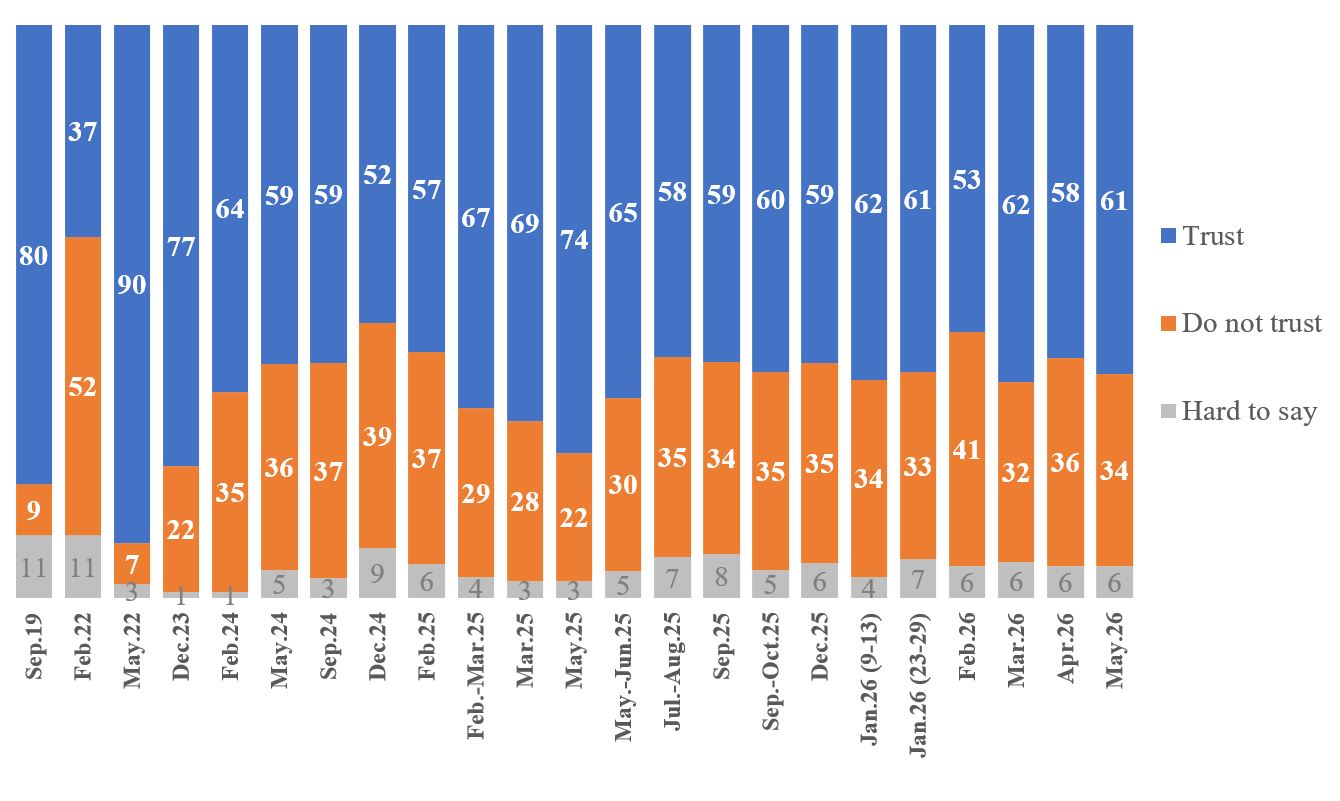
Trust in President V. Zelenskyy and other public figures
As we noted earlier, in January 2026 we also asked question about trust in various public figures. Compared to that list, we did not ask question about Ye. Muraiev and O. Arestovych, but added V. Kim, R. Brovdi, and O. Liashko. Table 2 shows the results for the current wave, and Table 3 shows the dynamics compared to January 2026.. So, among the politicians and public and political figures on the list, the highest trust indicators have I. Terekhov (52% trust and 19% don't trust, balance +32%), M. Fedorov (50% trust and 21% don't trust, balance +29%), V. Zelenskyy (61% trust and 34% don't trust, balance +27%) and V.Kim (47% trust and 27% don't trust, balance +20%).Moreover, in the case of I. Terekhov, M. Fedorov and V. Kim, quite a few people do not know about them (even with additional information), that is, they have the potential to improve their indicators due to better awareness. Next in terms of trust indicators are O. Liashko (47% trust and 43% do not trust, balance +5%) and S. Prytula (46% trust and 44% do not trust, balance +2%). All other politicians and public and political figures on the list have a negative balance, that is, they are distrusted more than they are trusted. At the same time, among them, we can single out those whose indicators (for Ukrainian realities) are relatively high: V. Klychko, Yu. Svyrydenko, D. Razumkov, O. Honcharenko. Their trust-distrust balance is from -11% to -23% and at least no more than half do not trust them (and in the case of Yu. Svyrydenko, D. Razumkov, O. Honcharenko, quite a few do not know them). P. Poroshenko is trusted by 26%, and distrusted by 71% (balance -45%). The lowest trust indicators are for Yu. Boiko (6% trust and 78% do not trust, balance -72%) and Yu. Tymoshenko (11% trust and 85% do not trust, balance -75%).
Among the list of figures from the defense sector, all have a positive balance of trust-distrust. Respondents have the best attitude towards R. Brovdi (70% trust, 7% don't trust, and the balance is +63%), V. Zaluzhnyi (73% trust, 21% don't trust, balance – +52%)and K. Budanov (70% trust, 22% don't trust, balance – +48%). Next comes A. Biletskyi, who is trusted by 49%, distrusted by 12%, and the balance, respectively, is +38%. At the same time, 33% did not know who A. Biletskyi was, even with a “hint”, that is, he has significant prospects for improving his indicators due to higher awareness. Commander-in-Chief O. Syrskyi is trusted by 52%, distrusted by 36%, the balance is +16%.
Table 2. Do you “completely do not trust”, “rather do not trust”, “rather trust” or “completely trust” the following Ukrainian public figures? If you do not know him or her, say so.
The table below shows the dynamics of trust indicators compared to January 2026 (except for R. Brovdi, V. Kim and O. Liashko, who we did not ask about at the beginning of the year). You can see some dynamics for many individuals, but we will note the most significant changes over the past few months:
We should also separately mention the trust in O. Lyashko. In February 2021, that is, a year before the full-scale invasion, 23% trusted him, 70% did not trust him[3]. That is, now his indicators are significantly higher (and this is due to his participation in the Defense Forces).
Table 3. Dynamics of trust compared to January 2026
A. Grushetskyi, comments on the survey results:
In preparing the survey results, we revisited our analysis and comments for January 2026. They remain relevant today, so it is worth recalling them (see below with some clarifications reflecting the dynamics and new findings of recent months). Thus, the survey results show that the level of trust in conventionally "old" politicians is low and there is an obvious demand for a new generation of leaders ("new" faces) who have proven themselves well during a full-scale war. We see that among current figures in the political and public spheres, M. Fedorov (a young, promising Minister of Defense and a leader in the field of advanced technologies, which Ukrainians constantly see on the battlefield), I. Terekhov (a representative of local government who, from the point of view of many citizens, effectively organizes community life despite frontline status, especially against the backdrop of a difficult winter, where his image of a “strong business man” was strengthened), V. Kim (similar considerations as for I. Terekhov), S. Prytula (a volunteer whose organization makes a large-scale contribution to defense) have quite high trust and prospects. O. Liashko may have a certain “rebirth” – thanks to his experience of participating in the Defense Forces, although when peacetime comes, the “past” may again affect his perception. Yu. Svyrydenko, D. Razumkov, V. Klychko, O. Honcharenko have lower trust, but still they currently have a certain segment and retain, albeit restrained, but also prospects (especially when it comes to obtaining a faction in the next parliament). In particular, the trust of O. Honcharenko has grown over the past few months. Some of the “old” figures also retain a “core” of supporters (and are even increasing it somewhat), which may allow them to enter parliament. However, in their case, the “ceiling” of opportunities is obvious (due to too high distrust and anti-rating). However, all of the above-mentioned figures are noticeably inferior to military figures, primarily V. Zaluzhnyi and K. Budanov (who have higher trust even than V. Zelenskyy). This reflects the significant public demand to see successful military figures at the head of the state after the war. However, we are talking about the demand now, in conditions of war and when the need for a leader-"national defender" is actualized. However, if the war ends on favorable terms for Ukraine (reliable security guarantees, realistic prospects for EU membership and accelerated reconstruction, etc.) and if there is a long preparation for the elections, then the public demand may change (for example, in favor of reformers who will be able to ensure the country's prosperity, overcome corruption, etc.).
Appendix 1. Formulation of questions from the questionnaire
Now we would like to know your attitude towards individual Ukrainian public figures. Do you “completely do not trust”, “rather do not trust”, “rather trust” or “completely trust” the following Ukrainian public figures? If you do not know him or her, say so. READING RANDOMIZATION
Now we would like to know your attitude towards individual Ukrainian public figures. Do you “completely do not trust”, “rather do not trust”, “rather trust” or “completely trust” the following Ukrainian public figures? If you do not know him or her, say so. READING RANDOMIZATION
[1] Level of trust in public figures in Ukraine // https://www.kiis.com.ua/?lang=ukr&cat=reports&id=1580&page=1 [2] Level of trust in Yuliia Svyrydenko and expectations from her Government // https://www.kiis.com.ua/?lang=ukr&cat=reports&id=1546&page=1&t=1 [3] Level of trust in politicians, electoral rating and attitude to individual events: February 2021 // https://www.kiis.com.ua/?lang=ukr&cat=reports&id=1016&page=1 [4] The composition of the macroregions is as follows: West – Volyn, Rivne, Lviv, Ivano-Frankivsk, Ternopil, Zakarpattia, Khmelnytskyi, Chernivtsi oblasts; Center – Vinnytsia, Zhytomyr, Kyiv, Kirovohrad, Poltava, Sumy, Cherkasy, Chernihiv oblasts, Kyiv city; South – Dnipropetrovsk, Zaporizhzhia oblasts, Mykolaiv, Odesa, Kherson oblasts; East – Donetsk and Kharkiv oblasts (formally, the macroregion also includes Luhansk oblast, but due to almost complete occupation, none of the respondents currently live there, although there are respondents who lived in this oblast until 2022).
10.6.2026
|
Our social media:
 KIIS page
 KIIS channel